

Digital shelf analytics helps ecommerce teams monitor how products appear and perform across online retail environments. For Amazon brands, the digital shelf includes everything shoppers encounter between search and purchase, from keyword rankings and product detail pages to pricing, reviews, Buy Box ownership, seller activity, and sponsored placements.
That visibility matters because search placement can heavily influence product discovery. NIQ reports that the first three products can capture as much as 80% of clicks on major retailers’ search engines, making it critical for brands to understand not only where products appear, but what may be affecting that position.
For enterprise teams managing large catalogs, those signals are more useful when viewed together. This guide explains how Amazon brands can use digital shelf analytics to connect changes in share, content, price, search visibility, sellers, and competition rather than managing each as a separate reporting stream.
Digital shelf analytics is the process of tracking and analyzing the signals that determine how products appear, compete, and perform across digital commerce channels. NIQ describes digital shelf analytics as a suite of KPIs used by consumer packaged goods brands to measure and improve digital commerce performance, typically through software that collects and interprets data at scale.
For Amazon teams, the digital shelf extends well beyond the product detail page. It can include:
That scope distinguishes digital shelf analytics from more narrowly focused reporting. Retail media reporting might tell a team how an ad campaign performed, while marketplace dashboards may show sales or inventory for the brand's own account.
First-party Amazon reporting can tell brands a great deal about their own catalog, shoppers, and advertising performance. Digital shelf and marketplace intelligence adds the external view: how competitors rank, price, advertise, gain share, and sell through the marketplace around you.
The goal is not simply to collect more KPIs. Effective digital shelf analytics software helps teams understand what changed, where it happened, and what deserves investigation.
Tracking a few ASINs manually is manageable. Enterprise brands may need to monitor hundreds or thousands of products across categories, seller relationships, search terms, pricing strategies, and retail media activity, often with different teams responsible for each piece.
NIQ identifies availability as a foundational digital shelf metric because out-of-stock products cannot effectively appear in search or generate sales. More broadly, shelf metrics are interconnected, so a decline in revenue or visibility may originate somewhere else in the customer journey.
Changes in search placement, availability, pricing, content, or Buy Box ownership can all affect conversion. Digital shelf analytics helps teams trace a performance decline back to the conditions surrounding the product rather than treating revenue as an isolated result.
Amazon performance is relative to the wider market. A brand can grow sales while still losing market share if the category is growing faster or competitors are gaining share.
Tracking Amazon market share by category, rankings, pricing, seller coverage, and advertising activity helps brands determine whether the problem sits within their own catalog or reflects a wider competitive shift.
Digital shelf changes rarely belong to one function. Ecommerce may see declining conversion while retail media sees weaker efficiency, Sales notices reseller pressure, and Supply Chain is managing an availability issue behind all three.
A shared view of marketplace signals helps enterprise teams work from the same diagnosis, prioritize the right response, and avoid optimizing one channel while the underlying issue sits somewhere else.
There is no single digital shelf metric that defines Amazon performance. Enterprise teams need a combination of indicators that assess whether products are available, discoverable, competitive, compelling, and effectively positioned in the market.
The most useful approach is to pair each metric with the business question it helps answer.
The key is to avoid treating any one metric as the diagnosis. Lost share of search may stem from ranking changes, inventory problems, stronger competitor advertising, or weaker conversion. Likewise, Buy Box loss can be due to pricing, fulfillment, or seller issues.
Broader Amazon search trends can also help teams distinguish short-term ranking changes from larger shifts in demand, competition, and category momentum.
Amazon adds several layers of complexity that generic ecommerce monitoring may not capture well. A single product can have Amazon Retail and third-party sellers competing for sales. One brand may participate across dozens of subcategories.
Paid and organic search results compete for the same shopper attention. Sellers, prices, promotions, search rankings, and category share can all change independently. For enterprise Amazon teams, the real value comes from seeing how those signals affect one another.
Knowing that an ASIN lost the Buy Box only tells part of the story. Amazon teams also need to know which seller gained it, whether pricing changed, how widespread the issue is across the catalog, and whether the same seller is appearing elsewhere.
For enterprise brands, seller analysis should extend beyond identifying who currently owns the Buy Box. Teams may need to understand whether the same seller appears across multiple ASINs, how much of the catalog is affected, whether pricing behavior is spreading, and how Amazon Retail participation changes the picture.
Seller monitoring can therefore reveal more than an isolated reseller. Brands can see whether distribution is shifting across multiple products, sellers, or subcategories.
Changes in search performance should also be interpreted competitively. A ranking decline could mean the product itself weakened, but it could also reflect rising competitors, changing shopper demand, or increased sponsored competition.
Search-term visibility becomes more useful when teams can compare the products, brands, and ads competing around the same query.
This makes Amazon keyword research more useful than looking at search volume or rankings alone, because teams can evaluate which brands, products, and ads are competing around the same terms.
The final layer is market structure. SmartScout indexes more than 40,000 Amazon subcategories and allows teams to examine brands, products, market share, sellers, pricing, and growth within them. Teams can then move from a category into the brands and products shaping it instead of evaluating an ASIN without its competitive surroundings.
Competitive ad research can show where brands are investing in sponsored visibility, which search terms they are targeting, and how their presence changes over time. Teams can also track competitor ads on Amazon to identify keyword gaps and shifts in share of voice.
The right platform depends on the problem the team needs to solve. A brand focused primarily on product content may value different capabilities than one investigating seller networks, category share, pricing pressure, or Amazon competitive intelligence.
When comparing digital shelf analytics platforms, start with the decisions your team actually needs the data to support.
Use this checklist:
For Amazon teams, having more data matters less if the platform cannot connect a change in performance to the sellers, keywords, products, or competitors behind it.
Digital shelf monitoring can show that a ranking, price, seller, or share metric changed. Amazon market intelligence helps explain what drove that change.
SmartScout is designed for that deeper investigation. Rather than requiring teams to research products independently, SmartScout connects Amazon brands, sellers, products, subcategories, search terms, and advertising activity into a broader marketplace view.
Teams can use that ecosystem to:
For larger organizations, the value also comes from scale and continuity. Historical data, seller exports, Share of Voice analysis, and custom dashboards or alerts can help marketplace teams move from one-off research into repeatable competitive monitoring across brands, categories, and portfolios.
Use SmartScout's Amazon brand list software to research brands, sellers, products, and market position in one connected Amazon intelligence platform.
Ready to build a more complete view of your Amazon market? Contact SmartScout to see how enterprise teams can connect brand, seller, category, keyword, and advertising intelligence across their Amazon portfolio.
For enterprise CPG teams, brand protection becomes difficult to manage at portfolio scale. A company may oversee hundreds or thousands of ASINs across multiple brands, categories, authorized partners, and third-party sellers, making it difficult to separate isolated listing issues from broader distribution or channel risks.
The right brand protection software helps teams monitor those risks at scale, while marketplace intelligence gives ecommerce, brand, legal, and marketplace teams the seller, product, and category data needed to prioritize action.
This guide explains what to look for in brand protection software, how marketplace-focused solutions differ from broader digital protection platforms, and where Amazon intelligence fits into the process.
Brand protection software monitors external digital channels for activity that may threaten a company's products, intellectual property, reputation, or customer relationships. Depending on the platform, that can include:
That makes the category broader than counterfeit detection software. Anti-counterfeit tools generally focus on identifying fake products or intellectual property violations, while digital brand protection platforms may monitor marketplaces, domains, search engines, ads, social media, and other external channels.
For CPG brands selling on Amazon, however, understanding the seller landscape deserves particular attention. A team may need to know which sellers carry its products, how concentrated sales are among those sellers, whether new sellers have appeared, and how activity differs across products or categories.
Amazon-native programs remain important, but they serve a different role. Amazon Brand Registry and related automated brand protection tools can support rights owners on Amazon, while third-party intelligence can help teams build a broader picture of marketplace activity before deciding where investigation or enforcement is warranted.
Marketplace abuse is difficult to monitor at scale. Amazon reports that its Counterfeit Crimes Unit has pursued more than 32,000 bad actors since 2020, while more than 15 million counterfeit products were identified, seized, and disposed of worldwide in 2025.
But counterfeits are only part of the risk. Unauthorized distribution of genuine products can create pricing pressure, channel conflict, inconsistent customer experiences, and less visibility into where inventory is coming from. Effective brand protection helps teams identify those issues, add marketplace context, and decide where action is warranted.
These risks rarely belong to one function. Ecommerce teams may see pricing or Buy Box disruption first, while legal teams focus on infringement, brand teams monitor customer experience, and channel leaders manage distributor relationships. Shared marketplace data helps those groups work from the same evidence rather than investigating issues separately.
Unauthorized seller activity can affect more than an individual listing. It may contribute to:
For large CPG catalogs, these effects can spread across multiple ASINs before teams recognize the pattern. Earlier detection helps teams focus on the products and sellers with the greatest potential business impact.
Finding an unfamiliar seller is only the first step. Teams need to determine whether it represents a one-off resale situation or a broader distribution issue affecting multiple products or approved channels.
Strong Amazon seller research can reveal seller scale, catalog overlap, brand relationships, and activity across multiple ASINs, giving teams a clearer basis for investigation.
Brand protection also shapes what shoppers encounter on Amazon. Counterfeit products, unauthorized distribution, inconsistent pricing, and poor listing experiences can all affect how customers perceive a brand.
The goal is not simply to count violations. Enterprise teams need enough marketplace data to identify which issues could meaningfully affect customer experience, authorized partners, revenue, or long-term brand control.
There is no single feature set that works for every organization. A company primarily concerned with phishing and impersonation will evaluate platforms differently from a CPG team trying to understand unauthorized Amazon sellers.
For marketplace-focused teams, these are the capabilities worth comparing:
The distinction between detection and context is important. A platform might be very good at flagging an infringing listing but provide limited insight into the seller or surrounding market. Another may specialize in intelligence that helps a team decide which issues deserve action first.
Brand abuse rarely stays confined to one channel. Companies may also encounter spoofed domains, fake social profiles, phishing, fraudulent advertising, impersonation, copyright misuse, and suspicious websites.
Neither approach is inherently better. The right fit depends on where a brand faces the most risk and what its team needs to do about it. Enterprise CPG teams may not solve every brand protection need with one platform.
A broader digital-risk solution may handle impersonation and domain threats, an enforcement platform may manage takedowns, and Amazon market intelligence may support seller investigation and prioritization. The evaluation should focus on how those capabilities fit together rather than assuming one tool must cover every workflow.
Brand protection on Amazon rarely stops at the listing level. Sellers can operate across multiple ASINs, search visibility can shift between competing products, and issues that look isolated may extend across an entire brand or category.
At enterprise scale, the challenge is not simply finding anomalies. It is determining which sellers, products, and categories represent enough business exposure to warrant investigation first. Amazon-specific seller, search, and category intelligence can make that prioritization more systematic.
Amazon-specific intelligence should let teams move from a brand to its products and then to the sellers carrying those products. That makes it easier to see whether an unfamiliar seller appears on one ASIN or across a meaningful portion of the catalog.
SmartScout's Brand List combines brand, product, and seller data with metrics such as estimated monthly revenue, FBA seller counts, dominant sellers, and Amazon in-stock rate. For brand teams, that helps surface where seller concentration or unexpected distribution deserves a closer look.
Seller activity does not happen in isolation from how shoppers discover products. Search data can help teams understand whether affected products also drive meaningful organic visibility.
SmartScout's approach to Amazon keyword research connects search terms with the products, brands, sellers, and categories around them. Combined with seller intelligence, this can help teams prioritize issues affecting products with meaningful search exposure.
Not every seller issue carries the same business impact across a large brand portfolio. A problem affecting a low-volume product may require a different response from one appearing across a high-revenue category where the brand holds significant market share.
SmartScout organizes Amazon across more than 40,000 subcategories and connects category analysis with brands, sellers, products, and market-share data. This type of Amazon marketplace intelligence can help teams prioritize issues in the categories that matter most to the business.
Before comparing vendors, align internally on what problem the software actually needs to solve. A marketplace team focused on unauthorized Amazon sellers will evaluate platforms differently from a security team monitoring phishing and impersonation.
Use these questions to narrow the field:
An Amazon analytics software comparison can also help teams understand how different intelligence platforms approach brands, sellers, market share, and competitive research.
SmartScout is not a counterfeit detection or takedown platform. It gives enterprise Amazon teams the market intelligence needed to investigate seller activity across large catalogs, understand potential business impact, and prioritize which issues deserve further action.
With Amazon brand list software, teams can move from a brand to its products and sellers, compare seller concentration across products, brands, or portfolio segments, and bring category and search data into the analysis. That can help answer practical questions such as:
For teams using Amazon Brand Registry, these capabilities are complementary. Amazon provides native tools for eligible rights owners, while SmartScout helps teams understand the seller and market structure surrounding the issues they are evaluating.
Contact SmartScout to see how enterprise Amazon intelligence can help your team map sellers across large catalogs, investigate channel risks, and prioritize the issues with the greatest business impact.
DataDive excels at helping Amazon sellers build custom niches and analyze competing products and keywords. When shopping for an alternative, keeping that specific strength in mind ensures you don't trade away the core functionality your business relies on.
While SmartScout covers that custom niche workflow through Custom Segments, it also gives you brand-level subcategory data to see the bigger market picture. Other platforms, such as Helium 10 and Jungle Scout, take different approaches to keyword research and product discovery.
Here is a fair comparison of the top DataDive alternatives to help you choose the right fit for your Amazon business.
DataDive’s custom niche workflow lets you select competing ASINs and organize research around that group. Its Niche Pipeline helps users manage their research, assign work, and organize niches by project or priority. That is useful when your real competitors do not fit neatly into a single Amazon category. See DataDive’s niche workflow.
Its wider toolkit includes keyword research, listing optimization, product evaluation, PPC campaign building, and rank monitoring. For a private label seller working from an idea toward a launch, that combination connects research with execution. Explore DataDive’s features and plans.
If you already know which products compete with yours and want to turn that research into a keyword and listing strategy, DataDive belongs on your shortlist.
The question is what else your research needs to cover.
These are our assessments of the platforms’ practical uses, based on their published capabilities. They are not rankings of data accuracy.
SmartScout is especially relevant when you need both a precisely defined niche and a broader understanding of the market around it.
A chosen competitor set can answer an important question: how do these products compare? Subcategory analysis helps you investigate another: what else should be in the conversation?
SmartScout’s Custom Segments let you group products according to the way your business defines a market. That can include product attributes, price positioning, ingredients, form factor, or parent brand. You are not limited to treating every product in an Amazon subcategory as an equally relevant competitor. Learn about SmartScout Custom Segments.
For example, a brand researching shampoo might want to focus specifically on solid shampoo bars. A broad hair care category would include many products that are less relevant to that decision. Defining the segment carefully makes the resulting comparison more useful.
DataDive deserves credit for custom niche research. SmartScout gives buyers another way to approach that need, alongside its broader market analysis tools.
Subcategory analysis is one of SmartScout’s strongest capabilities. It helps sellers and brands investigate related markets, examine competing products and brands, and identify areas worth researching for expansion. Explore SmartScout’s subcategory research.
That matters because a manually selected niche depends on the products you already know to include. Starting with a wider view can help challenge those assumptions.
Suppose you are considering a new product in an established category. Before settling on your closest competitors, it is useful to ask:
Custom Segments and subcategory analysis serve complementary purposes. One sharpens the scope of your research; the other helps you understand its context.
A niche becomes more informative when you can investigate the businesses participating in it. SmartScout connects brand, seller, subcategory, and product research, including brand revenue estimates and category positioning. Explore SmartScout’s research platform.
For a brand, that can support a closer look at a competitor’s assortment. For an agency, it can help frame a client’s position within a market. For a seller, it can broaden the investigation beyond the handful of products that first appeared in a search.
Consider two hypothetical niches with similar estimated revenue. In one, sales are distributed across several independent brands. In the other, many leading products
belong to the same parent brand. Those situations could call for different launch strategies, even when the headline market size looks similar.
SmartScout also supports investigation of Amazon search positions and competitive advertising. AdSpy helps users research competitors’ sponsored placements and keywords, while Share of Voice provides historical advertising presence and estimated share of spend. See SmartScout’s competitive advertising workflow.
Those insights can help you identify where a competitor is visible and which searches deserve further investigation. They should inform your strategy alongside your own conversion rates, costs, and margins. Estimated competitor spend is not a direct view into someone else’s advertising account.
SmartScout’s TikTok Shop analytics adds shop revenue estimates, product trends, category sizing, and market share research. That is relevant when your growth decisions involve both Amazon and TikTok Shop. Explore TikTok Shop analytics.
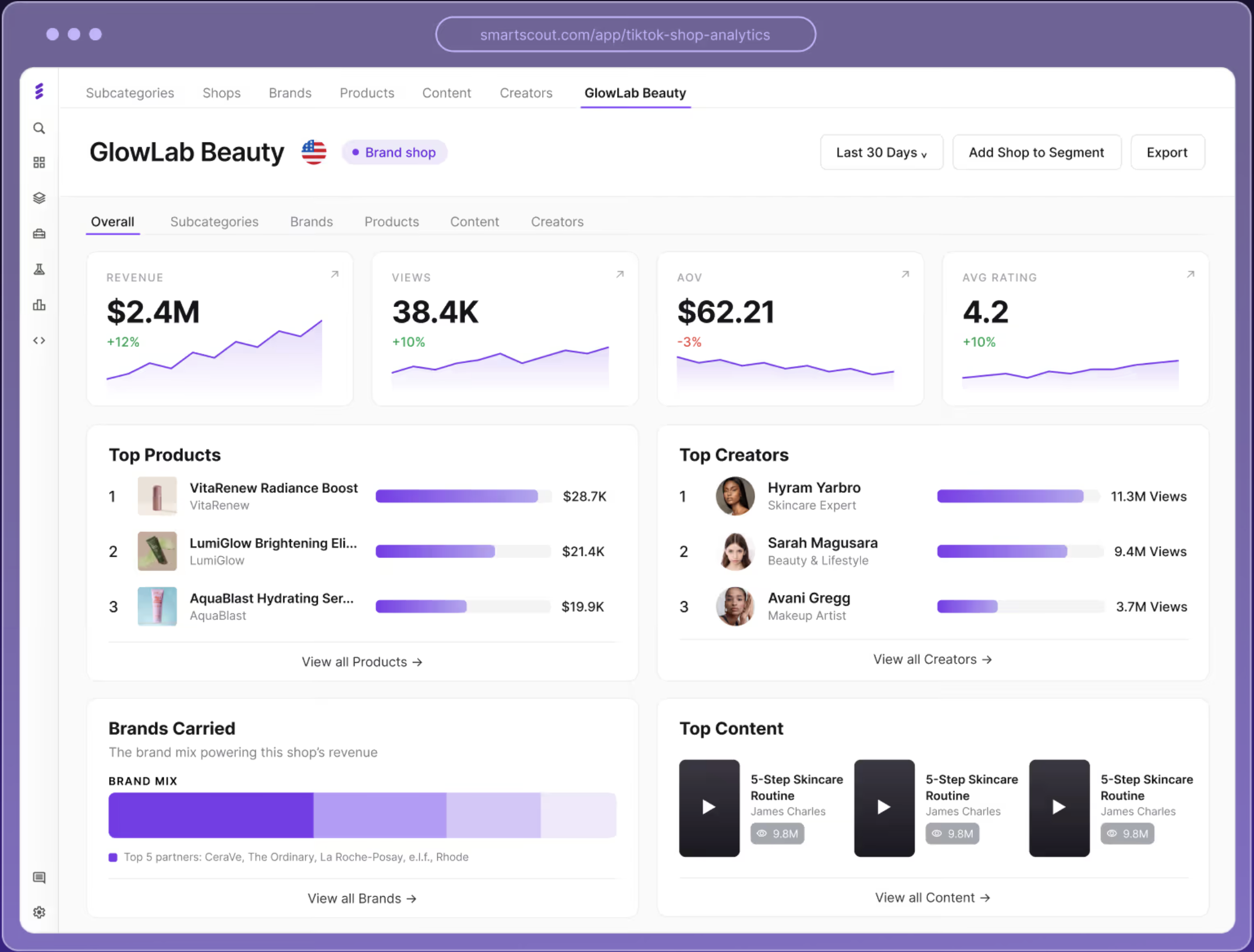
It gives your team another market to investigate when evaluating demand and competition. Cross-channel patterns can suggest questions to explore; they do not automatically prove that activity on one platform caused sales on another.
Choose SmartScout when: you want custom niche research plus substantial subcategory, brand, product, seller, and competitive advertising context.
Keep DataDive in consideration when: your main requirement is its particular workflow for turning a selected competitor group into keyword research, listing optimization, and launch preparation. Test that workflow directly rather than assuming the tools are interchangeable.
Helium 10 is worth considering when you want research and day-to-day seller tools from the same provider. Its offering includes product discovery, keyword research, keyword tracking, listing tools, and operational features.
Its Market Tracker supports custom market views based on keywords or ASINs. Market Tracker 360 adds broader category, brand, and product analysis. That means Helium 10 should also be evaluated for market research, rather than treated only as a keyword tool.

Choose Helium 10 when: the team researching opportunities also wants tools for executing and managing its Amazon business.
Buying consideration: compare the exact package. Standard Market Tracker and Market Tracker 360 are different offerings, and feature availability and limits matter more than the length of the overall tool list.
Jungle Scout’s Opportunity Finder is relevant when you are still deciding which niche to enter. It uses keyword-led research to help users investigate demand, competition, sales performance, and seasonal patterns. Users can also inspect leading products within an opportunity and add them to Product Tracker.
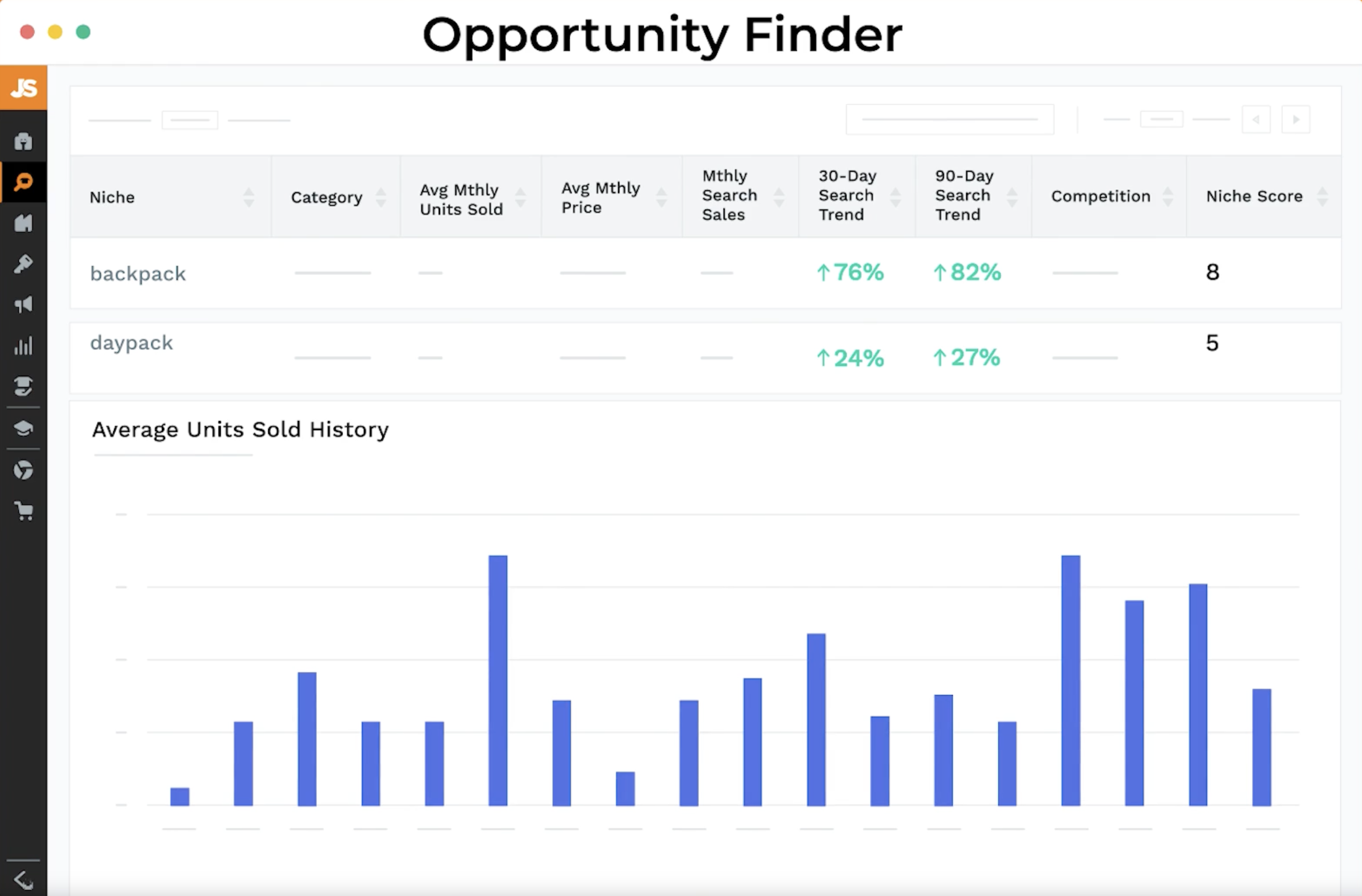
That makes it a useful candidate for a seller building a shortlist of product ideas and deciding which deserve deeper validation.
Choose Jungle Scout when: your immediate task is discovering and screening Amazon product opportunities.
Buying consideration: treat opportunity scores as screening aids. Before committing to a product, examine the underlying competitors, seasonality, costs, and differentiation. A promising score is a starting point for due diligence.
Both platforms support research around a defined competitive group. The useful distinction is how that research connects to the rest of your work.
DataDive is worth evaluating for its niche-to-keyword and listing workflow. SmartScout is worth evaluating for the combination of Custom Segments, subcategory analysis, and connected market intelligence.
To compare them fairly, use the same product idea in both tools. Create the competitor group you believe matters, then assess:
.jpg)
If you want to define your own niche and understand the larger market around it, try SmartScout. Custom Segments give your research focus; subcategory analysis helps you see where that focus fits.
Compare SmartScout plans to find the research capabilities that fit your business.


