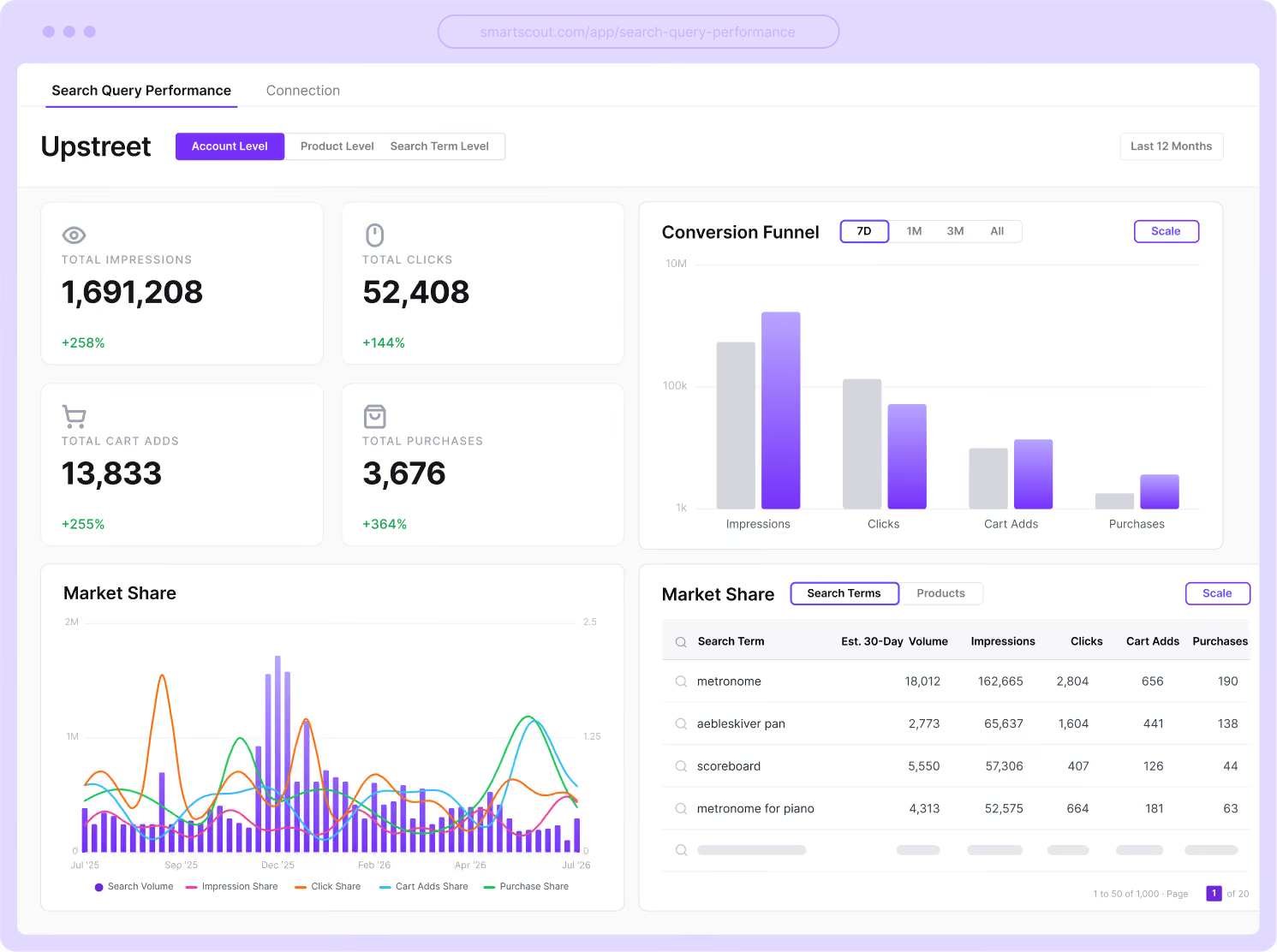
Sort any brand's catalog by monthly revenue estimate and Amazon rank. Identify the brand's best-sellers instantly. These are the SKUs worth ordering first when testing a new wholesale relationship.
See a quality score for each listing's title, images, bullets, and A+ content. Low scores on high-revenue products are wholesale gold. You can pitch the brand-improved content as part of your partnership pitch.
Pull up price, rank, and revenue history for any ASIN, similar to Keepa but integrated into your workflow. Check for seasonal patterns, price stability, and demand trends before committing inventory capital.
Filter for products that Amazon frequently runs out of stock on. When Amazon isn't holding inventory on a specific SKU, you face less Buy Box pressure and can maintain healthier wholesale margins.
Add notes to individual product rows during research, flag "order first," "verify MAP policy," "needs UPC confirmation," then export the entire annotated spreadsheet for your team or VA.
Every ASIN in SmartScout links directly to its Amazon product page. One click to verify listing accuracy, check current Buy Box price, read reviews, and confirm the product matches your expectations.


Selling wholesale on Amazon means purchasing products in bulk directly from brand owners or authorized distributors, then reselling them under the brand's existing listing. Unlike private label (where you create your own brand) or arbitrage (where you buy discounted retail), wholesale is a relationship business. Your profitability depends on finding brands that are open to new reseller partnerships, have strong existing demand, and aren't already saturated with competing sellers.
The challenge is finding those brands. Amazon has hundreds of thousands of active brands across its marketplace. Most wholesale sellers spend weeks or months manually searching for viable partners — opening category pages, checking brands one by one, and assessing competition by hand. This is the "hunt and peck" problem that wastes more wholesale seller hours than any other task.
Traditional Amazon research tools are built around product search. You type in a keyword, get a list of ASINs, and work backward to figure out which brand owns each product and whether it's wholesale-friendly. SmartScout's brand database flips this model entirely. Instead of starting with products, you start with brands and apply filters that matter specifically to wholesale sellers.
For example, you can filter for brands doing $50K–$500K per month in revenue (proven demand, but not so large that they have exclusive distribution deals), with fewer than 3 average FBA sellers (low competition), and an Amazon in-stock rate below 10% (Amazon isn't wholesaling directly). In seconds, you've narrowed 500,000+ brands to a manageable shortlist. Every result links to the brand's full catalog, so you can drill down and verify with the FBA Calculator before reaching out.
Finding a good brand is step one. Step two is validating which of their products are worth ordering. SmartScout's product database shows every ASIN a brand sells, with monthly revenue estimates, rank, review count, page quality scores, and historical performance. For wholesale sellers, the key metrics are revenue stability (check the history charts for seasonal swings), FBA seller count per ASIN (fewer competitors = healthier margins), and Amazon's in-stock rate at the product level.
If you already have a supplier price list, the UPC Scanner lets you skip the manual research entirely. Upload a CSV of product UPCs, and SmartScout matches each one to its Amazon ASIN, pulling revenue, rank, and competition data automatically. What used to take a VA two days now takes five minutes.
Wholesale sellers commit capital based on revenue estimates, so data accuracy matters more here than in any other Amazon business model. SmartScout publishes a public accuracy comparison against Amazon's reported data. Estimates use the largest Amazon dataset available and are refreshed continuously.
Have something else? Reach out to support@smartscout.com and we’d love to chat.
Most Amazon research tools are product-first. You search by keyword and get a list of ASINs. SmartScout is brand-first. You filter across 500,000+ brands using wholesale-specific criteria (revenue size, Amazon involvement, FBA seller count, dominant seller presence, catalog depth, average selling price), then drill into a brand's products once you've confirmed it's a viable wholesale target. This saves hours of manual research and surfaces brands that product-focused tools miss entirely.
The UPC Scanner lets you upload a CSV or Excel file of product UPCs from any supplier. SmartScout automatically matches each UPC to its Amazon ASIN and pulls revenue estimates, rank, competition data, and FBA fees. You'll have a profitability report in minutes instead of days. This is one of SmartScout's most popular wholesale features.
SmartScout provides several signals. The Dominant Seller filter identifies brands where a single seller controls 50%+ of revenue; these are typically private label. The Product Count filter helps too: brands with only 1–5 SKUs are almost always private label, while brands with 50+ products are far more likely to have wholesale distribution. Additionally, the Number of FBA Sellers data per brand shows how many resellers already carry the brand. A healthy middle range (2–8 sellers) often indicates an open wholesale policy.
Online arbitrage (OA) means buying discounted products from retail websites and reselling them on Amazon; it's deal-by-deal with no guaranteed replenishability. Wholesale means establishing a direct account with a brand or distributor and ordering in bulk at a fixed wholesale price. Wholesale offers more predictable margins, consistent supply, and the ability to reorder the same products month after month. SmartScout supports both models with different filter sets. The OA page focuses on product-level filters, while the wholesale page centers on brand-level discovery.
Plans start at $25/month (billed annually) for the Basic plan, with Essentials at $75/month and Business at $158/month. Most wholesale sellers choose Essentials or Business for access to the full brand database, UPC Scanner, and product-level filters. All plans include a 7-day money-back guarantee. Enterprise pricing with API access is available for agencies and large-scale operations.