.png)
DataDive excels at helping Amazon sellers build custom niches and analyze competing products and keywords. When shopping for an alternative, keeping that specific strength in mind ensures you don't trade away the core functionality your business relies on.
While SmartScout covers that custom niche workflow through Custom Segments, it also gives you brand-level subcategory data to see the bigger market picture. Other platforms, such as Helium 10 and Jungle Scout, take different approaches to keyword research and product discovery.
Here is a fair comparison of the top DataDive alternatives to help you choose the right fit for your Amazon business.
What DataDive Does Well
DataDive’s custom niche workflow lets you select competing ASINs and organize research around that group. Its Niche Pipeline helps users manage their research, assign work, and organize niches by project or priority. That is useful when your real competitors do not fit neatly into a single Amazon category. See DataDive’s niche workflow.
Its wider toolkit includes keyword research, listing optimization, product evaluation, PPC campaign building, and rank monitoring. For a private label seller working from an idea toward a launch, that combination connects research with execution. Explore DataDive’s features and plans.
If you already know which products compete with yours and want to turn that research into a keyword and listing strategy, DataDive belongs on your shortlist.
The question is what else your research needs to cover.
DataDive Alternatives at a Glance
These are our assessments of the platforms’ practical uses, based on their published capabilities. They are not rankings of data accuracy.
1. SmartScout: Custom Niches With Deeper Subcategory Context
SmartScout is especially relevant when you need both a precisely defined niche and a broader understanding of the market around it.
A chosen competitor set can answer an important question: how do these products compare? Subcategory analysis helps you investigate another: what else should be in the conversation?
Build a niche around your own criteria
SmartScout’s Custom Segments let you group products according to the way your business defines a market. That can include product attributes, price positioning, ingredients, form factor, or parent brand. You are not limited to treating every product in an Amazon subcategory as an equally relevant competitor. Learn about SmartScout Custom Segments.
For example, a brand researching shampoo might want to focus specifically on solid shampoo bars. A broad hair care category would include many products that are less relevant to that decision. Defining the segment carefully makes the resulting comparison more useful.
DataDive deserves credit for custom niche research. SmartScout gives buyers another way to approach that need, alongside its broader market analysis tools.
Explore subcategories before narrowing the market
Subcategory analysis is one of SmartScout’s strongest capabilities. It helps sellers and brands investigate related markets, examine competing products and brands, and identify areas worth researching for expansion. Explore SmartScout’s subcategory research.
That matters because a manually selected niche depends on the products you already know to include. Starting with a wider view can help challenge those assumptions.
Suppose you are considering a new product in an established category. Before settling on your closest competitors, it is useful to ask:
- Which brands have the largest presence?
- Is estimated revenue spread across many products or concentrated in a few?
- Which adjacent subcategories deserve a closer look?
- Are you overlooking a competitor because its product uses different language or positioning?
Custom Segments and subcategory analysis serve complementary purposes. One sharpens the scope of your research; the other helps you understand its context.
Connect the niche to brands, products, and sellers
A niche becomes more informative when you can investigate the businesses participating in it. SmartScout connects brand, seller, subcategory, and product research, including brand revenue estimates and category positioning. Explore SmartScout’s research platform.
For a brand, that can support a closer look at a competitor’s assortment. For an agency, it can help frame a client’s position within a market. For a seller, it can broaden the investigation beyond the handful of products that first appeared in a search.
Consider two hypothetical niches with similar estimated revenue. In one, sales are distributed across several independent brands. In the other, many leading products
belong to the same parent brand. Those situations could call for different launch strategies, even when the headline market size looks similar.
Add advertising and keyword context
SmartScout also supports investigation of Amazon search positions and competitive advertising. AdSpy helps users research competitors’ sponsored placements and keywords, while Share of Voice provides historical advertising presence and estimated share of spend. See SmartScout’s competitive advertising workflow.
Those insights can help you identify where a competitor is visible and which searches deserve further investigation. They should inform your strategy alongside your own conversion rates, costs, and margins. Estimated competitor spend is not a direct view into someone else’s advertising account.
Extend research to TikTok Shop
SmartScout’s TikTok Shop analytics adds shop revenue estimates, product trends, category sizing, and market share research. That is relevant when your growth decisions involve both Amazon and TikTok Shop. Explore TikTok Shop analytics.
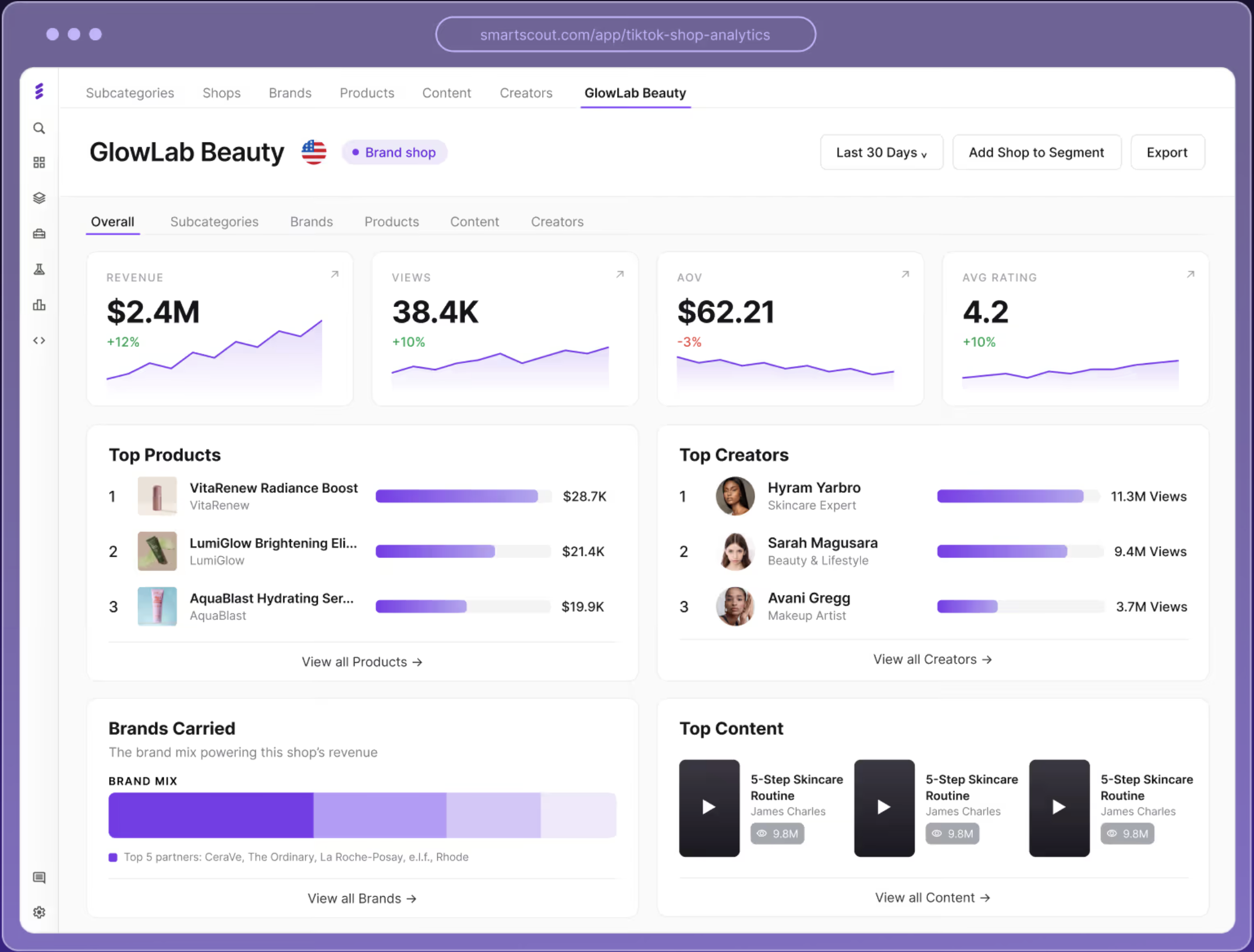
It gives your team another market to investigate when evaluating demand and competition. Cross-channel patterns can suggest questions to explore; they do not automatically prove that activity on one platform caused sales on another.
Choose SmartScout when: you want custom niche research plus substantial subcategory, brand, product, seller, and competitive advertising context.
Keep DataDive in consideration when: your main requirement is its particular workflow for turning a selected competitor group into keyword research, listing optimization, and launch preparation. Test that workflow directly rather than assuming the tools are interchangeable.
2. Helium 10: Research Within a Broader Amazon Toolkit
Helium 10 is worth considering when you want research and day-to-day seller tools from the same provider. Its offering includes product discovery, keyword research, keyword tracking, listing tools, and operational features.
Its Market Tracker supports custom market views based on keywords or ASINs. Market Tracker 360 adds broader category, brand, and product analysis. That means Helium 10 should also be evaluated for market research, rather than treated only as a keyword tool.

Choose Helium 10 when: the team researching opportunities also wants tools for executing and managing its Amazon business.
Buying consideration: compare the exact package. Standard Market Tracker and Market Tracker 360 are different offerings, and feature availability and limits matter more than the length of the overall tool list.
3. Jungle Scout: Product Opportunity Discovery
Jungle Scout’s Opportunity Finder is relevant when you are still deciding which niche to enter. It uses keyword-led research to help users investigate demand, competition, sales performance, and seasonal patterns. Users can also inspect leading products within an opportunity and add them to Product Tracker.
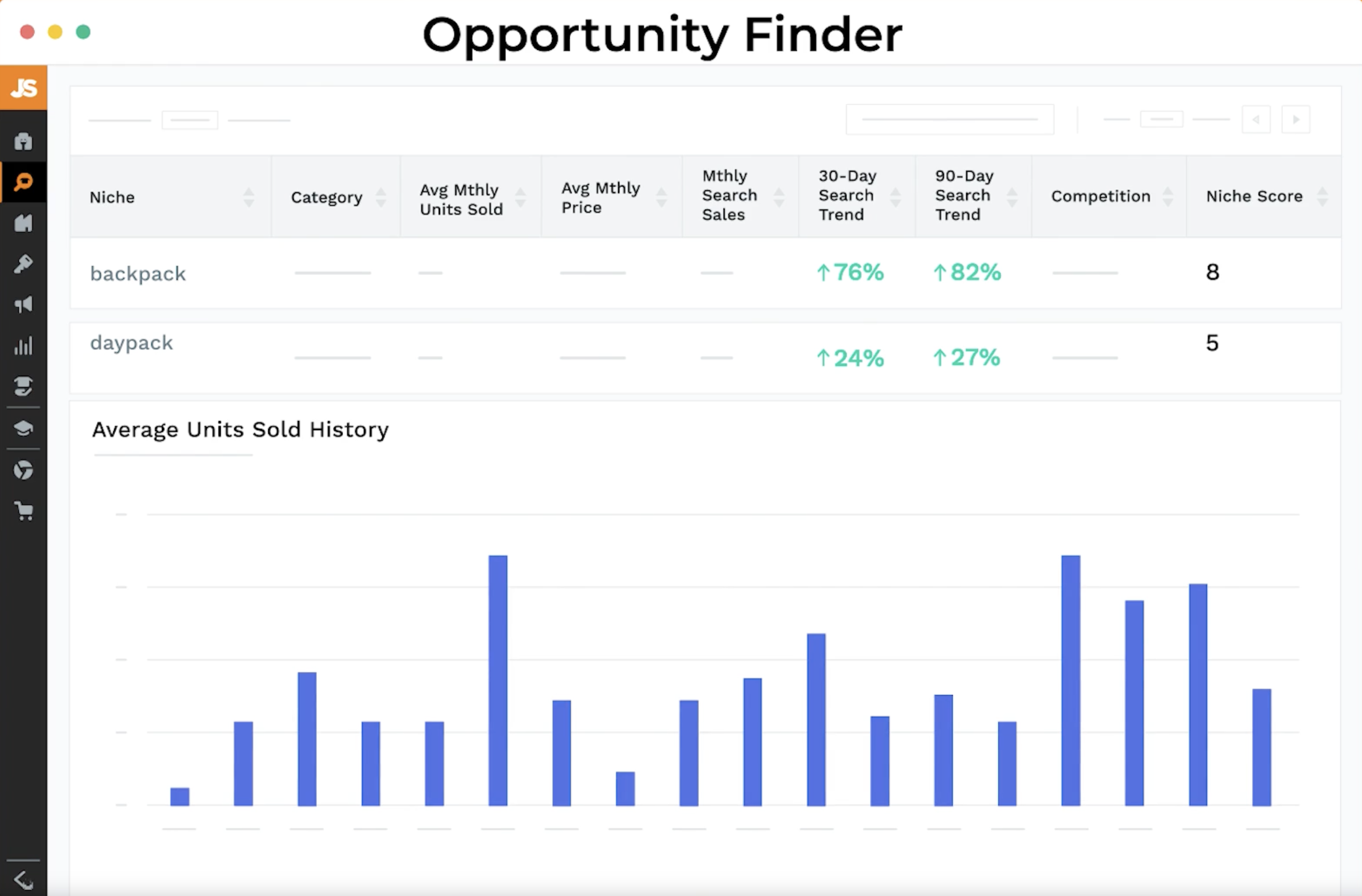
That makes it a useful candidate for a seller building a shortlist of product ideas and deciding which deserve deeper validation.
Choose Jungle Scout when: your immediate task is discovering and screening Amazon product opportunities.
Buying consideration: treat opportunity scores as screening aids. Before committing to a product, examine the underlying competitors, seasonality, costs, and differentiation. A promising score is a starting point for due diligence.
SmartScout vs. DataDive: Which Approach Fits Your Research?
Both platforms support research around a defined competitive group. The useful distinction is how that research connects to the rest of your work.
DataDive is worth evaluating for its niche-to-keyword and listing workflow. SmartScout is worth evaluating for the combination of Custom Segments, subcategory analysis, and connected market intelligence.
To compare them fairly, use the same product idea in both tools. Create the competitor group you believe matters, then assess:
- Market definition: Can you include the relevant competitors and exclude unrelated products?
- Discovery: How well can you find important products and brands you did not initially consider?
- Depth: Can you answer the category, brand, product, and keyword questions your team actually asks?
- Execution: How useful is the research for your next decision, whether that is a listing update, a launch, or expansion into another segment?
- Cost and access: Which plan includes the features, history, users, and research volume you need?
SmartScout vs DataDive Yearly Pricing
.jpg)
If you want to define your own niche and understand the larger market around it, try SmartScout. Custom Segments give your research focus; subcategory analysis helps you see where that focus fits.
Compare SmartScout plans to find the research capabilities that fit your business.