Most Recent

The Fall of RavPower on Amazon

25+ “How to Sell on Amazon” Courses, Mentorships, and Trainings
Efe Osazuwa
Growth Marketing Manager

In 2021, one of Amazon's most dominant electronics brands vanished from the platform almost overnight. RAVPower had top rankings, thousands of reviews, and a commanding presence in phone chargers and power banks.

Then its listings went blank, replaced by Amazon's "Sorry, we couldn't find that page." This was not a slow decline or a competitor stealing share. RAVPower was banned, and it was far from the only big name to fall that year.

Here is what happened, who else went down with it, and the hard lessons every Amazon seller should take from it.

Who was RAVPower on Amazon?


RAVPower was a brand of Sunvalley Group (it still is), a Shenzhen-based electronics manufacturer that also owned TaoTronics and VAVA. It competed in one of Amazon's most crowded and lucrative categories: portable chargers, power banks, charging cables, USB hubs, and related accessories. 
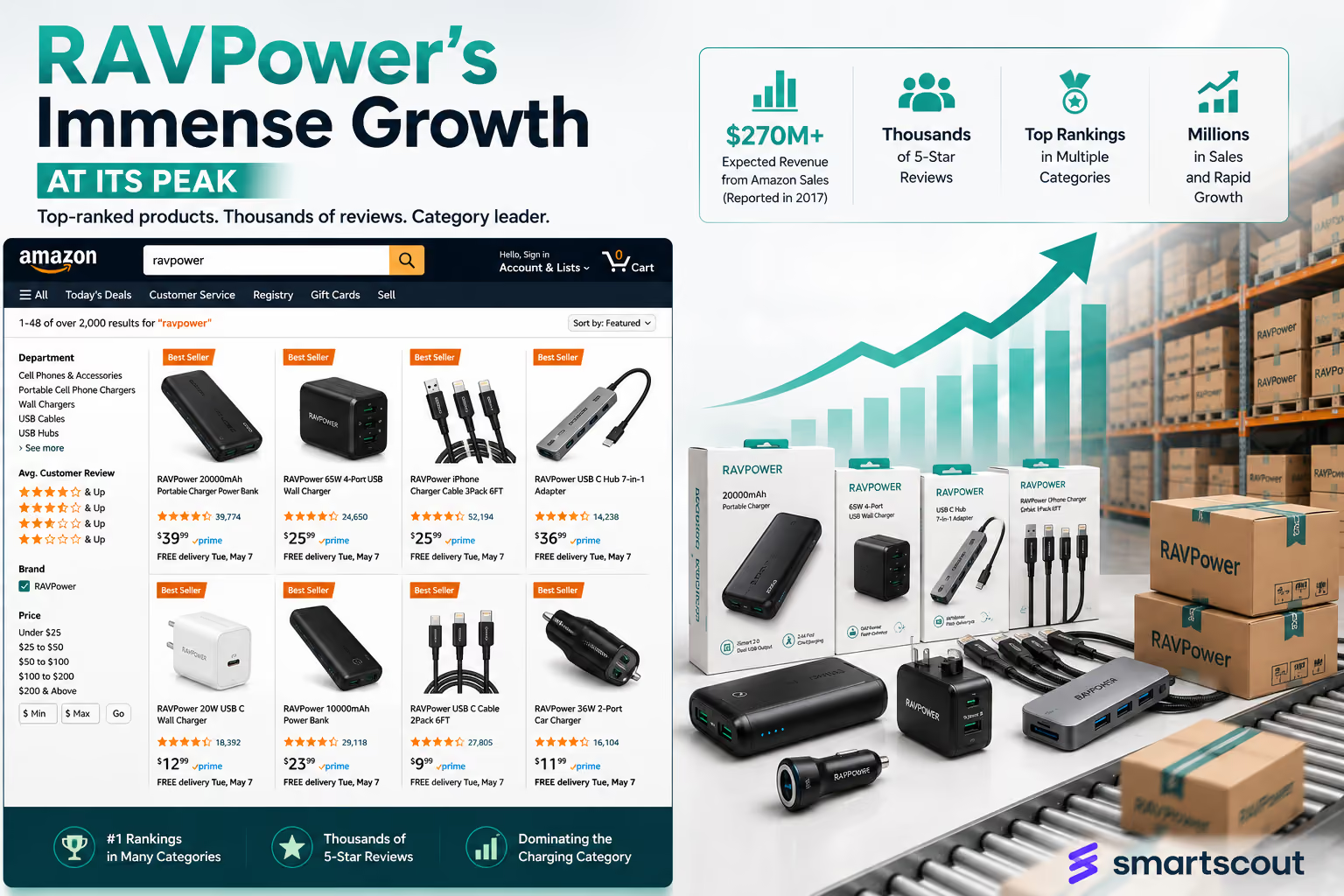
For years, it was a genuine heavyweight. A 2017 New York Times profile reported that Sunvalley expected roughly $270 million in revenue from Amazon sales alone, and RAVPower routinely ranked at the top of search results with thousands of reviews per product. In the charging aisle, its main rival was Anker, and for a time, the two traded blows at the top of the category.

How RAVPower Grew So Fast?


RAVPower's rise followed a playbook common to Amazon-native brands: launch a wide range of SKUs quickly, accumulate reviews aggressively, optimize relentlessly for Amazon's ranking algorithm, and treat Amazon as the primary, sometimes only, sales channel.

Priced sharply and backed by mountains of positive reviews, its products were hard to scroll past. The model worked beautifully, right up until the part of it that broke the rules caught up with the brand.

Why Was RAVPower Banned From Amazon?


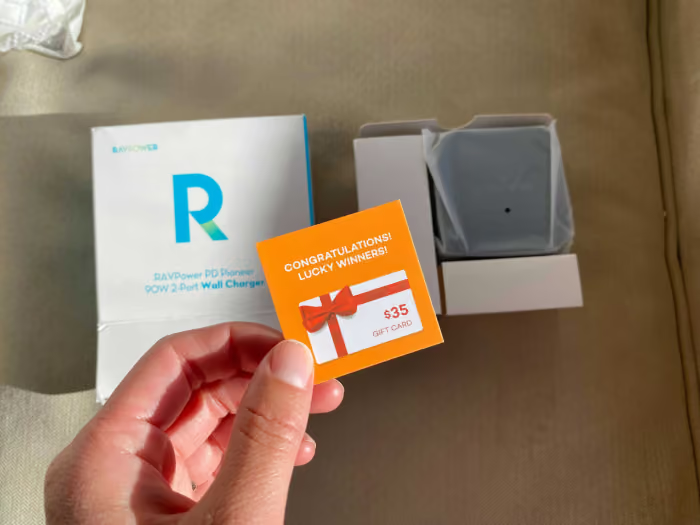
The trigger was public and specific. In June 2021, a Wall Street Journal reporter, Nicole Nguyen,  wrote that a RAVPower charger she ordered arrived with an insert offering a $35 gift card in exchange for a review

That was a direct violation of Amazon's review policy, which lets sellers request a review but forbids incentivizing one with gift cards, discounts, refunds, or free products, and forbids asking for a positive or five-star rating specifically.

Within days, RAVPower's listings were wiped from Amazon, replaced by blank pages and 404 errors. Its sibling brands TaoTronics and VAVA were delisted right after. Sunvalley confirmed the suspensions affected about 31% of its revenue, and its stock fell roughly 12%. There was no warning and no appeal that brought the listings back. One day, RAVPower led the category; the next, it did not exist on Amazon at all.
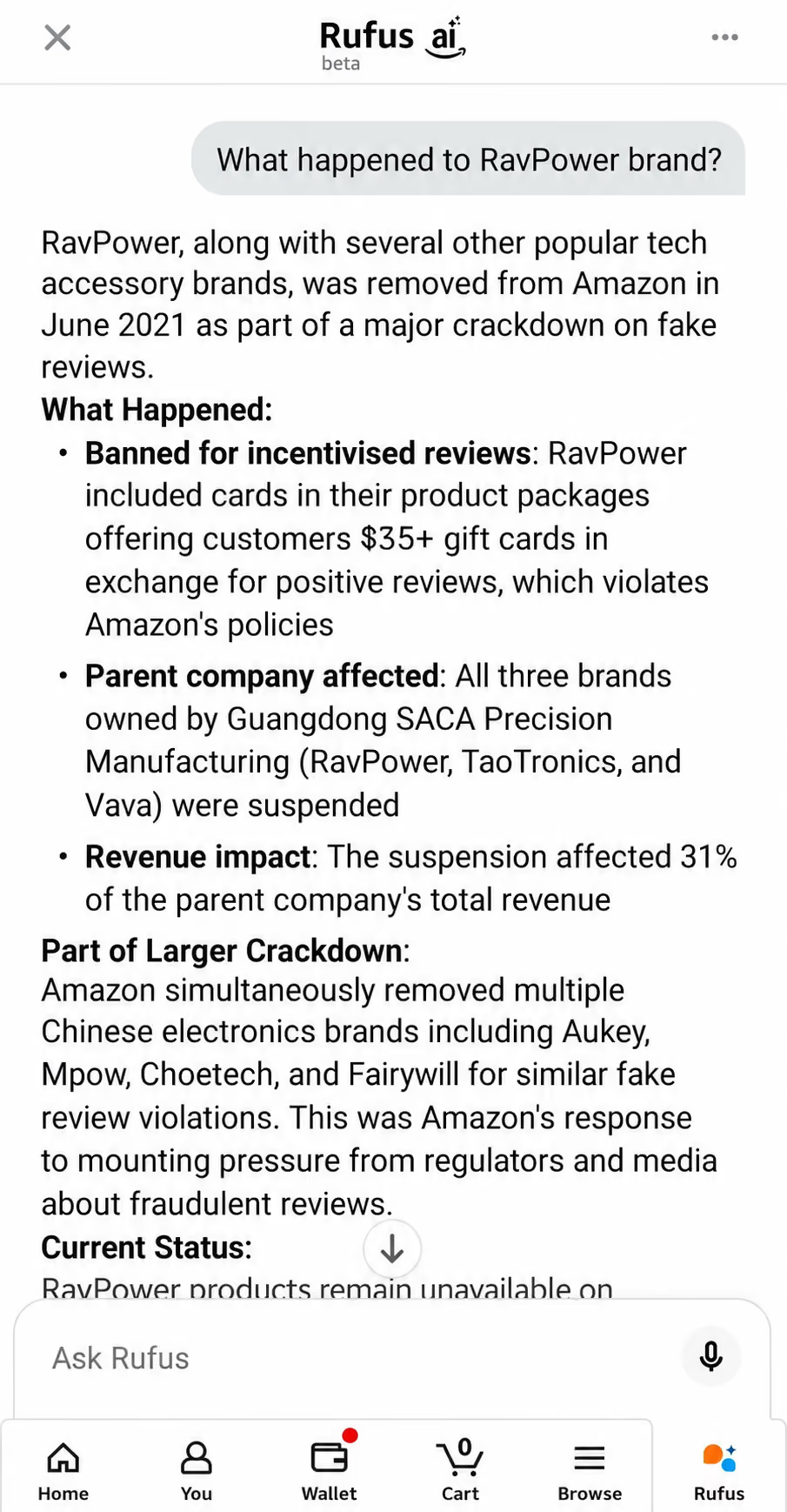

Even to date, if you try to search RAVPower products on Amazon, you will get a reply like this: 

RAVPower Was Not Alone: Other Brands Amazon Banned


RAVPower was one chapter in a much larger purge. Amazon's crackdown on incentivized and fake reviews began earlier in 2021, when Aukey and Mpow disappeared in May after researchers uncovered a network that paid shoppers to buy products and leave positive reviews, refunding them afterward. 

Over the following months, the bans widened to a long list of well-known electronics brands.

Brand Main Category Delisted
Aukey Charging and electronics accessories May 2021
Mpow Headphones and audio May 2021
RAVPower Power banks and chargers June 2021
TaoTronics Audio and home electronics June 2021
VAVA Dashcams and electronics June 2021
Choetech Charging accessories Summer 2021


By September 2021, an Amazon vice president confirmed the company had permanently banned more than 600 Chinese brands across over 3,000 seller accounts, several of them doing well over $100 million in annual sales. The common thread was not product quality. Many of these brands made genuinely good hardware. The common thread was review manipulation.

What Happened After the Ban?


RAVPower did exactly what any other company should have done. Its parent retreated to its own direct-to-consumer website and offline channels, and the RAVPower name never meaningfully returned to Amazon.
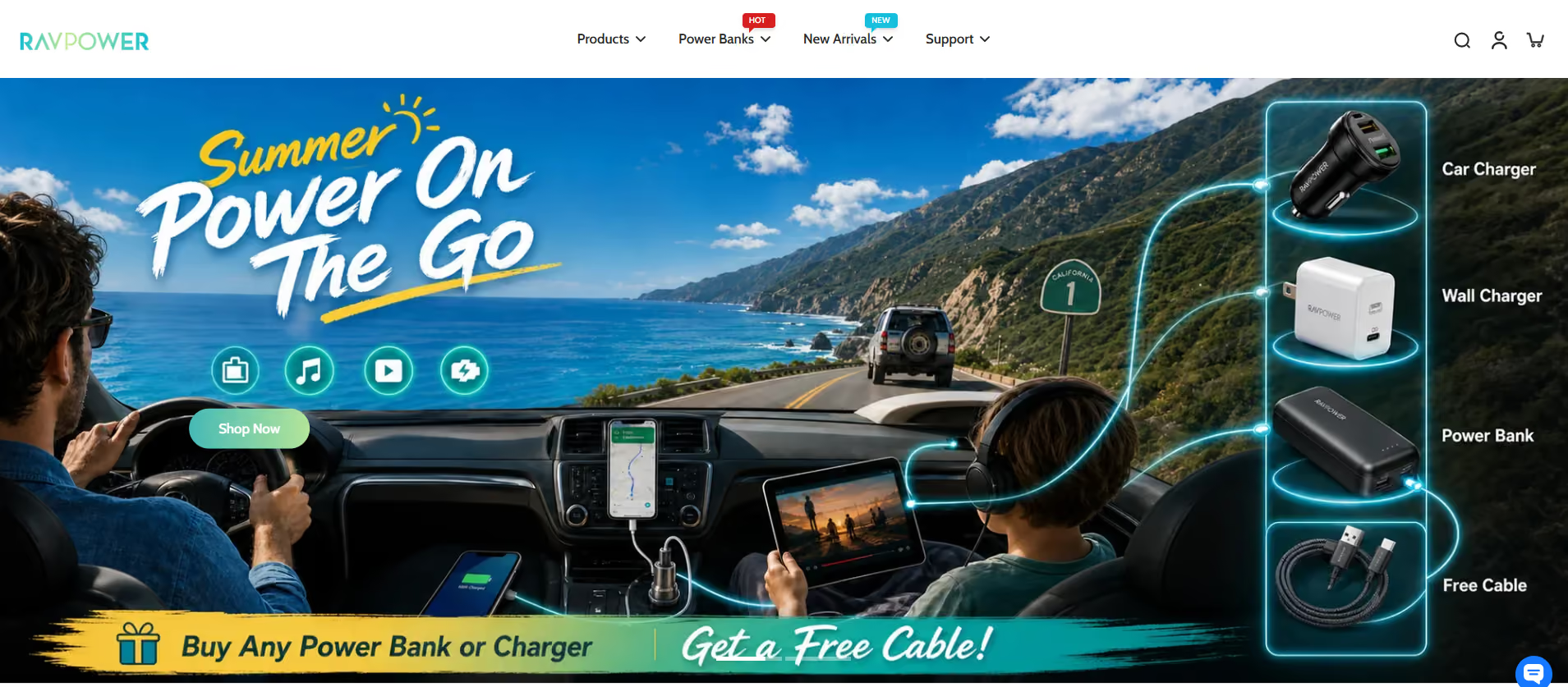
Some of the products may appear in some marketplaces like India, but they are probably third-party products. In the US and other marketplaces, the products are not even listed.

Aukey took a different path. Its parent, now Augroup, absorbed a heavy hit, with revenue falling more than 20% and a roughly $81 million loss, but it diversified hard into Walmart and Wayfair, built its own logistics arm, and went public on the Hong Kong Stock Exchange in late 2024.

The sharpest contrast of all is Anker, RAVPower's old rival in the charging category. Anker played by the rules, invested in its own brand, and is now one of the largest brands on all of Amazon. Same category, same era, opposite outcome. The difference was not the products. It was the choices.

What Not to Do When Selling on Amazon


RAVPower's story sets an example for fellow and aspiring Amazon sellers that a trick might work for some time. But eventually, you will get caught by Amazon and get your listings erased like they never existed.

Here is what you should not do if you are selling on Amazon: 

1. Do Not Manipulate Reviews


This is the one that pulled the trigger. Insert cards offering gift cards, refund-for-review schemes, and paid five-star ratings all violate Amazon's policy, and enforcement can be sudden and permanent. You can ask a customer to leave a review, but the moment you attach an incentive or request a specific rating, you put the entire business at risk. Build reviews the slow way, through good products and Amazon's own compliant Request a Review tools.

2. Do Not Depend on a Single Channel


RAVPower lost more than visibility when Amazon pulled its listings. It lost its primary growth engine. A business that earns most of its revenue from one marketplace is only ever one policy change away from collapse. The brands that survived the purge were the ones, like Aukey, that had or quickly built other channels: their own sites, Walmart, Wayfair, and physical retail.

3. Do Not Chase Tactical Growth Over Brand Building


Hacking the algorithm can produce fast results, but it produces fragile businesses. A brand that customers seek out by name, with demand on Amazon as well as on its own, can weather a suspension. A brand that exists only as a set of well-optimized listings cannot. Sustainable growth is slower and far harder to take away.

4. Do Not Ignore Policy Changes


Amazon's rules evolve constantly, and what was tolerated yesterday can be enforced aggressively tomorrow. The sellers who get caught are usually the ones still running an old playbook after the rules have moved. Treat compliance as an ongoing job, not a one-time checkbox you tick at launch.

How SmartScout Helps You Build a Durable Amazon Business


Everything that protected the survivors comes down to building on real demand and real data rather than shortcuts, and that is exactly where research earns its place. SmartScout supports the durable version of growth in a few concrete ways:

  • Find genuine demand before you commit, using the Subcategories browser and Products database to build on real, underserved demand instead of forcing a product up the rankings.
  • Grow visibility legitimately, with Keyword Detective, Search Terms Relevancy, and the AI Listing Architect so you win search through relevance, not fake reviews.
  • Watch the category and the competition through the Brands tool and Seller Tools, so you can see who is rising, who is slipping, and where the next opportunity sits.
  • Diversify with evidence, identifying new categories and niches to expand into so your business never rests on a single listing or a single channel.

None of this is a shortcut. It is the opposite: a way to grow on the kind of foundation Amazon rewards rather than punishes.

The Bottom Line


RAVPower did not lose because its products were bad or because a competitor outsold it. It lost because it built on tactics it did not control and a single channel it did not own. 

The brands that endured did the unglamorous things instead: they earned reviews honestly, diversified their sales, and built real demand for their name. That is the lesson of 2021, and it is just as true for any brand selling on Amazon today.

Start using SmartScout with Risk-Free pricing

7-day money back guarantee, cancel at any time
Back

The Fall of RavPower on Amazon

Most Recent
4.9.26
0
Min

In 2021, one of Amazon's most dominant electronics brands vanished from the platform almost overnight. RAVPower had top rankings, thousands of reviews, and a commanding presence in phone chargers and power banks.

Then its listings went blank, replaced by Amazon's "Sorry, we couldn't find that page." This was not a slow decline or a competitor stealing share. RAVPower was banned, and it was far from the only big name to fall that year.

Here is what happened, who else went down with it, and the hard lessons every Amazon seller should take from it.

Who was RAVPower on Amazon?


RAVPower was a brand of Sunvalley Group (it still is), a Shenzhen-based electronics manufacturer that also owned TaoTronics and VAVA. It competed in one of Amazon's most crowded and lucrative categories: portable chargers, power banks, charging cables, USB hubs, and related accessories. 

For years, it was a genuine heavyweight. A 2017 New York Times profile reported that Sunvalley expected roughly $270 million in revenue from Amazon sales alone, and RAVPower routinely ranked at the top of search results with thousands of reviews per product. In the charging aisle, its main rival was Anker, and for a time, the two traded blows at the top of the category.

How RAVPower Grew So Fast?


RAVPower's rise followed a playbook common to Amazon-native brands: launch a wide range of SKUs quickly, accumulate reviews aggressively, optimize relentlessly for Amazon's ranking algorithm, and treat Amazon as the primary, sometimes only, sales channel.

Priced sharply and backed by mountains of positive reviews, its products were hard to scroll past. The model worked beautifully, right up until the part of it that broke the rules caught up with the brand.

Why Was RAVPower Banned From Amazon?


The trigger was public and specific. In June 2021, a Wall Street Journal reporter, Nicole Nguyen,  wrote that a RAVPower charger she ordered arrived with an insert offering a $35 gift card in exchange for a review

That was a direct violation of Amazon's review policy, which lets sellers request a review but forbids incentivizing one with gift cards, discounts, refunds, or free products, and forbids asking for a positive or five-star rating specifically.

Within days, RAVPower's listings were wiped from Amazon, replaced by blank pages and 404 errors. Its sibling brands TaoTronics and VAVA were delisted right after. Sunvalley confirmed the suspensions affected about 31% of its revenue, and its stock fell roughly 12%. There was no warning and no appeal that brought the listings back. One day, RAVPower led the category; the next, it did not exist on Amazon at all.


Even to date, if you try to search RAVPower products on Amazon, you will get a reply like this: 

RAVPower Was Not Alone: Other Brands Amazon Banned


RAVPower was one chapter in a much larger purge. Amazon's crackdown on incentivized and fake reviews began earlier in 2021, when Aukey and Mpow disappeared in May after researchers uncovered a network that paid shoppers to buy products and leave positive reviews, refunding them afterward. 

Over the following months, the bans widened to a long list of well-known electronics brands.

Brand Main Category Delisted
Aukey Charging and electronics accessories May 2021
Mpow Headphones and audio May 2021
RAVPower Power banks and chargers June 2021
TaoTronics Audio and home electronics June 2021
VAVA Dashcams and electronics June 2021
Choetech Charging accessories Summer 2021


By September 2021, an Amazon vice president confirmed the company had permanently banned more than 600 Chinese brands across over 3,000 seller accounts, several of them doing well over $100 million in annual sales. The common thread was not product quality. Many of these brands made genuinely good hardware. The common thread was review manipulation.

What Happened After the Ban?


RAVPower did exactly what any other company should have done. Its parent retreated to its own direct-to-consumer website and offline channels, and the RAVPower name never meaningfully returned to Amazon.

Some of the products may appear in some marketplaces like India, but they are probably third-party products. In the US and other marketplaces, the products are not even listed.

Aukey took a different path. Its parent, now Augroup, absorbed a heavy hit, with revenue falling more than 20% and a roughly $81 million loss, but it diversified hard into Walmart and Wayfair, built its own logistics arm, and went public on the Hong Kong Stock Exchange in late 2024.

The sharpest contrast of all is Anker, RAVPower's old rival in the charging category. Anker played by the rules, invested in its own brand, and is now one of the largest brands on all of Amazon. Same category, same era, opposite outcome. The difference was not the products. It was the choices.

What Not to Do When Selling on Amazon


RAVPower's story sets an example for fellow and aspiring Amazon sellers that a trick might work for some time. But eventually, you will get caught by Amazon and get your listings erased like they never existed.

Here is what you should not do if you are selling on Amazon: 

1. Do Not Manipulate Reviews


This is the one that pulled the trigger. Insert cards offering gift cards, refund-for-review schemes, and paid five-star ratings all violate Amazon's policy, and enforcement can be sudden and permanent. You can ask a customer to leave a review, but the moment you attach an incentive or request a specific rating, you put the entire business at risk. Build reviews the slow way, through good products and Amazon's own compliant Request a Review tools.

2. Do Not Depend on a Single Channel


RAVPower lost more than visibility when Amazon pulled its listings. It lost its primary growth engine. A business that earns most of its revenue from one marketplace is only ever one policy change away from collapse. The brands that survived the purge were the ones, like Aukey, that had or quickly built other channels: their own sites, Walmart, Wayfair, and physical retail.

3. Do Not Chase Tactical Growth Over Brand Building


Hacking the algorithm can produce fast results, but it produces fragile businesses. A brand that customers seek out by name, with demand on Amazon as well as on its own, can weather a suspension. A brand that exists only as a set of well-optimized listings cannot. Sustainable growth is slower and far harder to take away.

4. Do Not Ignore Policy Changes


Amazon's rules evolve constantly, and what was tolerated yesterday can be enforced aggressively tomorrow. The sellers who get caught are usually the ones still running an old playbook after the rules have moved. Treat compliance as an ongoing job, not a one-time checkbox you tick at launch.

How SmartScout Helps You Build a Durable Amazon Business


Everything that protected the survivors comes down to building on real demand and real data rather than shortcuts, and that is exactly where research earns its place. SmartScout supports the durable version of growth in a few concrete ways:

  • Find genuine demand before you commit, using the Subcategories browser and Products database to build on real, underserved demand instead of forcing a product up the rankings.
  • Grow visibility legitimately, with Keyword Detective, Search Terms Relevancy, and the AI Listing Architect so you win search through relevance, not fake reviews.
  • Watch the category and the competition through the Brands tool and Seller Tools, so you can see who is rising, who is slipping, and where the next opportunity sits.
  • Diversify with evidence, identifying new categories and niches to expand into so your business never rests on a single listing or a single channel.

None of this is a shortcut. It is the opposite: a way to grow on the kind of foundation Amazon rewards rather than punishes.

The Bottom Line


RAVPower did not lose because its products were bad or because a competitor outsold it. It lost because it built on tactics it did not control and a single channel it did not own. 

The brands that endured did the unglamorous things instead: they earned reviews honestly, diversified their sales, and built real demand for their name. That is the lesson of 2021, and it is just as true for any brand selling on Amazon today.

Start Using SmartScout with Risk-Free Pricing

try it today
7-day money back guarantee, cancel at any time