It’s no surprise that video content and audio content are taking storm this early into 2021. With the viral hold e-commerce has had on consumer activity in the last year, it makes sense that various types of content output are necessary to help brands boost awareness and trust in their audiences.
Video content is essential to brand building as it assists in creating a brand profile. Video content can take many forms and include social platforms like TikTok and Instagram, Advertising, Webinars, etc.
While video was once a costly production, the more mainstream it has become, the more accessible it is to the small and large brands — and any size in between. Video content is a great way to build a relationship with your audience and make people feel connected to a sense of brand community. This connection can be an effective means to sales, but also brand loyalty.
If you’re an Amazon seller, video content is key to your business’s growth, and you can quickly master delivery in a few simple options.
Video Content You Need To Look Out For
Social Platforms (TikTok & Instagram)
Amazon Live
Amazon Video Advertisements
We’ll break down how to leverage each video content component to help you boost your Amazon business below!
TikTok
In December, our sister company Buy Boxer experienced a massive impact from a TikTok video that went viral, so we know first hand the benefits that can come from this type of content creation.
The video in question hit 15 million views, jumped our sales rank from 1500 to 100, and spiked our sales to the point of awe and disbelief, all literally from 60 seconds worth of content, for a full view of the TikTok video head here.
Social Video Content Creation Tips
Start small but be consistent. Video content on Instagram and TikTok requires daily effort and consistency to please the algorithms.
Post on all video mediums. TikTok content creators suggest posting 1- 3 times a day, while Instagram users recommend posting on all available channels. Ex: Instagram Reels, Stories, and IGTV.
If you’re not comfortable posting your content, hire a brand ambassador or someone from your brand’s inner workings to be the face of your video content.
Get creative! Both Instagram and TikTok offer various tools to help you personalize and engage your audience. Take advantage of the music available in your country as viral songs are said to help gain videos more recognition. Think of video content as you would in your other social profiles, and post content surrounding the four main content pillars: Educate, Inspire, Promote, and Entertain.
Amazon Live
Released last fall, Amazon live was in Beta. Now out of the trial period, there is discussion in the Amazon community about whether or not the extension to Amazon advertising content will take off.
But, like anything, time will tell as to its success rate. In the meantime, it’s essential to pick up on these trends and at least give them space, provided you have the opportunity.
To access Amazon live, a seller needs to be Brand Registered. Similar to QVC style content, content is created by way of video to model and demonstrate a brand’s products and then streamed live for viewing. This content is featured across Amazon’s home page and Amazon listings for easy access to your audience.
Tips to Creating Great Live Streaming Content
Good lighting. Lighting can make or break how your content looks, and therefore who watches. Invest in a ring light if you don’t have a larger budget for a production team.
Work with influencers. If you’re not comfortable being the face of your brand, that’s okay. Source influencers through agencies, but be sure that you have the right fit for your brand, as this should be a fun and engaging experience for everyone. Also, remember that pricing for an influencer varies based on many factors, such a reach.
Be sure that the individual doing the demonstration understands the product fully at the outset. Provide them with a full scope of features and benefits alongside a healthy FAQ list.
This is a great chance to connect with your audience, and since, as of yet, there isn’t a flood of participants, it’s a good time to give it a try and stand out!
Amazon Video Advertising
Not every Amazon marketplace has the ability to create a video located in the Amazon listing image section. For example, this is not yet available in the Canadian market, providing a seller avoids black hat tactics.
However, for those sellers that are Brand Registered, the option to create stunning video advertisements regardless of what market you are in is available at your disposal. With the right tools and strategy, sellers can easily create a video that highlights product features, improves customer engagement, and increases conversions.
Besides the apparent brand-boosting awareness and eye-catching content, another benefit of video advertising is that not many sellers take partake in it. Doing so is a great way to differentiate yourself on the platform and become a more recognized brand.
Amazon Video Ad Creation Tips
Video content, like any form of content, requires a strategic plan of action to be successful.
If you’re small and just starting, focus on microforms of video content production that are free and only require your time and energy. As your business grows and you become Brand Registered, begin creating your video content using software such as Biteable, where the cost is low considering the reach the ad can have to an Amazon audience.
Your Amazon video advertising can vary, so remember to track these campaigns closely.
Once again, get creative. There are many resources online for DIY video content creation, and the result can be shockingly good!
All in all, it’s vital to stay ahead of trends. While there may be uncertainty about Amazon Live’s viability, it’s a great idea to participate early on to get your feet wet. If Amazon Live doesn’t take off, there will always be new video content innovations on and off Amazon, so be open-minded and ready to explore.
TikTok Shop crossed $50 billion in global GMV in just the first half of 2026. That puts it on track to surpass $100 billion for the full year, making it the fastest e-commerce platform to ever reach that milestone.
What started as a social commerce experiment inside a video app is now a top-tier global retail channel, one that added more GMV in 18 months than most marketplaces generate in a decade.
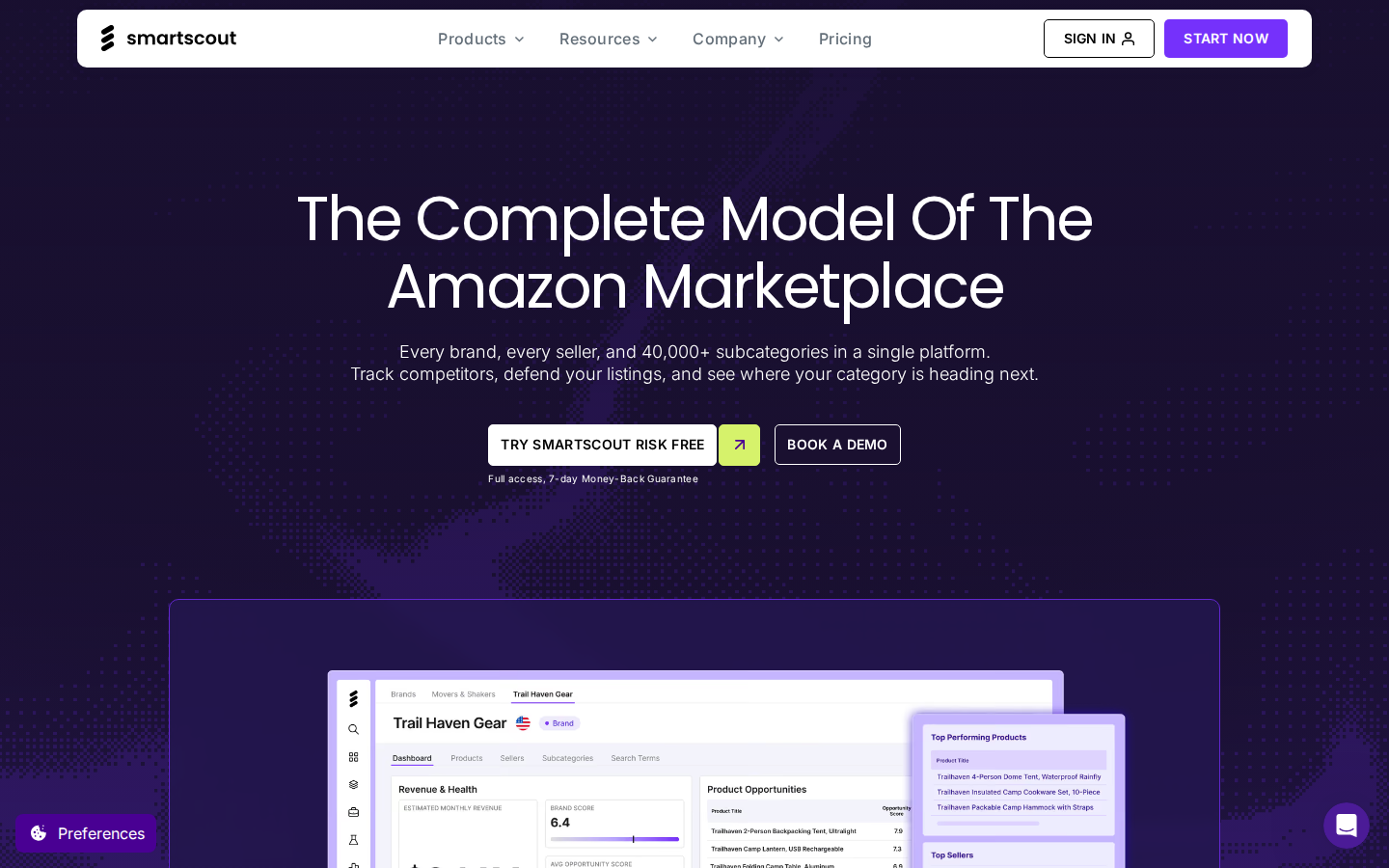
At SmartScout, we track TikTok Shop data at the category, shop, and product level. For this report, we combined publicly available data from industry trackers with our own proprietary data on category revenue, shop performance, and market structure.
Here is everything you need to know about TikTok Shop in 2026, backed by numbers.
Key TikTok Shop Statistics 2026
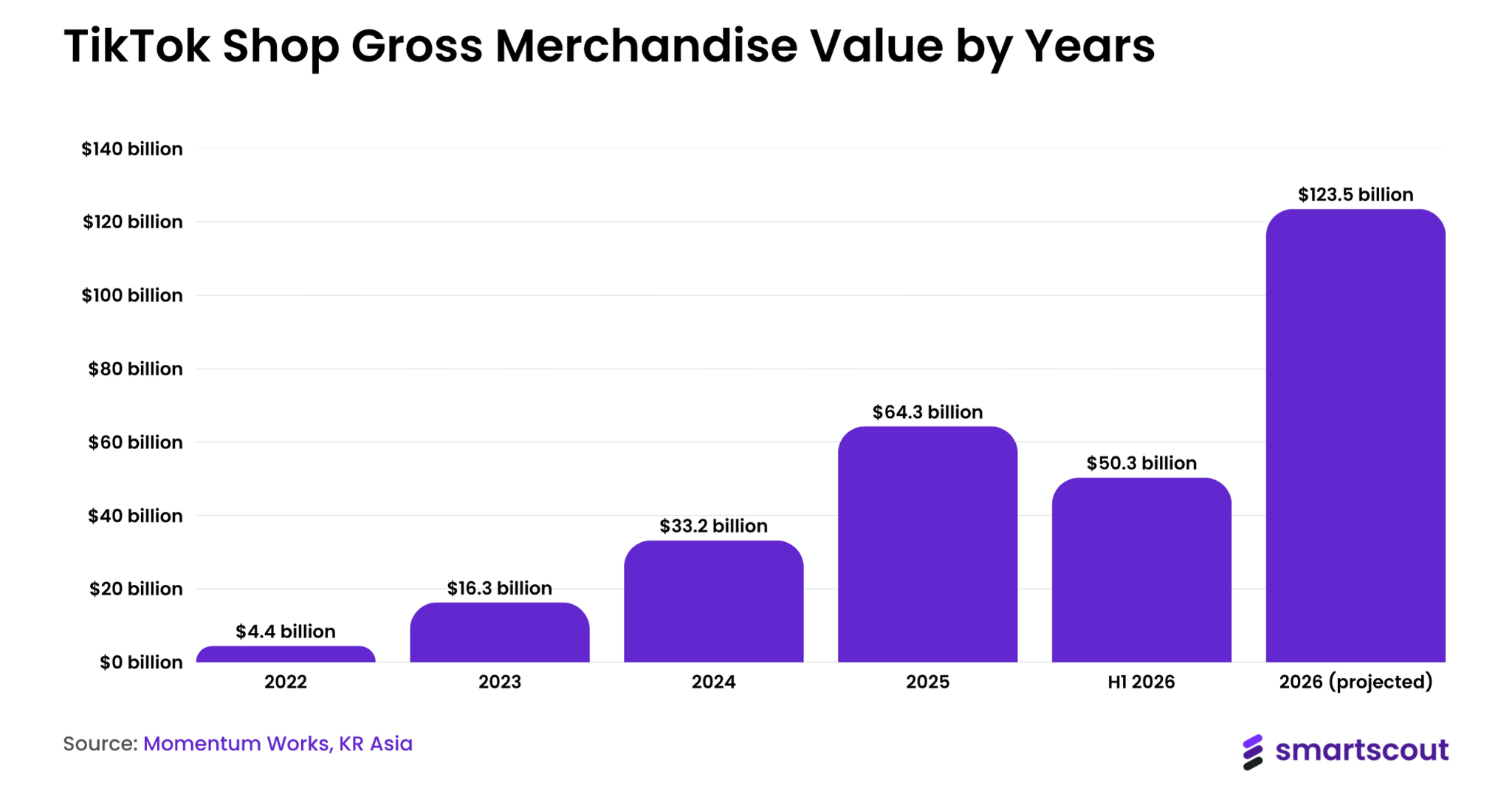
TikTok Shop's global GMV reached $50.3 billion in H1 2026, up 92% year-over-year.
The platform is projected to reach $123.5 billion in global GMV for full-year 2026.
US GMV hit $11.8 billion in H1 2026, growing 103% year-over-year.
There are over 15 million sellers on TikTok Shop globally.
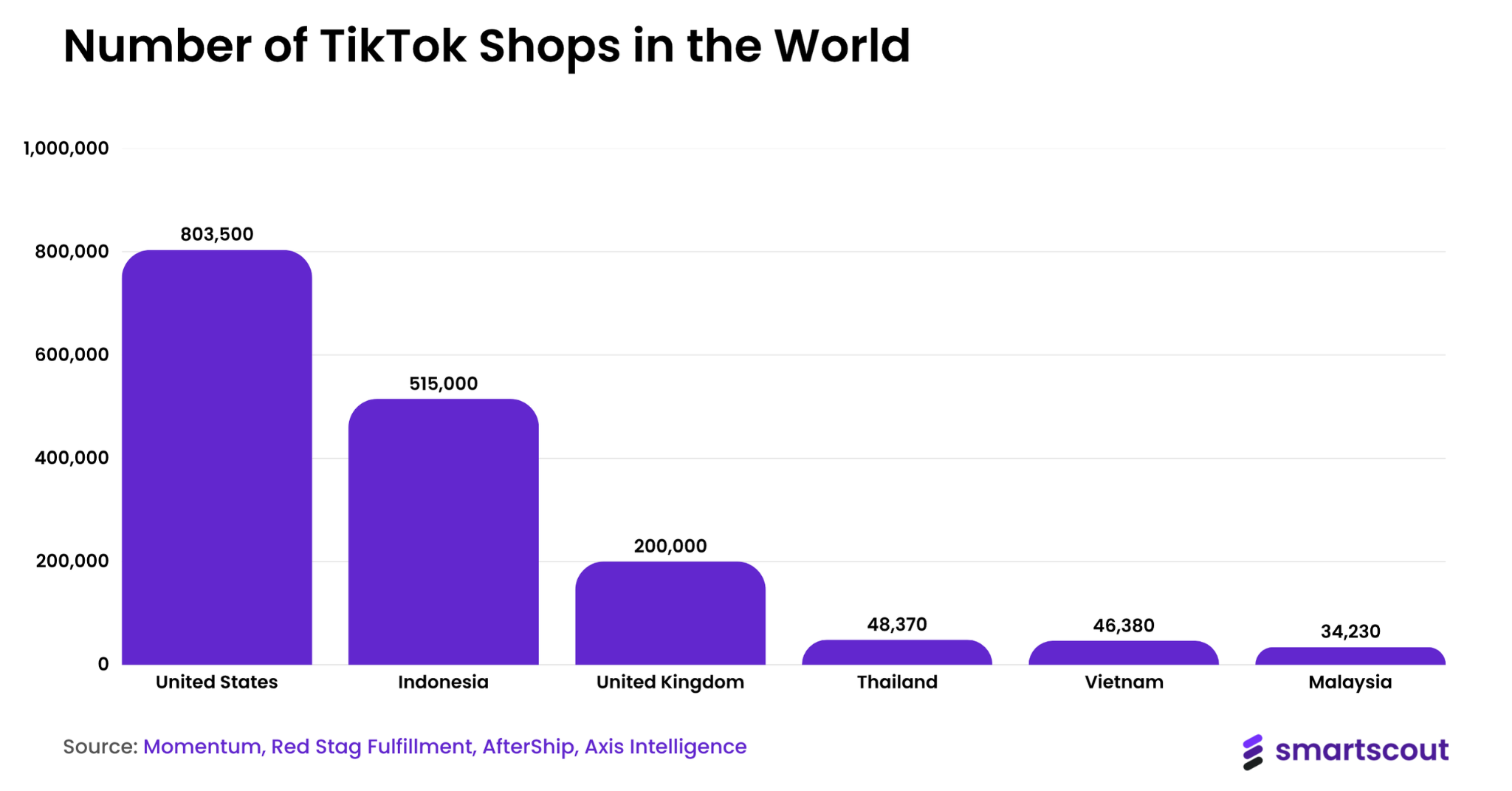
The US has 803,500 registered stores, though more than half recorded no sales.
More than 5,700 US stores crossed $1 million in GMV in H1 2026, an 8x increase year-over-year.
Beauty & Personal Care is the largest category, generating over $9.7 billion in lifetime revenue.
TikTok Shop captured 18.2% of all US social commerce sales in 2025.
53.2 million US buyers purchased on TikTok in 2025, projected to reach 57.7 million in 2026.
Affiliate-driven content accounts for 42% of total US TikTok Shop GMV.
Shop tab now drives 51.4% of attributed GMV in the US, overtaking video and live.
97% of TikTok Shop customers in the US also shop on Amazon.
How Many TikTok Shops Are There?
TikTok Shop hosts more than 15 million sellers globally as of 2026. The platform operates in 16 countries as of mid-2026, with four more expected by year-end.
The US market saw the most dramatic expansion. Shop count grew from 4,450 in mid-2023 to 803,500 by the end of 2025. In the same period, US GMV went from near zero to $15.1 billion.
Country
Number of Shops
United States
803,500
Indonesia
515,000
United Kingdom
200,000
Thailand
48,370
Vietnam
46,380
Malaysia
34,230
Southeast Asia still dominates total shop count. Indonesia alone has more registered shops than the entire US market, driven by TikTok's integration with Tokopedia and the region's deeply established social commerce behavior.
New markets launched in 2025 include Germany, France, Italy, and Brazil. Brazil launched in May 2025 and grew its monthly GMV from $1 million to $25.7 million within three months, reaching $46.1 million by August 2025.
TikTok Shop generated $64.3 billion in global GMV in 2025, nearly doubling its 2024 performance. In just the first half of 2026, that number already crossed $50.3 billion.
Here is how TikTok Shop's GMV has grown since launch:
Note: GMV figures represent gross transaction values before returns and cancellations. TikTok does not publicly report net revenue from Shop, so all figures are estimates from third-party trackers.
TikTok Shop in the United States
TikTok Shop launched in the US in September 2023. It reached $9 billion in GMV within 16 months.
US GMV reached $15.1 billion in 2025, a 68% increase from $9 billion in 2024. In H1 2026 alone, the US hit $11.8 billion, growing 103% year-over-year. TikTok Shop captured 18.2% of all US social commerce sales in 2025.
A major structural shift happened in the US during H1 2026. The Shop tab (TikTok's in-app marketplace) now accounts for 51.4% of attributed GMV, up from 36% in 2025. Video dropped to 40.4%, and Live narrowed to just 8.2%.
The 2025 BFCM four-day shopping period generated over $500 million in sales in the US, with shoppers up 50% year-over-year.
TikTok recorded 3.8 billion visits in August 2026, making it the 5th most-visited social media website in the world. Since the platform registers this much traffic, selling on this platform makes it much easier.
Monthly Visits
TikTok Shop (seller.tiktok) had 3 million visitors in August, with a decline of 26.37% from July 2026. An average person stays on the website for 1 minute 43 seconds and visits 1.45 pages on average.
Traffic Share by Country
The United States drives the most traffic among all the countries, with 29.78% of the total traffic. Vietnam and Indonesia come in second and third place in terms of traffic.
Country
Share of Traffic
United States
29.78%
Vietnam
12.02%
Indonesia
9.99%
Brazil
8.04%
Mexico
5.84%
Rest of the World
34.33%
(Data as of September 2026)
Age Distribution
People aged between 25 and 34 years account for the most traffic on TikTok Shop, with 32.66% of the traffic.
Age Group
Traffic
18-24
16.48%
25-34
32.66%
35-44
21.6%
45-54
15.7%
55-64
8.77%
65+
4.77%
Gender Share
Male shoppers on TikTok Shop slightly dominate the platform by accounting for 50.94% of the audience. Female shoppers are also very close, at 49.06%.
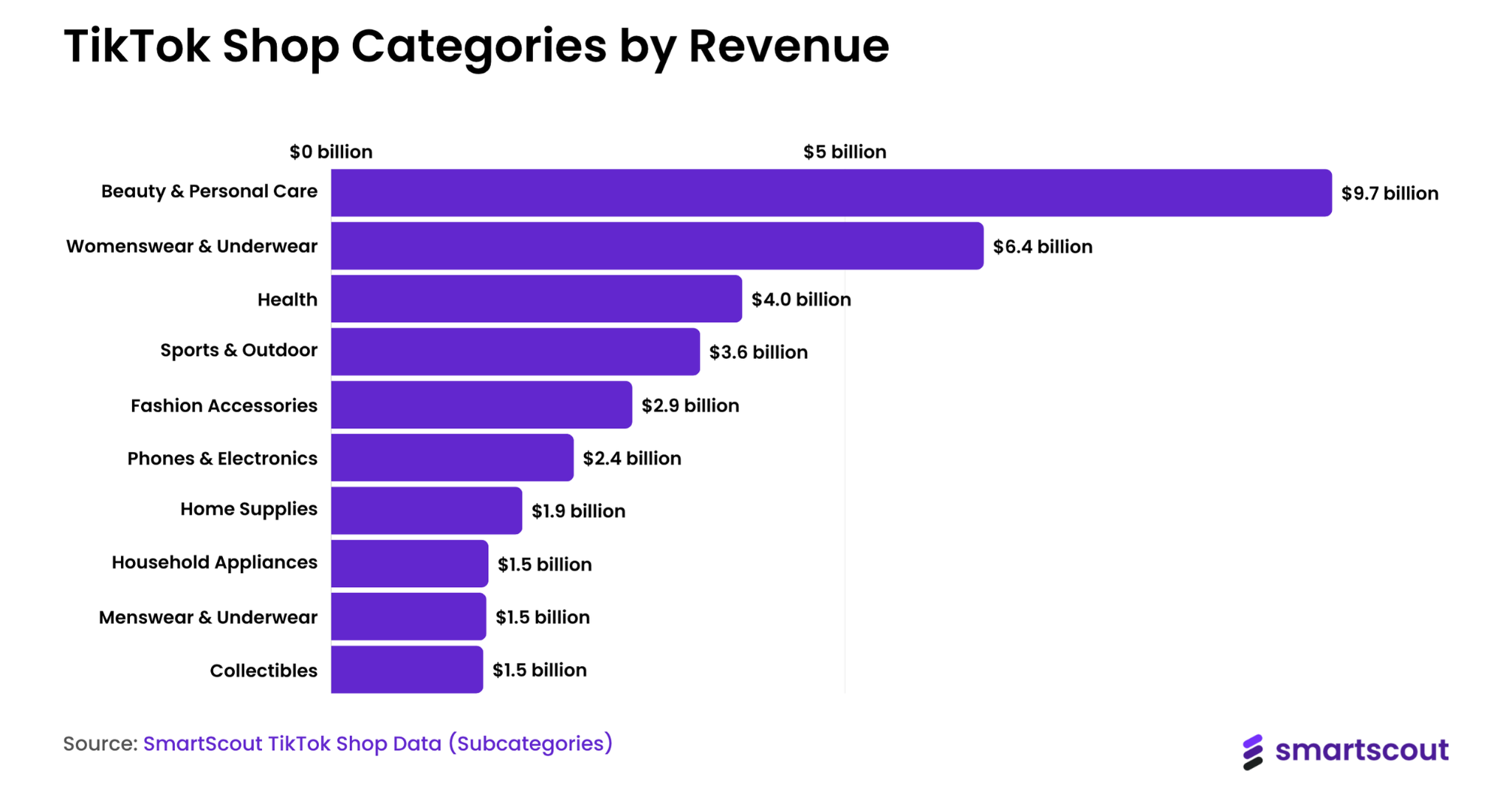
Beauty & Personal Care dominates TikTok Shop by a wide margin. It has generated over $9.7 billion in lifetime revenue, nearly $3.4 billion more than the second-place category. Monthly revenue alone tops $515 million, more than the next two categories combined.
Womenswear & Underwear holds second place with $6.3 billion in lifetime revenue and nearly $378 million per month. Together, the top two categories account for more than 40% of all tracked category revenue on the platform.
Here are the top 10 TikTok Shop categories ranked by lifetime revenue:
Rank
Category
Lifetime Revenue
Monthly Revenue
1
Beauty & Personal Care
$9.74 billion
$515.1 million
2
Womenswear & Underwear
$6.35 billion
$377.5 million
3
Health
$4.00 billion
$148.7 million
4
Sports & Outdoor
$3.59 billion
$202.1 million
5
Fashion Accessories
$2.93 billion
$147.1 million
6
Phones & Electronics
$2.36 billion
$114.1 million
7
Home Supplies
$1.86 billion
$113.0 million
8
Household Appliances
$1.53 billion
$72.6 million
9
Menswear & Underwear
$1.51 billion
$103.2 million
10
Collectibles
$1.48 billion
$78.8 million
Source: SmartScout TikTok Shop Data (Subcategories)
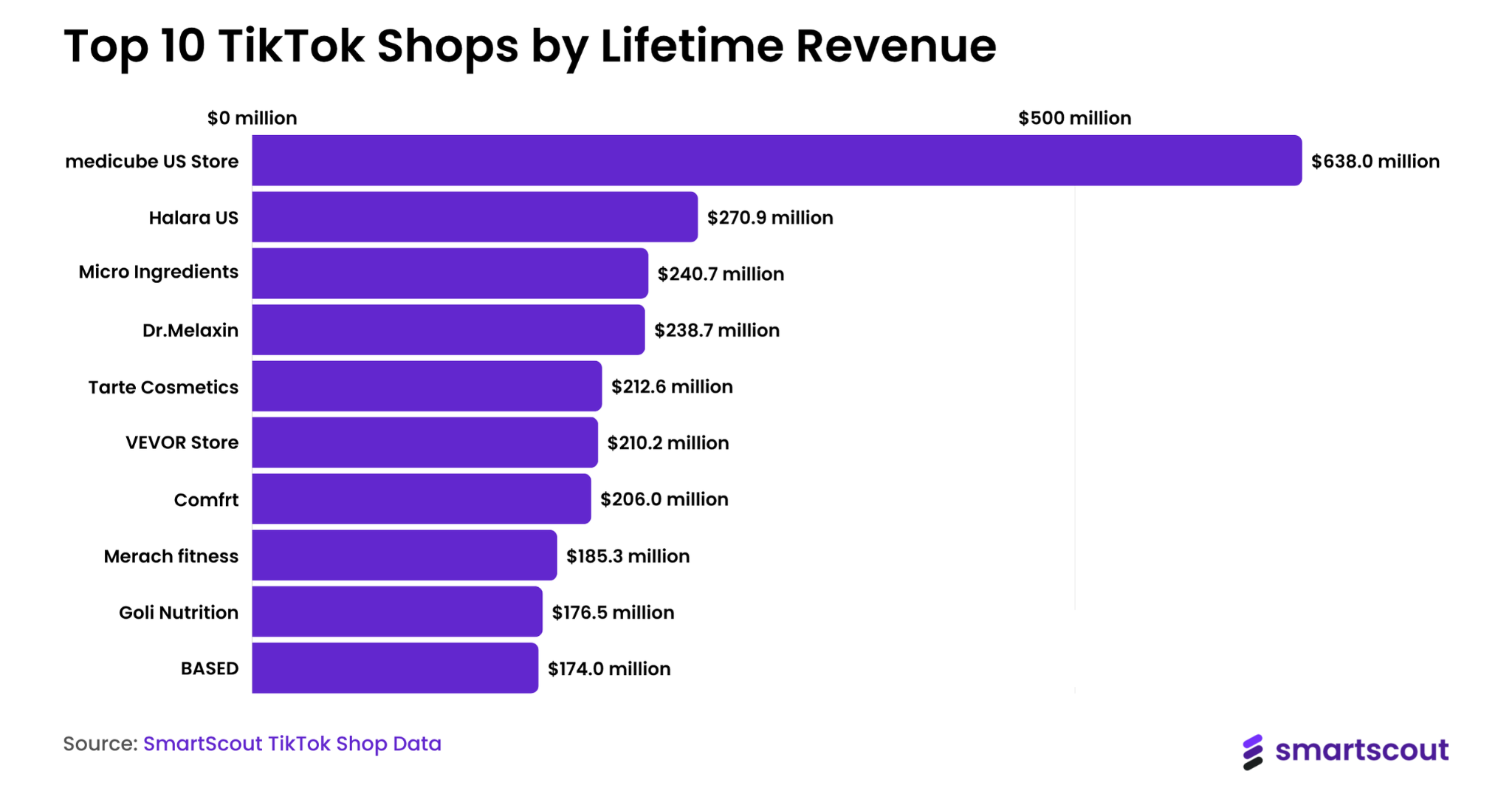
Top 10 TikTok Shops in the US
medicube US Store is the highest-earning shop on TikTok, pulling in $39.6 million in monthly revenue and $638 million in lifetime revenue. It sells skin care kits and has built a dominant position through consistent creator-driven content and aggressive product launches.
Nine of the top 10 shops are based in the US. The only exception is Halara US, which is registered in China but sells primarily to US consumers.
All 10 are classified as Official Shops, meaning they are brand-operated storefronts rather than third-party resellers.
Rank
Shop Name
Primary Sub Category
Lifetime Revenue
Monthly Revenue
1
medicube US Store
Skin Care Kits
$638.0 million
$39.6 million
2
Dr.Melaxin
Skin Care Kits
$238.7 million
$22.4 million
3
Comfrt
Women's Hoodies
$206.0 million
$13.5 million
4
BASED
Mousse & Gel
$174.0 million
$11.9 million
5
Tarte Cosmetics
Lipstick & Lip Gloss
$212.6 million
$11.4 million
6
VEVOR Store
Storage Boxes
$210.2 million
$9.5 million
7
Halara US
Women's Sports Leggings
$270.9 million
$8.9 million
8
Micro Ingredients
Vitamins Supplements
$240.7 million
$6.6 million
9
Merach fitness
Vibration Trainers
$185.3 million
$5.7 million
10
Goli Nutrition
Vitamins Supplements
$176.5 million
$2.1 million
Source: SmartScout TikTok Shop Data
TikTok Shop Social Commerce Market Share
TikTok Shop now owns 18.2% of all US social commerce sales. Two years ago, that number was close to zero.
Total US social commerce hit $87 billion in 2025, up 21.5% year-over-year. It is projected to surpass $100 billion in 2026.
Year
US Social Commerce (Total)
TikTok Shop's Share
2025
$87 billion
18.2%
2026 (projected)
$100 billion+
22%
2027 (projected)
$110 billion+
24.1%
By 2026, one in two US social media shoppers will have made a purchase on TikTok. No other social platform reached that threshold this quickly.
The total number of US social buyers (ages 14 and older) grew 6.8% in 2025 to reach 108.3 million. That is 47.9% of social network users and 47.5% of digital buyers.
TikTok Shop consistently outperforms traditional e-commerce and other social commerce platforms on conversion.
Platform / Channel
Average Conversion Rate
Instagram Shopping
1.9-2.1%
Traditional E-commerce (Shopify average)
2.0-3.0%
TikTok Shop (overall)
3.2-4.7%
TikTok Shop (in-app checkout)
5-8%
TikTok Shop (Live sessions)
5-12%
The higher conversion rate is driven by a few structural factors. TikTok's in-app checkout removes the friction that kills conversions on traditional platforms. Creator content builds trust faster than product pages. And the algorithm surfaces products to high-intent audiences based on viewing behavior.
Live shopping sessions produce the highest spikes. During interactive livestreams, purchase rates can climb well above 10%, driven by scarcity tactics, host persuasion, and real-time interaction.
TikTok Shop is not replacing Amazon. But it is pulling from the same buyer pool. 97% of TikTok Shop customers in the US also shop on Amazon. The difference is how and why they buy.
Amazon is a search-driven marketplace. Buyers arrive with intent, type in a product name, compare reviews, and purchase. TikTok Shop is discovery-driven. Buyers encounter a product in a video or livestream and purchase on impulse. These are fundamentally different buying behaviors on platforms that now compete for the same wallet.
TikTok is heading into late 2026 and 2027 with a huge shift in social commerce.
Shop tab is becoming the primary transaction layer. In the US, the Shop tab surpassed video as the top GMV driver in H1 2026, accounting for 51.4% of attributed sales. This signals a shift in buyer behavior from impulse-only to intentional browsing.
Average prices fell in 21 of 27 categories in H1 2026. More sellers entering the platform means tighter margins and a stronger need for product differentiation.
AI-generated content is accelerating. AI-produced videos and livestreams are becoming more common on TikTok Shop, lowering the content creation barrier but also increasing noise.
TikTok Shop launched in Germany, France, and Italy in March 2025 and entered Brazil in May 2025. As of mid-2026, the platform operates in 16 countries with plans to add four more by year-end.
The $100 billion threshold is within reach. Momentum Works projects full-year 2026 GMV at $123.5 billion based on H1 momentum.
TikTok finalized a deal in January 2026 to form a majority American-owned joint venture to run its US operations, with investors including Oracle, Silver Lake, and MGX.
Methodology
This report combines publicly available data from third-party industry trackers with SmartScout's proprietary analytics.
SmartScout data covers TikTok Shop category revenue, shop-level revenue estimates, product performance, growth trends, and competition density. SmartScout's data is generated by proprietary algorithms processing TikTok Shop category, shop, product, creator, and video data.
TikTok does not publicly disclose all financial metrics. GMV figures cited in this report represent gross transaction values before returns, cancellations, and platform fees. Different trackers use slightly different methodologies, which is why some figures vary. Where estimates diverge, we note the range.
All data is current as of September 2026 unless otherwise stated.
SoldScope has carved out a useful position in the Amazon software market: it offers a broad collection of seller tools without charging the higher prices associated with some established platforms. Its plans cover product and keyword research, rank tracking, listing analysis, review automation, a Chrome extension, and other everyday Amazon workflows.
That makes price an important part of any honest SoldScope comparison. If your only goal is finding the lowest-cost paid toolkit, SoldScope may be hard to beat. Its Starter plan is currently listed at $29 per month, or $24 per month when billed annually.
But the cheapest plan is not automatically the best fit. Some sellers need deeper competitive intelligence, a broader view of brands and categories, more mature operational tools, or data across multiple marketplaces. The best SoldScope alternative depends on what questions you need the software to answer.
Below are five strong alternatives, starting with SmartScout.
Disclosure: This article is published by SmartScout. We put SmartScout first because we believe it is the strongest overall alternative for sellers and brands that want to understand the market beyond individual products. We have also included competitors that may be a better fit for certain budgets and use cases.
SoldScope Alternatives at a Glance
Tool
Best for
Entry price*
Main strength
SmartScout
Sellers, brands, agencies, and wholesale teams
$49/month or $29/month billed annually
Product, keyword, brand, seller, and category intelligence
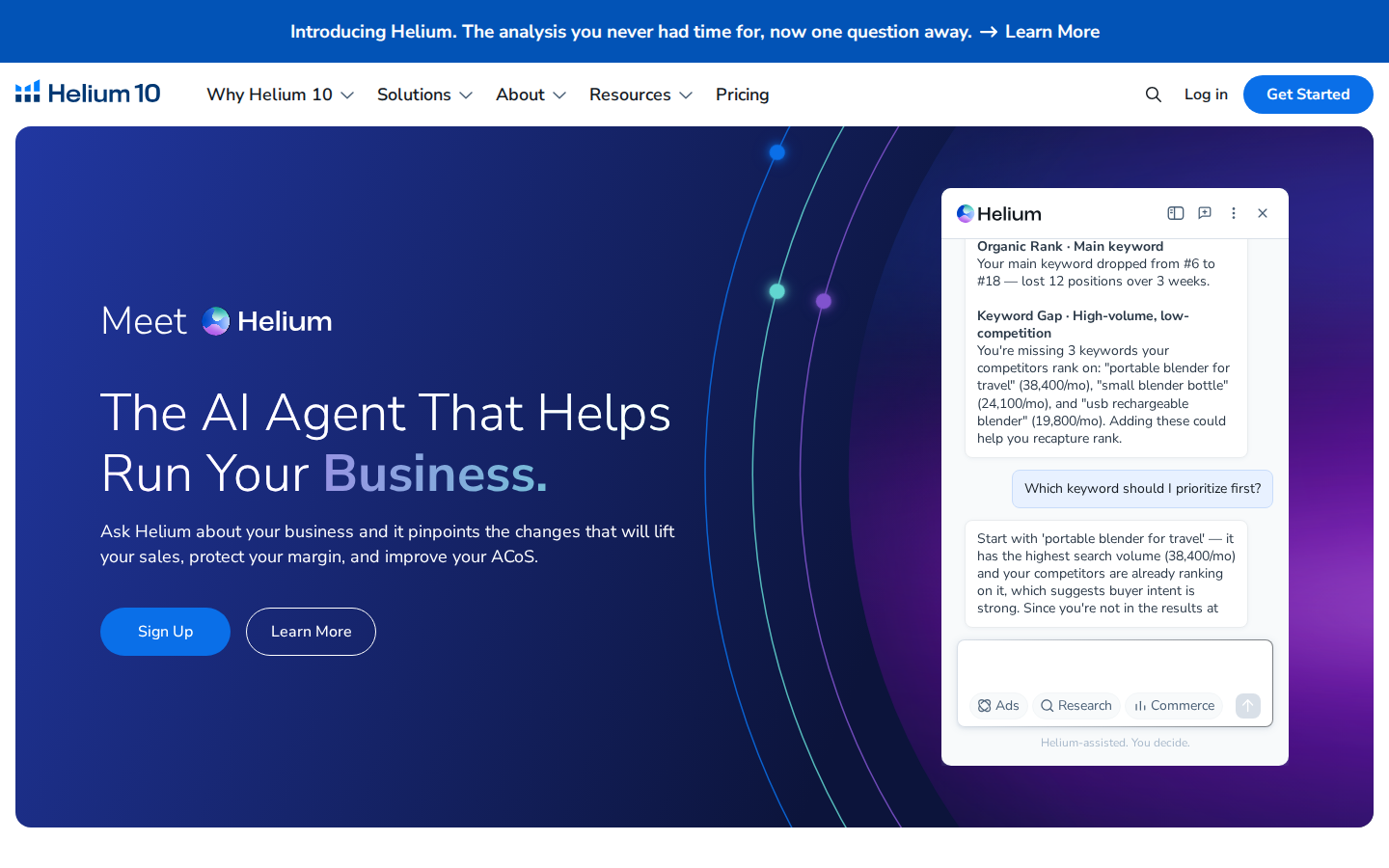
Helium 10
Sellers wanting a large all-in-one operations suite
$129/month or $99/month billed annually
Broad collection of research and operational tools
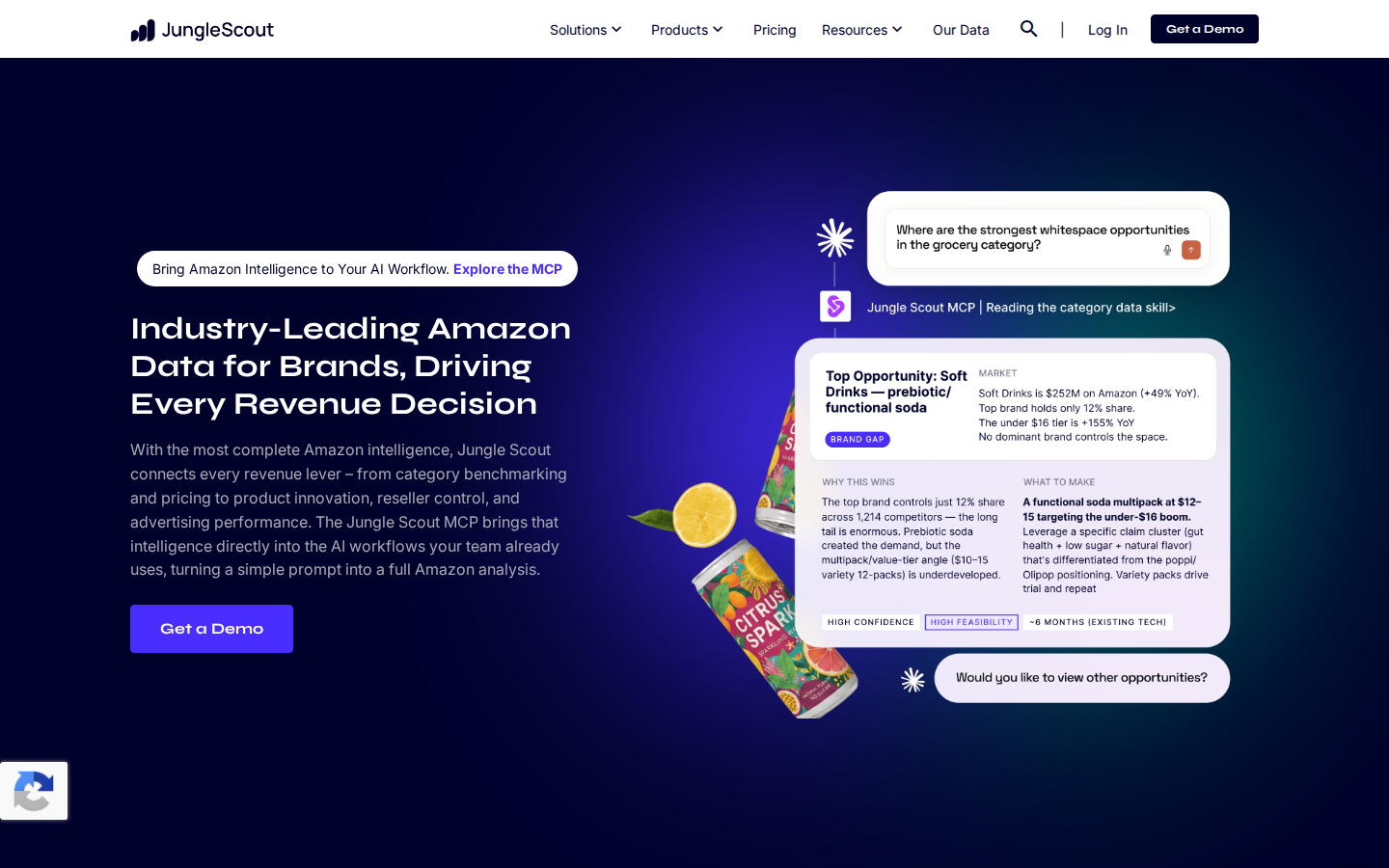
Jungle Scout
New and growing private-label sellers
Varies by plan and billing term
Product discovery, launch workflows, and seller education
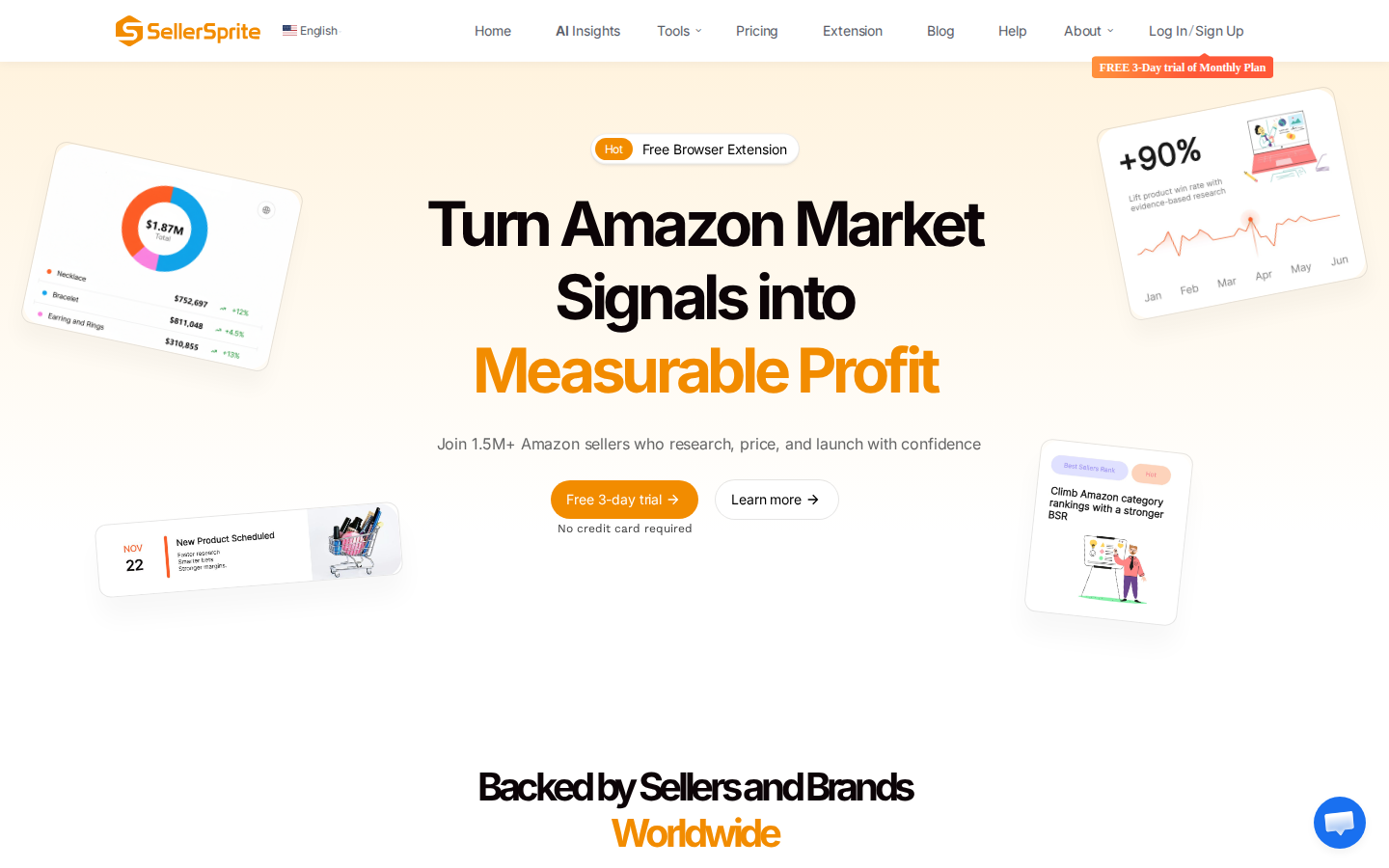
SellerSprite
Keyword-focused sellers and international marketplace research
Varies by plan and region
Keyword mining, reverse ASIN research, and marketplace coverage
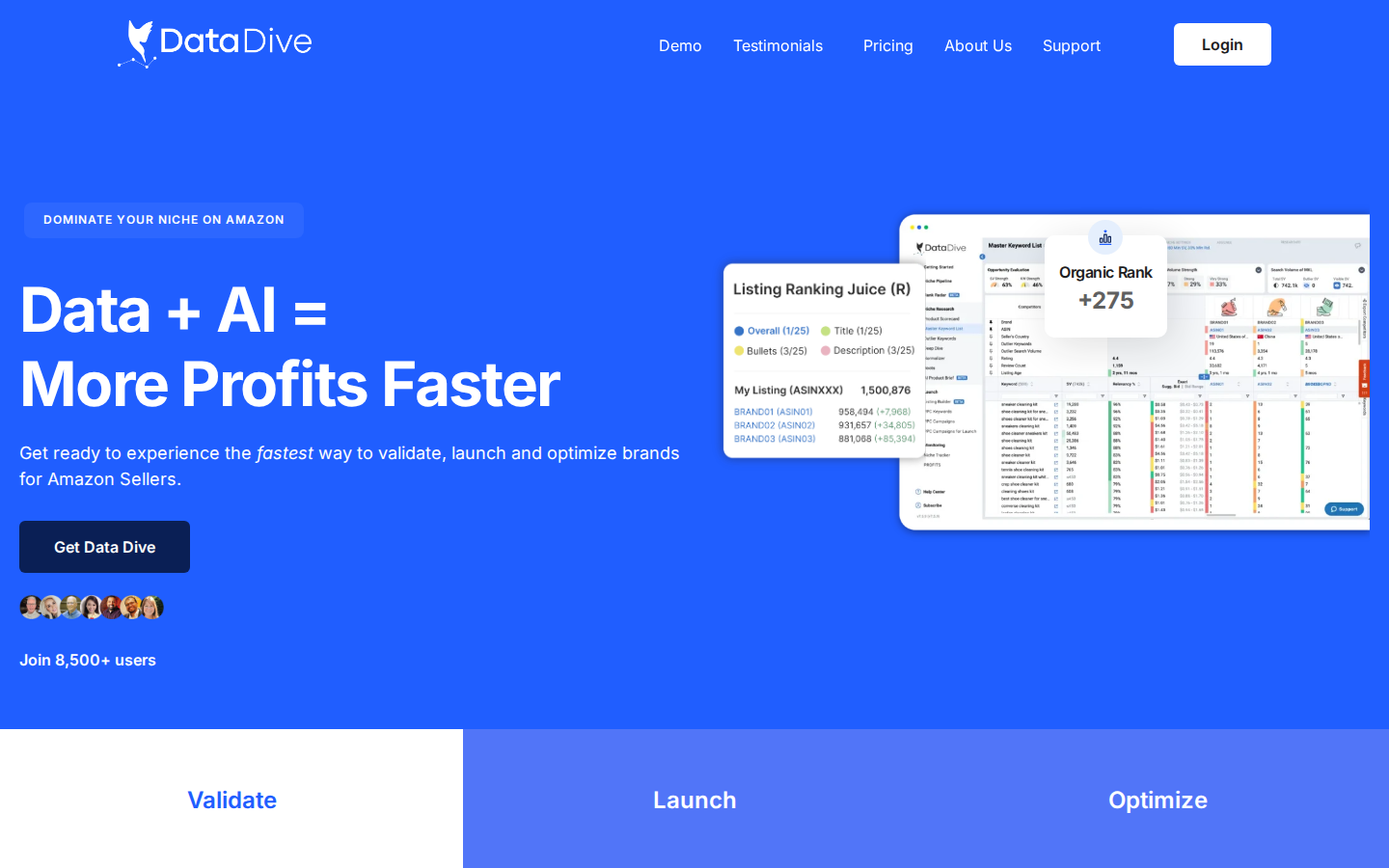
Data Dive
Private-label sellers focused on product development and listing optimization
$39/month or $32/month billed annually
Niche validation, keyword analysis, and listing workflows
*Pricing is based on publicly listed U.S. pricing in September 2026 and can change. Compare current features, limits, and billing terms before subscribing.
1. SmartScout: Best Overall SoldScope Alternative for Market Intelligence
SmartScoutis the best SoldScope alternative for sellers who want to move from researching individual products to understanding entire brands, sellers, niches, and categories.
SoldScope and SmartScout overlap in several practical areas. Both provide tools for Amazon product and keyword research, sales estimation, competitor analysis, and listing-related workflows. The biggest difference is the level at which they are designed to analyze the marketplace.
SmartScout connects product data to a wider competitive picture. Users can research millions of products, examine brands and their catalogs, identify third-party sellers, compare subcategory market share, analyze keyword visibility, and see how traffic connects competing listings. That makes it especially useful for established Amazon sellers, wholesale teams, agencies, aggregators, and brands making category-level decisions.
SmartScout pricing compared with SoldScope
SoldScope is less expensive at the entry level. Its Starter plan is listed at $29 per month or $24 per month billed annually. SmartScout Basic is listed at $49 per month or $29 per month billed annually.
That five-dollar difference between the annual entry plans is important. SoldScope still wins on absolute price, but SmartScout has a genuine budget plan for sellers who do not need its more advanced brand, seller, and category datasets. SmartScout Basic includes product-level research, keyword research, the Product Research Extension, review automation, a price-list scanner, and sales estimates.
SmartScout also offers more expensive plans for teams that need deeper data. Essentials is listed at $119 monthly or $99 per month billed annually, while Business is $299 monthly or $239 per month billed annually. Those are meaningful software expenses, but the comparable upper self-serve pricing is still below Helium 10 Diamond, which is listed at $359 monthly or $279 per month billed annually.
The practical takeaway is simple:
Choose SoldScope when minimizing software cost is the overriding priority.
Choose SmartScout Basic when you want an affordable starting point with a path into a much deeper market-intelligence platform.
Choose SmartScout Essentials or Business when brand, seller, category, market-share, or broader competitive analysis will influence real decisions.
Where SmartScout stands out
Product, keyword, brand, seller, and category-level research
Brand and subcategory market-share analysis
Seller databases, seller history, and catalog research
Rank Maker for reverse ASIN and keyword strategy
Traffic Graph for understanding the competitive landscape around search terms and products
Historical product, pricing, review, offer, and sales-rank data
TikTok Shop research included across current plans, with deeper access by tier
Higher-level tools such as Share of Voice, Ad Spy, custom dashboards, and alerts for qualifying plans
Where SoldScope may be better
Lower entry price
A straightforward toolkit for a solo seller with lighter research needs
Higher included focus on certain operational features at a low price, depending on the plan
Best for: Sellers, brands, agencies, wholesale teams, and marketplace professionals who want competitive context—not just a shortlist of products.
2. Helium 10: Best for a Broad All-in-One Seller Suite
Helium 10 is one of the best-known SoldScope competitors. It combines product research, reverse ASIN keyword research, listing optimization, rank tracking, financial dashboards, inventory management, review requests, reimbursement services, advertising features, and education.
Its breadth is the main attraction. A seller who wants one platform touching research, launch, operations, and advertising may prefer Helium 10 over a more specialized market-intelligence product.
That breadth comes with a higher price. Helium 10 currently lists Platinum at $129 monthly or $99 per month billed annually. Diamond is listed at $359 monthly or $279 per month billed annually, with some advanced capabilities or higher limits available as add-ons. This makes SoldScope's criticism that Helium 10 can feel expensive understandable, especially for a new seller who will use only a fraction of the suite.
SmartScout sits between these positions. Its $29-per-month annual Basic plan is much closer to SoldScope's budget pricing, while its higher plans offer deeper market research without reaching Helium 10 Diamond's current price.
Where Helium 10 stands out
Large suite covering much of the Amazon seller lifecycle
Well-known keyword tools such as Cerebro and Magnet
Listing creation and optimization workflows
Connected-account tools for profits, inventory, and operations
Advertising automation on qualifying plans
Extensive seller education
Where SoldScope may be better
Much lower cost for basic seller research
Less risk of paying for a large suite of tools you rarely use
Simpler choice for sellers who primarily need core research and tracking
Best for: Active private-label sellers who want a broad operations platform and expect to use many parts of it.
3. Jungle Scout: Best for Guided Product Research and Launches
Jungle Scout remains a recognizable option for Amazon sellers researching products and launching private-label brands. Its seller offering focuses on demand validation, keyword research, competitive analysis, listing optimization, rank tracking, and launch support. Jungle Scout also separates its seller-focused Catalyst product from Cobalt, its higher-end platform for established brands and enterprise teams.
Compared with SoldScope, Jungle Scout may appeal to beginners who value education, a familiar research workflow, and a platform organized around moving from product idea to launch. SoldScope may be more attractive when subscription cost and access to a wide list of individual tools are the primary considerations.
Where Jungle Scout stands out
Established product-research workflow
Product discovery and sales-estimation tools
Supplier and launch resources
Training content for newer sellers
A separate enterprise platform for deeper market and brand intelligence
Where SoldScope may be better
Aggressive entry-level pricing
Useful free tools that can be tested before paying
A broad collection of tactical utilities for smaller sellers
Best for: New or growing private-label sellers who want structured product discovery and launch support.
4. SellerSprite: Best for Deep Keyword Research Across Marketplaces
SellerSprite is a strong SoldScope alternative for sellers whose workflow revolves around keywords, reverse ASIN research, competitor traffic, product tracking, and international Amazon marketplaces.
Its toolkit includes product research, category insights, keyword mining, reverse ASIN searches, traffic comparison, keyword conversion-rate data, listing tools, review analysis, and product and keyword monitoring. SellerSprite also offers a free browser extension and supports multiple Amazon marketplaces.
SellerSprite can be data-dense, which experienced researchers may appreciate but newer sellers may find less intuitive. SoldScope's cleaner low-cost proposition may make more sense for someone who wants a simpler set of everyday tools.
Where SellerSprite stands out
Detailed keyword-mining and reverse ASIN workflows
Research across multiple Amazon marketplaces
Competitor traffic and advertising insights
Product, keyword, and new-listing tracking
Free tools and browser extension
Where SoldScope may be better
Simpler positioning for a beginning seller
Transparent, easy-to-understand entry pricing
A balanced toolkit beyond keyword research
Best for: Keyword-heavy researchers, international sellers, and users comfortable working with dense datasets.
5. Data Dive: Best for Private-Label Product Development
Data Dive is more specialized than SoldScope. It is built around niche validation, competitor keyword analysis, product development, listing optimization, rank tracking, and PPC launch workflows.
Its Starter plan is currently listed at $39 monthly or $32 per month billed annually. That is still above SoldScope's entry plan, but it is reasonably close for sellers who specifically want Data Dive's research methodology and listing-development workflow. Higher tiers increase research limits, tracked keywords, collaboration, and PPC capabilities.
Data Dive is less of a general toolbox and more of a guided system for private-label research and optimization. That focus is a benefit if it matches your business model and a limitation if you need seller, wholesale, or market-share intelligence.
Where Data Dive stands out
Structured niche and competitor analysis
Keyword-root and listing optimization workflows
Product briefs and AI-assisted copywriting
Rank tracking and PPC campaign tools
Collaboration features on higher tiers
Where SoldScope may be better
Lower entry price
Broader collection of general seller utilities
Better fit for users who do not need a private-label product-development system
Best for: Private-label sellers validating niches, developing products, and building keyword-driven listings.
How to Choose the Best SoldScope Alternative
Start with the decision you are trying to make—not the length of the feature list.
Choose SmartScout if you need to understand the wider market
SmartScout is the strongest choice when your questions involve brands, sellers, categories, market share, traffic relationships, or competitive positioning. The Basic plan keeps the initial cost approachable, while the higher plans provide room for a growing operation.
Choose Helium 10 if you want one large operational suite
Helium 10 makes sense when product research, listings, inventory, financial tracking, education, and advertising all need to live in one ecosystem—and you will use enough of those features to justify the price.
Choose Jungle Scout if you want a guided path from idea to launch
Jungle Scout is a practical fit for newer private-label sellers who want familiar product-discovery workflows and seller education.
Choose SellerSprite if keyword depth and international research matter most
SellerSprite is worth evaluating when detailed keyword datasets, reverse ASIN workflows, and research across several Amazon marketplaces drive your process.
Choose Data Dive if you have a focused private-label workflow
Data Dive is a good option when you want a repeatable system for validating niches, creating product briefs, optimizing listings, and planning PPC.
Stay with SoldScope if price is the deciding factor
SoldScope is not a bad product simply because alternatives exist. Its biggest strength is legitimate: a wide feature set at a low entry price. A new or part-time seller may not need to pay more until the limits of that toolkit begin to affect decisions.
Final Verdict
The best overall SoldScope alternative is SmartScout for sellers and teams that want a fuller picture of Amazon competition. It costs slightly more than SoldScope at the entry level, but the annual Basic plan keeps the gap small: $29 per month for SmartScout versus $24 per month for SoldScope at current listed prices.
SmartScout also offers something important as a business grows: a clear path from product research into brand, seller, category, market-share, and cross-marketplace intelligence. Its advanced plans are not cheap, and we would not pretend otherwise. However, they remain below Helium 10's current comparable upper self-serve pricing while serving a different, more market-intelligence-oriented use case.
If you are choosing primarily on price, SoldScope deserves serious consideration. If you want software that can help you understand not only what a product is doing but also who is winning the market and why, try SmartScout.
FAQs
5 Best SoldScope Alternatives for Amazon Sellers in 2026
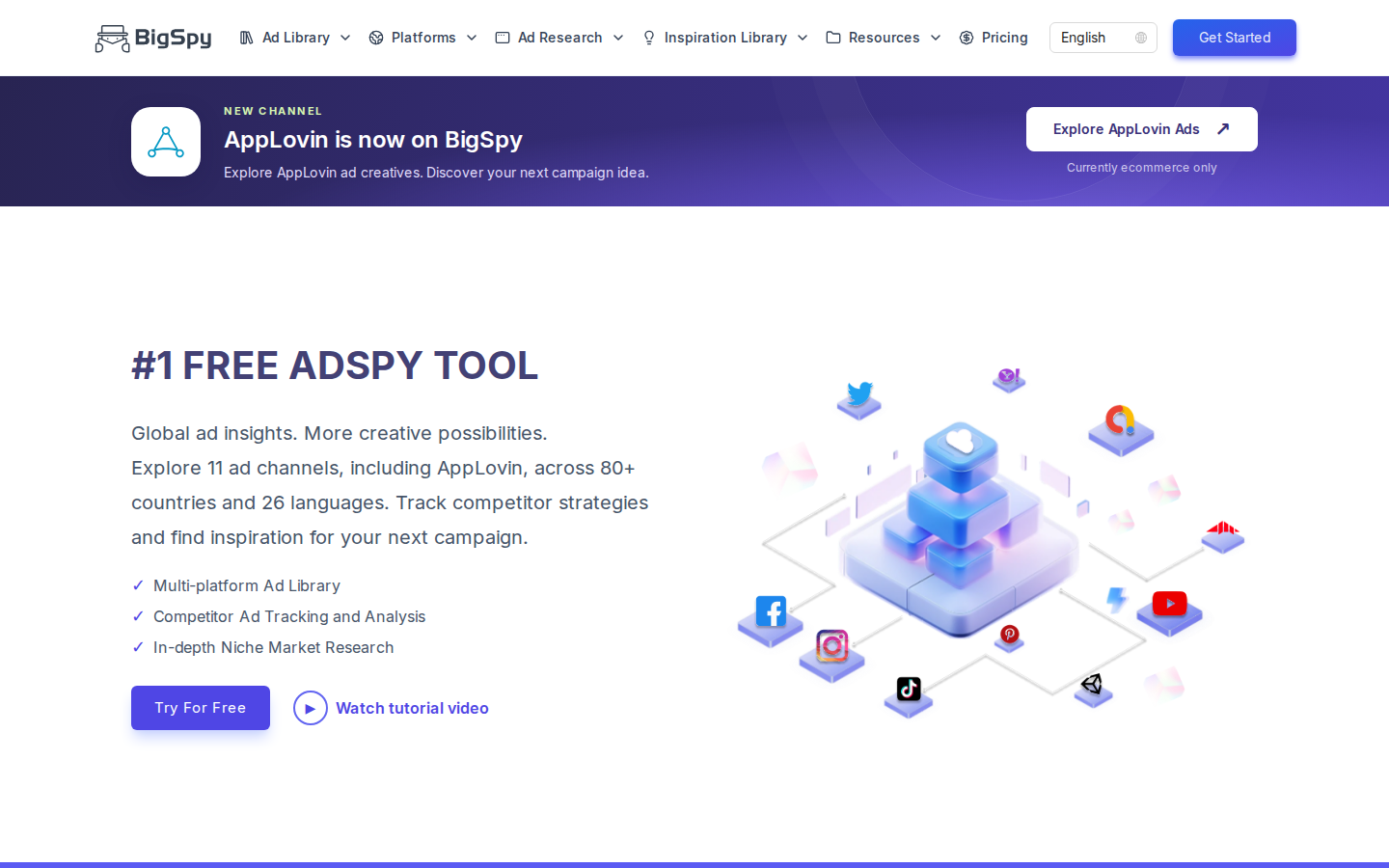
PiPiADS is an advertising-intelligence and ecommerce product-research platform. It helps marketers search TikTok and Facebook ads, track advertisers, research TikTok Shop products and stores, study competitor creatives, and identify products showing strong paid-promotion signals.
That makes PiPiADS useful for performance marketers, dropshippers, media buyers, and creative strategists. Its TikTok Shop tools connect products and stores with ad activity, estimated spend, exposure, conversions, orders, scripts, hooks, and creative formats.
But paid ads are only one part of ecommerce intelligence.
Brands may need category market share, product concentration, creator performance, or cross-marketplace demand. Agencies may require deeper TikTok Shop coverage across shops, livestreams, and international regions. Dropshippers may want multi-platform sourcing tools, while some creative teams only need a large ad library at a lower level of complexity.
We compared five strong PiPiADS alternatives across those different jobs. SmartScout ranks first for TikTok Shop market intelligence and cross-marketplace analysis, but this guide also explains when FastMoss, Kalodata, Minea, BigSpy—or PiPiADS itself—may be the better fit.
Quick answer: SmartScout is the best PiPiADS alternative for brands and agencies that need category sizing, market share, shop analysis, product momentum, and creator performance across TikTok Shop, Amazon, and Walmart. FastMoss is stronger for broad TikTok-native and livestream research, Kalodata for product and creator discovery, Minea for multi-platform dropshipping and ad research, and BigSpy for a broad, accessible creative library.
PiPiADS Alternatives at a Glance
Platform
Best for
Key strength
Important tradeoff
SmartScout
Brands and agencies making market-level decisions
TikTok Shop category intelligence plus Amazon and Walmart research
Not a dedicated multi-network ad library
FastMoss
TikTok-first operators and live-commerce teams
Products, shops, creators, videos, ads, livestreams, regions, and history
Large feature set can require more time and budget
Kalodata
Product, creator, and affiliate teams
Product discovery connected with creators, shops, content, ads, and live commerce
Primarily TikTok-focused rather than cross-marketplace
Minea
Dropshippers researching ads and sourcing products
TikTok and Meta ad research tied to products, shops, and suppliers
Dropshipping orientation may not fit established marketplace brands
BigSpy
Creative teams seeking broad ad inspiration
Large multi-platform ad library, flexible filters, and free access
Less focused on complete TikTok Shop market structure
1. SmartScout: Best PiPiADS Alternative for TikTok Shop Market Intelligence
SmartScout is the best PiPiADS alternative for teams that need to decide which markets are worth entering, not only which ads appear to be working.
PiPiADS begins with advertising and creative activity. SmartScout begins with the marketplace. Its TikTok Shop analytics cover categories, shops, products, creators, affiliates, videos, and trends. Teams can examine estimated shop revenue, product momentum, category size, market share, product concentration, creator activity, and competitive intensity.
That distinction matters because advertising activity can validate attention without proving that the underlying market is attractive. A product may have several successful ads while competing in a category already dominated by a few shops. Another product may receive less paid promotion but sit inside a rapidly expanding category with more room for a new brand.
SmartScout helps users evaluate the market behind the creative signal.
Its other major advantage is cross-marketplace intelligence. SmartScout supports research across Amazon, TikTok Shop, and Walmart. A brand can investigate a TikTok Shop trend, measure the surrounding category and competitors, then evaluate related demand and marketplace position on Amazon instead of treating each channel as an isolated business.
Product momentum, velocity, creator attention, and repeat video-driven performance
Creator and affiliate analysis based on commerce activity
White-space opportunity research for finding markets where demand may outpace competition
Marketplace intelligence across Amazon, TikTok Shop, and Walmart
TikTok Shop analytics included with every SmartScout plan
Where SmartScout may not be the best fit
If your daily job is to search millions of ad creatives, study scripts and hooks, and build paid-social campaigns, PiPiADS may remain the better specialist. Minea and BigSpy are also more direct alternatives for multi-platform ad discovery.
FastMoss may be better for teams that require extensive livestream analysis or the broadest TikTok-native research environment. SmartScout is strongest when category strategy, competitor share, product opportunity, and cross-marketplace context are the priority.
Best for: Brands, agencies, Amazon sellers expanding to TikTok Shop, Walmart marketplace teams, and ecommerce leaders allocating inventory and marketing resources across channels.
Verdict: Choose SmartScout when the question is larger than “Which ad should we copy?” and includes “How large is this market, who controls it, and where can we actually win?”
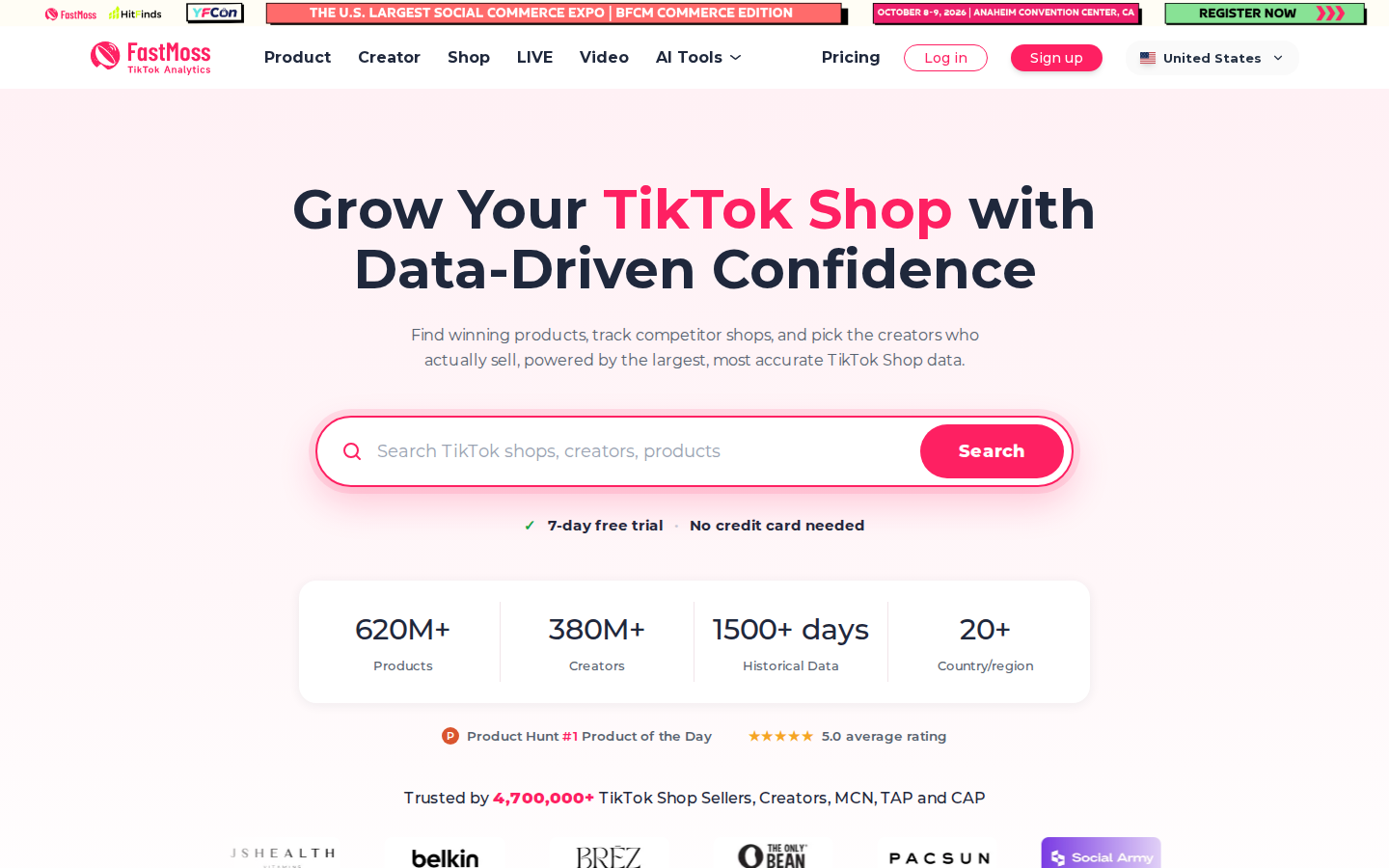
2. FastMoss: Best for Broad TikTok Shop and Livestream Research
FastMoss is a strong PiPiADS alternative for teams that want advertising intelligence inside a much broader TikTok Shop research platform.
FastMoss covers products, competitor shops, creators, ads, videos, and livestreams across more than 20 countries or regions. It also advertises a large product and creator database and more than 1,500 days of historical data.
Compared with PiPiADS, FastMoss places more emphasis on the entire TikTok commerce ecosystem. Users can research products and creatives, but they can also analyze shops, evaluate creators, monitor live sessions, compare regions, and study longer-term performance.
FastMoss strengths
Broad coverage across TikTok Shop products, shops, creators, ads, videos, and livestreams
Strong competitor-shop and creator-vetting workflows
Livestream research for markets where live commerce drives significant sales
Multi-region coverage for international operators
Long historical windows for seasonality and trend analysis
Developer and AI options for advanced workflows
FastMoss limitations
FastMoss can be more platform than an ad buyer needs. Teams focused strictly on finding creatives may get to answers faster with PiPiADS, Minea, or BigSpy. It is also TikTok-centered, while SmartScout provides stronger context across Amazon, TikTok Shop, and Walmart.
Best for: TikTok-first agencies, experienced sellers, international operators, creator teams, and live-commerce businesses.
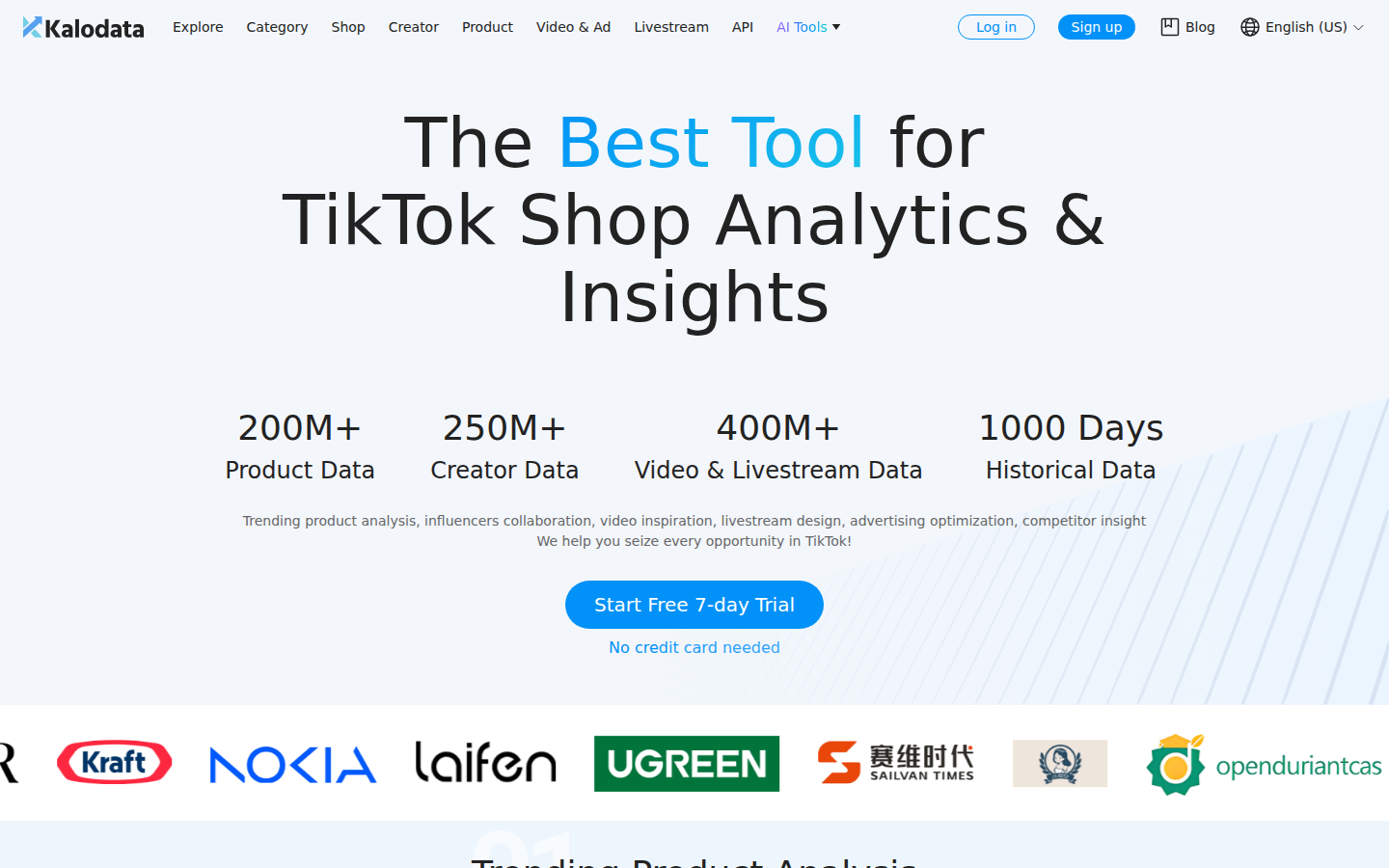
3. Kalodata: Best for Product Discovery and Creator Analysis
Kalodata is another strong PiPiADS competitor for TikTok Shop sellers who care more about products and creators than about building a broad cross-network ad library.
Kalodata covers categories, products, shops, creators, videos, advertising, and livestreams. Teams can use it to discover products, examine competitor shops, connect creator activity with commerce signals, study successful content, and evaluate live selling.
Where PiPiADS uses paid promotion as a central discovery signal, Kalodata offers a more balanced TikTok Shop workflow across products, creators, content, shops, and sales estimates.
Kalodata also states that its transaction and ad-spend figures are modeled from public-channel data and may differ from actual values. It recommends against using estimates for high-precision tasks such as commission settlement. The same caution should apply to every third-party platform in this category.
Kalodata strengths
Product, creator, shop, category, video, ad, and livestream research
Strong product-discovery and affiliate-partner workflows
Content and creator research connected with commerce signals
Historical data for evaluating performance over time
TikTok-native experience built around seller and brand decisions
Kalodata limitations
Kalodata is not primarily a general ad-spy platform across many networks. It may be less useful than PiPiADS, Minea, or BigSpy for teams managing both TikTok and Meta creative research. Brands needing category-first intelligence across several marketplaces may prefer SmartScout.
Best for: TikTok Shop brands, sellers, agencies, affiliate managers, and creator-partnership teams.
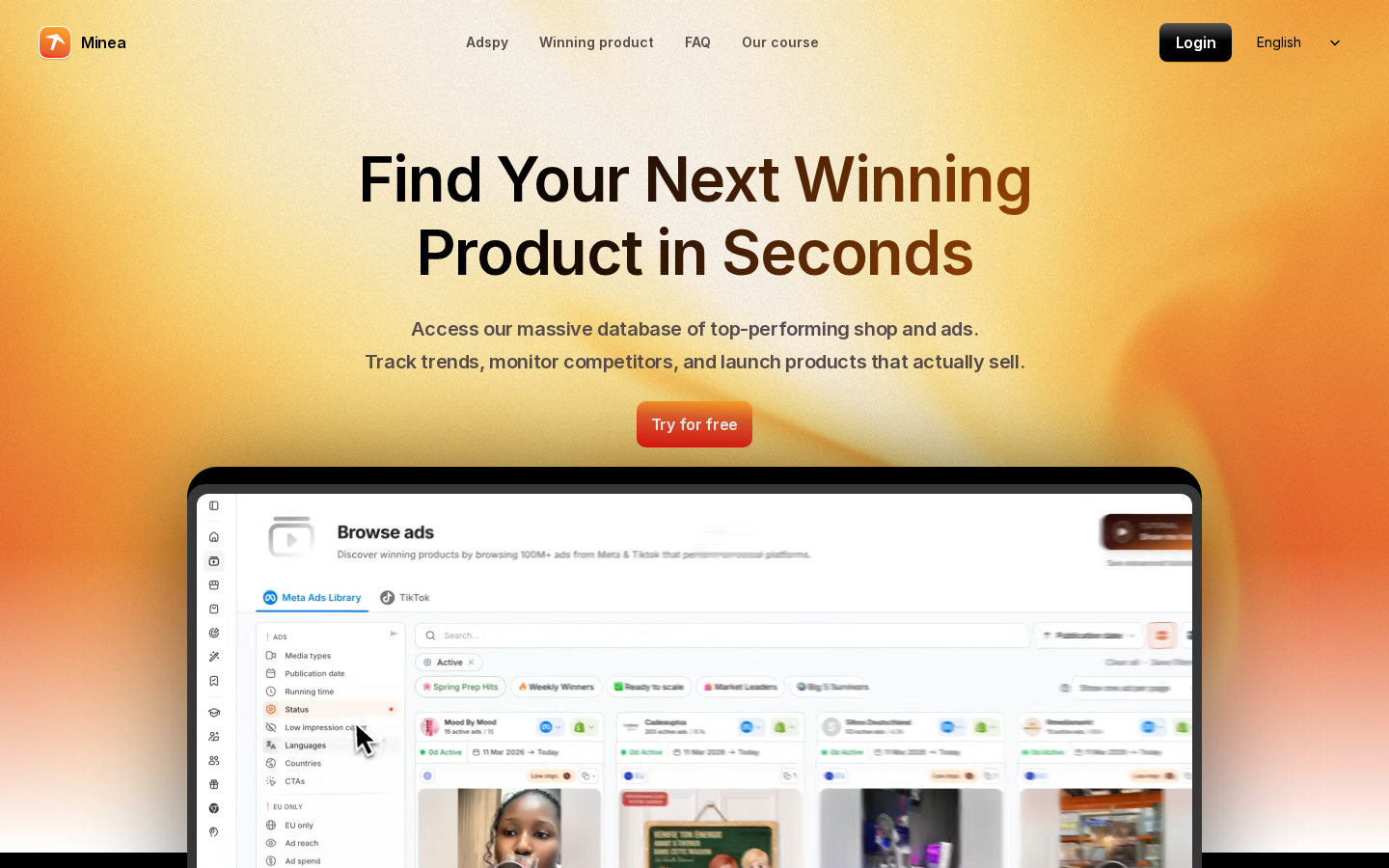
4. Minea: Best for Multi-Platform Dropshipping and Product Sourcing
Minea is one of the closest PiPiADS alternatives for dropshippers and ecommerce marketers who want ad research tied directly to product discovery and sourcing.
Its TikTok ad-spy tools support creative search, historical performance, competitor tracking, viral-signal detection, and filters by product or niche. Users can study hooks, video formats, music, duration, and creative angles, then connect the ad with product listings, stores, and potential suppliers.
Minea also covers Meta advertising and broader ecommerce research. That makes it useful for operators who discover a product on TikTok but plan to advertise or validate it across multiple social platforms.
Minea strengths
TikTok ad discovery with filters, competitor tracking, and historical signals
Creative analysis covering hooks, formats, sounds, duration, and angles
Product, shop, and supplier research connected with advertised products
Multi-platform workflow spanning TikTok and Meta advertising
Useful path from ad discovery to product sourcing and campaign launch
Minea limitations
Minea is heavily oriented toward dropshipping and rapid product sourcing. An established CPG brand, marketplace agency, or enterprise ecommerce team may care more about category share, competitor structure, creators, and durable market demand than sourcing a product seen in a viral ad.
Minea’s own comparison claims should also be treated as marketing rather than independent evidence. Test the platform using creatives and competitors you already know before relying on its viral or performance signals.
Best for: Dropshippers, ecommerce entrepreneurs, paid-social marketers, and teams moving from creative discovery to product sourcing.
5. BigSpy: Best for Broad and Accessible Ad Inspiration
BigSpy is a broad ad-intelligence platform for creative discovery and competitor research. It supports TikTok Shop ads, TikTok creative research, advertiser and domain analysis, popular and rising creative charts, ad copy research, and additional networks beyond TikTok.
BigSpy’s TikTok tools allow users to filter by keyword, advertiser, ad text, video subtitles, landing page, country, objective, engagement, duration, language, industry, and time period. The company says its TikTok dataset spans more than 70 countries or regions and includes millions of ad assets.
It also provides a free version, making it a practical place for a small creative team to collect examples and explore ad patterns before purchasing a more specialized platform.
BigSpy strengths
Broad creative library across TikTok and other advertising platforms
Flexible search across ad text, subtitles, advertisers, domains, and landing pages
Popular, rising, and new-creative discovery
Filters for geography, objective, engagement, duration, language, industry, and time
Free access for basic creative research
BigSpy limitations
BigSpy is strongest as an ad library and creative-research system. It does not replace TikTok Shop category sizing, shop performance, creator sales analysis, livestream intelligence, or cross-marketplace market share.
Creative metrics such as likes, comments, shares, and estimated impressions are useful signals, but they do not reveal margin, return rates, fulfillment quality, or actual profitability.
Best for: Creative strategists, media buyers, agencies, SaaS marketers, app marketers, and ecommerce teams seeking broad ad inspiration.
Is PiPiADS Still the Right Choice?
PiPiADS may remain the best option when advertising is the center of your TikTok Shop research process.
Its official platform combines ad search, advertiser research, tracking, image search, TikTok Shop products, stores, top-product lists, store monitoring, and creative analysis. It is built to help users connect a product with the ads, scripts, hooks, advertiser behavior, and estimated performance behind it.
Stay with PiPiADS if:
Your team spends most of its research time studying TikTok and Facebook ads.
You want product and store discovery closely connected with paid-promotion signals.
Creative hooks, scripts, formats, landing pages, and advertiser tracking drive your workflow.
You operate in dropshipping or performance marketing, where testing speed matters more than category strategy.
PiPiADS already covers the networks, countries, filters, and history your team needs.
An alternative makes more sense when advertising data is only one input into a larger market, product, creator, or channel decision.
How to Choose the Best PiPiADS Alternative
Choose SmartScout for TikTok Shop category sizing, market share, shops, products, creators, trends, and unified Amazon and Walmart intelligence.
Choose FastMoss for deep TikTok-native analysis, livestreams, international coverage, and longer historical research.
Choose Kalodata for product discovery and creator analysis inside a broad TikTok Shop workflow.
Choose Minea for TikTok and Meta ad research tied to dropshipping products, stores, and supplier discovery.
Choose BigSpy for a broad, accessible ad library and multi-platform creative inspiration.
Stay with PiPiADS when detailed ad, advertiser, creative, store, and product research is the primary job.
A Note About Ad and TikTok Shop Data Accuracy
Third-party platforms generally collect public signals and use proprietary models to estimate impressions, sales, conversions, spend, orders, and attribution. These values are directional—not audited campaign or financial data.
Ad activity can help validate demand, but it has important limits:
A long-running ad does not prove the campaign is profitable.
High engagement does not guarantee purchases.
Estimated spend and conversion figures may differ materially from the advertiser’s actual results.
A winning creative can be difficult to reproduce without the same offer, audience, brand trust, landing page, inventory, and fulfillment.
A product can perform in paid social while competing in an unattractive or saturated category.
Use first-party TikTok Ads Manager and Seller Center data for your own exact performance. Use PiPiADS and its alternatives for competitive research, creative inspiration, product discovery, and market signals that first-party analytics cannot show.
Final Recommendation
PiPiADS is a credible specialist for marketers who want to connect TikTok Shop products and stores with ads, advertisers, scripts, hooks, and paid-promotion signals.
But when the decision requires category market share, competitive concentration, shop performance, creator activity, and connections between TikTok Shop and other marketplaces, SmartScout is the strongest PiPiADS alternative.
Explore SmartScout TikTok Shop Analytics to research shops, products, categories, creators, affiliates, videos, and emerging opportunities alongside Amazon and Walmart intelligence.
FAQs
5 Best PiPiADS Alternatives for TikTok Shop and Ad Research in 2026
Lorem ipsum dolor sit amet, consectetur adipiscing elit, sed do eiusmod tempor incididunt ut labore et dolore magna aliqua. Ut enim ad minim veniam, quis nostrud exercitation ullamco laboris nisi ut aliquip ex ea commodo consequat. Duis aute irure dolor in reprehenderit in voluptate velit esse cillum dolore eu fugiat nulla pariatur.
Lorem ipsum dolor sit amet, consectetur adipiscing elit, sed do eiusmod tempor incididunt ut labore et dolore magna aliqua. Ut enim ad minim veniam, quis nostrud exercitation ullamco laboris nisi ut aliquip ex ea commodo consequat. Duis aute irure dolor in reprehenderit in voluptate velit esse cillum dolore eu fugiat nulla pariatur.
Lorem ipsum dolor sit amet, consectetur adipiscing elit, sed do eiusmod tempor incididunt ut labore et dolore magna aliqua. Ut enim ad minim veniam, quis nostrud exercitation ullamco laboris nisi ut aliquip ex ea commodo consequat. Duis aute irure dolor in reprehenderit in voluptate velit esse cillum dolore eu fugiat nulla pariatur.






.png)