

DataDive excels at helping Amazon sellers build custom niches and analyze competing products and keywords. When shopping for an alternative, keeping that specific strength in mind ensures you don't trade away the core functionality your business relies on.
While SmartScout covers that custom niche workflow through Custom Segments, it also gives you brand-level subcategory data to see the bigger market picture. Other platforms, such as Helium 10 and Jungle Scout, take different approaches to keyword research and product discovery.
Here is a fair comparison of the top DataDive alternatives to help you choose the right fit for your Amazon business.
DataDive’s custom niche workflow lets you select competing ASINs and organize research around that group. Its Niche Pipeline helps users manage their research, assign work, and organize niches by project or priority. That is useful when your real competitors do not fit neatly into a single Amazon category. See DataDive’s niche workflow.
Its wider toolkit includes keyword research, listing optimization, product evaluation, PPC campaign building, and rank monitoring. For a private label seller working from an idea toward a launch, that combination connects research with execution. Explore DataDive’s features and plans.
If you already know which products compete with yours and want to turn that research into a keyword and listing strategy, DataDive belongs on your shortlist.
The question is what else your research needs to cover.
These are our assessments of the platforms’ practical uses, based on their published capabilities. They are not rankings of data accuracy.
SmartScout is especially relevant when you need both a precisely defined niche and a broader understanding of the market around it.
A chosen competitor set can answer an important question: how do these products compare? Subcategory analysis helps you investigate another: what else should be in the conversation?
SmartScout’s Custom Segments let you group products according to the way your business defines a market. That can include product attributes, price positioning, ingredients, form factor, or parent brand. You are not limited to treating every product in an Amazon subcategory as an equally relevant competitor. Learn about SmartScout Custom Segments.
For example, a brand researching shampoo might want to focus specifically on solid shampoo bars. A broad hair care category would include many products that are less relevant to that decision. Defining the segment carefully makes the resulting comparison more useful.
DataDive deserves credit for custom niche research. SmartScout gives buyers another way to approach that need, alongside its broader market analysis tools.
Subcategory analysis is one of SmartScout’s strongest capabilities. It helps sellers and brands investigate related markets, examine competing products and brands, and identify areas worth researching for expansion. Explore SmartScout’s subcategory research.
That matters because a manually selected niche depends on the products you already know to include. Starting with a wider view can help challenge those assumptions.
Suppose you are considering a new product in an established category. Before settling on your closest competitors, it is useful to ask:
Custom Segments and subcategory analysis serve complementary purposes. One sharpens the scope of your research; the other helps you understand its context.
A niche becomes more informative when you can investigate the businesses participating in it. SmartScout connects brand, seller, subcategory, and product research, including brand revenue estimates and category positioning. Explore SmartScout’s research platform.
For a brand, that can support a closer look at a competitor’s assortment. For an agency, it can help frame a client’s position within a market. For a seller, it can broaden the investigation beyond the handful of products that first appeared in a search.
Consider two hypothetical niches with similar estimated revenue. In one, sales are distributed across several independent brands. In the other, many leading products
belong to the same parent brand. Those situations could call for different launch strategies, even when the headline market size looks similar.
SmartScout also supports investigation of Amazon search positions and competitive advertising. AdSpy helps users research competitors’ sponsored placements and keywords, while Share of Voice provides historical advertising presence and estimated share of spend. See SmartScout’s competitive advertising workflow.
Those insights can help you identify where a competitor is visible and which searches deserve further investigation. They should inform your strategy alongside your own conversion rates, costs, and margins. Estimated competitor spend is not a direct view into someone else’s advertising account.
SmartScout’s TikTok Shop analytics adds shop revenue estimates, product trends, category sizing, and market share research. That is relevant when your growth decisions involve both Amazon and TikTok Shop. Explore TikTok Shop analytics.
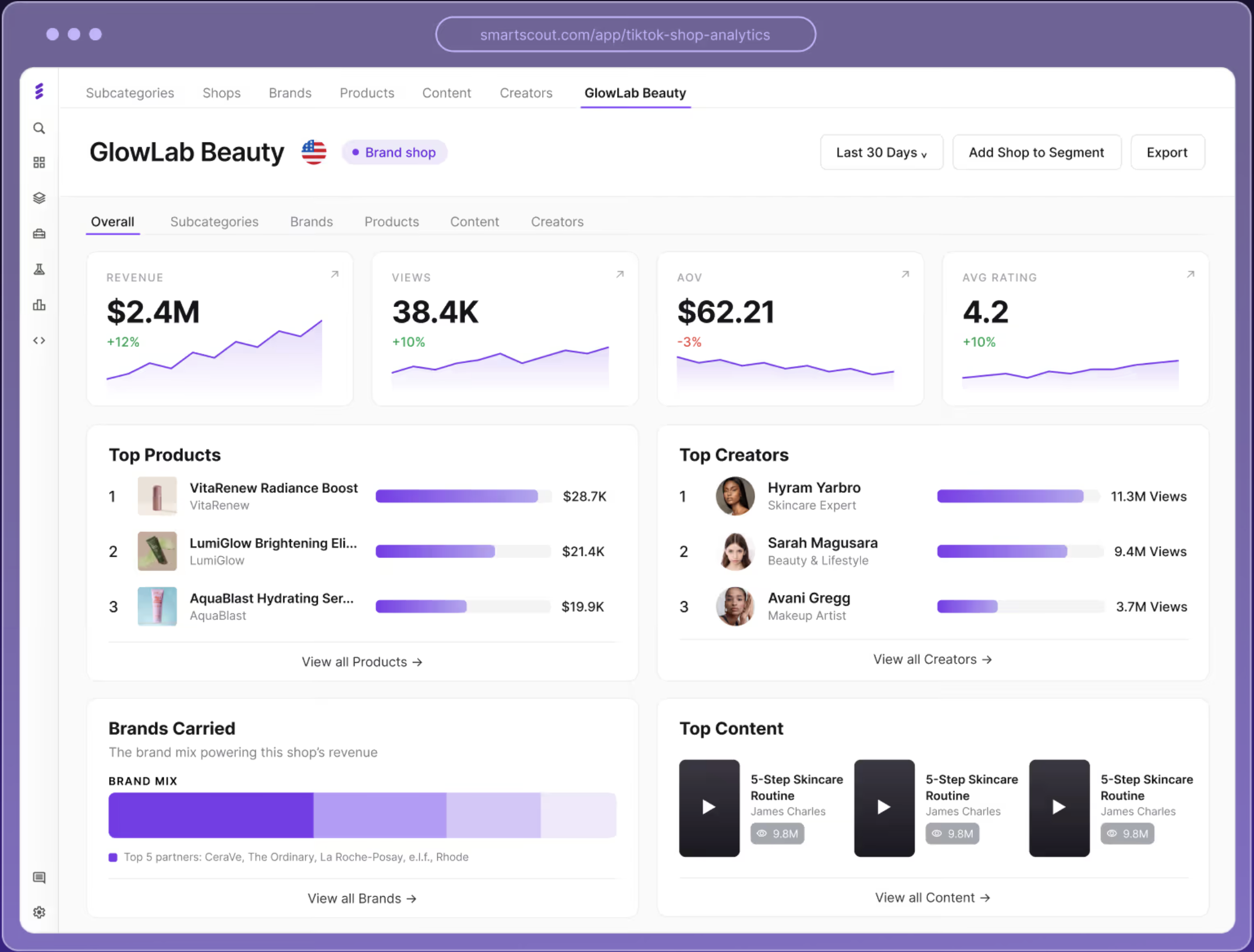
It gives your team another market to investigate when evaluating demand and competition. Cross-channel patterns can suggest questions to explore; they do not automatically prove that activity on one platform caused sales on another.
Choose SmartScout when: you want custom niche research plus substantial subcategory, brand, product, seller, and competitive advertising context.
Keep DataDive in consideration when: your main requirement is its particular workflow for turning a selected competitor group into keyword research, listing optimization, and launch preparation. Test that workflow directly rather than assuming the tools are interchangeable.
Helium 10 is worth considering when you want research and day-to-day seller tools from the same provider. Its offering includes product discovery, keyword research, keyword tracking, listing tools, and operational features.
Its Market Tracker supports custom market views based on keywords or ASINs. Market Tracker 360 adds broader category, brand, and product analysis. That means Helium 10 should also be evaluated for market research, rather than treated only as a keyword tool.

Choose Helium 10 when: the team researching opportunities also wants tools for executing and managing its Amazon business.
Buying consideration: compare the exact package. Standard Market Tracker and Market Tracker 360 are different offerings, and feature availability and limits matter more than the length of the overall tool list.
Jungle Scout’s Opportunity Finder is relevant when you are still deciding which niche to enter. It uses keyword-led research to help users investigate demand, competition, sales performance, and seasonal patterns. Users can also inspect leading products within an opportunity and add them to Product Tracker.
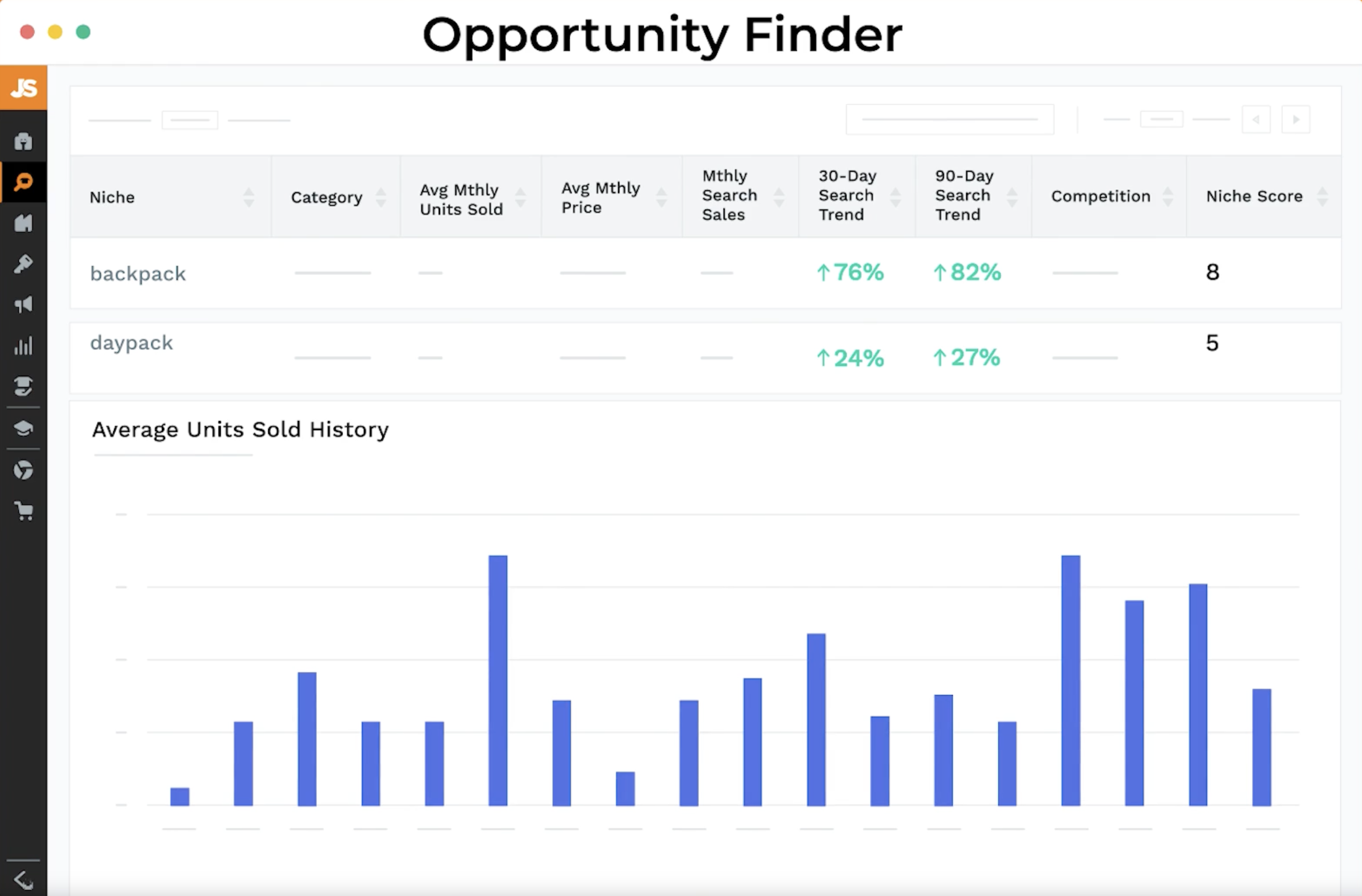
That makes it a useful candidate for a seller building a shortlist of product ideas and deciding which deserve deeper validation.
Choose Jungle Scout when: your immediate task is discovering and screening Amazon product opportunities.
Buying consideration: treat opportunity scores as screening aids. Before committing to a product, examine the underlying competitors, seasonality, costs, and differentiation. A promising score is a starting point for due diligence.
Both platforms support research around a defined competitive group. The useful distinction is how that research connects to the rest of your work.
DataDive is worth evaluating for its niche-to-keyword and listing workflow. SmartScout is worth evaluating for the combination of Custom Segments, subcategory analysis, and connected market intelligence.
To compare them fairly, use the same product idea in both tools. Create the competitor group you believe matters, then assess:
.jpg)
If you want to define your own niche and understand the larger market around it, try SmartScout. Custom Segments give your research focus; subcategory analysis helps you see where that focus fits.
Compare SmartScout plans to find the research capabilities that fit your business.
If you are researching Analytic Index alternatives, start with the questions your team needs to answer.
Are you measuring category market share on Amazon? Investigating competitors’ advertising?
Exploring TikTok Shop? Or monitoring product availability and content across a long list of retailers?
Those needs overlap, but they do not lead to the same software purchase.
This guide compares SmartScout, Stackline, Profitero+, and Helium 10 by their practical uses. As this is published on SmartScout, our primary focus is on our own platform. However, we will also highlight scenarios where a competitor's solution deserves a closer look.
Analytic Index provides retail search intelligence, digital shelf analytics, sales and market share insights, and promotional analysis. Its published coverage includes Amazon, Walmart, Target, Kroger, and Home Depot. It also offers curated reporting services for brands and agencies. Explore Analytic Index’s solutions.
That makes it relevant to teams evaluating organic and sponsored search alongside category performance across multiple retailers. If that breadth is central to your work, retailer coverage should be an early requirement when comparing alternatives.
These are our assessments of where each platform fits, based on its published capabilities. They are not rankings of data accuracy.
SmartScout is a strong alternative to evaluate when your priorities are understanding Amazon competition and identifying opportunities on TikTok Shop.
The core value is the ability to work at different levels of detail. Leadership may need a category and brand view. An ecommerce manager needs to understand the products behind that picture. A search specialist needs to investigate keywords and competitive visibility.
SmartScout supports those different questions within one platform.
A product’s growth becomes more useful when you understand the market around it.
Is the category expanding? Is one brand taking a larger share? Is a competitor’s performance concentrated in a few products?
SmartScout’s category market share and brand insights help teams put individual product performance into context. From that broader view, you can examine the products and keywords relevant to your investigation.
For example, a brand evaluating a new segment could use this approach to identify the leading competitors, inspect their assortments, and decide which products warrant deeper research. An agency could use it to prepare a category assessment before recommending a strategy to a prospective client.
SmartScout also helps teams examine where competitors appear in Amazon search and how they compete for sponsored visibility.
AdSpy supports research into competitors’ sponsored placements and keywords. Share of Voice adds historical advertising presence and estimated share of spend across selected keywords. These tools help answer practical questions: Which brands repeatedly appear on important searches? Where is sponsored competition increasing? Which terms deserve investigation? Read how SmartScout tracks competitor advertising.
Competitive spend estimates should be treated as estimates, not access to another company’s advertising account. Similarly, strong search visibility does not by itself establish profitability. The value is in identifying patterns and opportunities to test against your own results.
SmartScout’s TikTok Shop analytics adds shop revenue estimates, product trends, category sizing, and market share research. That gives brands and agencies another marketplace to evaluate when deciding where to expand or which competitors to investigate. Explore SmartScout’s TikTok Shop analytics.
For an Amazon brand considering TikTok Shop, useful starting questions include:
Having intelligence for both channels can support a more informed expansion discussion. It does not, by itself, prove that TikTok activity caused a change in Amazon sales.
SmartScout’s pricing is designed to make market research accessible to smaller sellers and brands while supporting larger organizations. Its enterprise offering includes options such as historical data, AdSpy, Share of Voice, and custom dashboards and alerts. Features and access depend on the package. Compare SmartScout plans.
For buyers considering Analytic Index, the overlap is meaningful: category and brand analysis, competitive advertising intelligence, and product and keyword research address many of the same business questions. Evaluate those capabilities against your actual workflow, data requirements, and budget.
Choose SmartScout when: Amazon and TikTok Shop insights are central to your work, and you want research that serves both strategic market analysis and detailed competitive investigation.
Look more closely at other options when: your main requirement is consistent reporting across retailers such as Walmart, Target, Kroger, and Home Depot. Coverage across those retailers is a different purchasing requirement from depth on Amazon and TikTok Shop.
Stackline’s Atlas product covers market share, competitor advertising, traffic, pricing, and product performance across retailers including Amazon, Walmart, and Target. Its broader platform also includes shopper analytics, forecasting, and advertising management products. Explore Stackline’s platform.
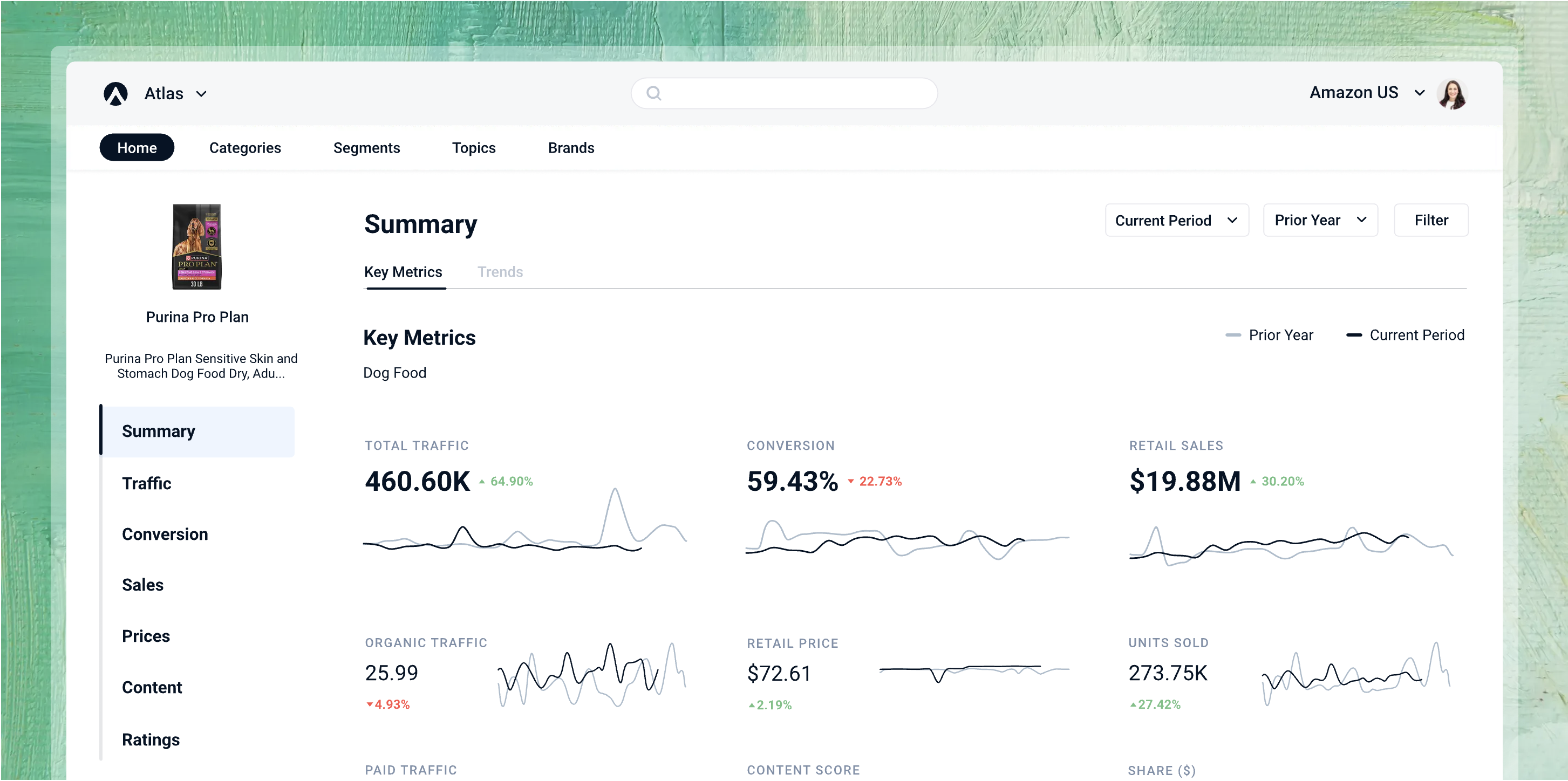
That makes Stackline worth evaluating when your organization wants competitive intelligence alongside shopper behavior analysis or other commerce workflows. For example, a brand might want to investigate its competitive position and also understand shopper retention or share of wallet.
Choose Stackline when: multiple retail teams need a broader combination of market, shopper, and commerce capabilities.
Buying consideration: ask which products are included in the proposal. A capability listed somewhere in a vendor’s platform is not necessarily included in the package you are purchasing.
Profitero+ is particularly relevant to brands managing the quality and availability of their retail presence. Its digital shelf offering covers areas including search visibility, product content, pricing, stock availability, and ratings and reviews across a broad retailer network. Explore Profitero+ Digital Shelf.
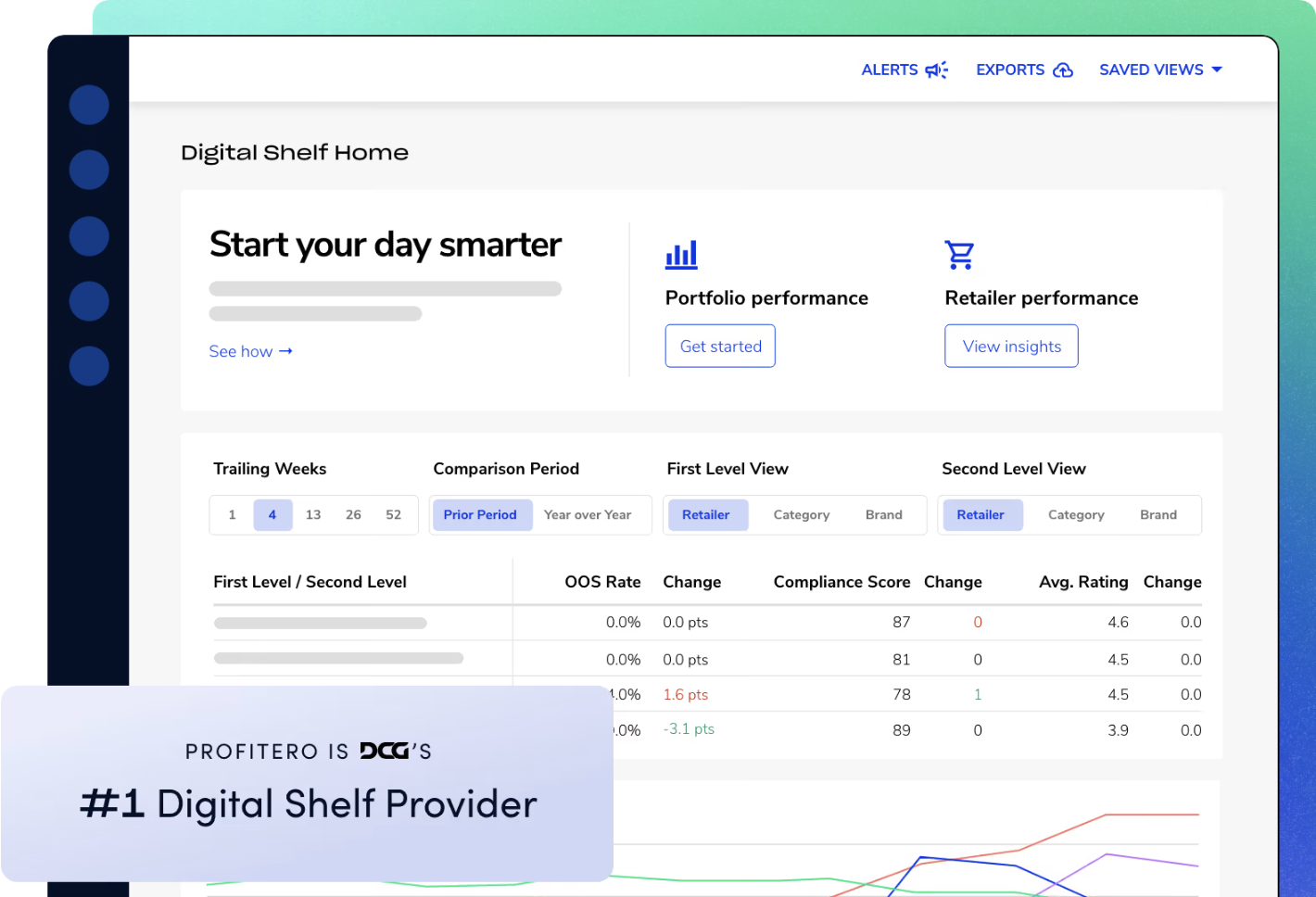
Consider a brand whose immediate problems are missing product images, inconsistent descriptions, out-of-stock listings, and weak search placement across several retail partners. Those are concrete digital shelf execution needs, and they make Profitero+ a relevant candidate.
Choose Profitero+ when: your team needs to find and prioritize issues affecting product presentation and availability across retailers.
Buying consideration: test your actual retailer and SKU list during evaluation. Broad advertised coverage is useful, but the coverage that matters is the portion your business will use.
Helium 10 combines product and keyword research with listing, advertising, and seller operations tools. Its Market Tracker supports competitive market monitoring, while Market Tracker 360 adds broader analysis across categories, brands, and products. Compare Helium 10’s market research tools.
It deserves consideration when the same team conducting research also handles day-to-day Amazon execution. An operator may value access to keyword research, listing tools, inventory workflows, and market monitoring through one vendor.
Choose Helium 10 when: you want market intelligence as part of a wider collection of Amazon seller tools.
Buying consideration: distinguish the standard Market Tracker from Market Tracker 360. Compare the specific product, limits, and package being offered rather than assuming every plan includes the full research offering.
Bring the same research assignment to each demo. Choose a category, several competing brands, a product set, and a handful of important search terms. Ask each vendor to show how its platform would answer your questions.
Then compare:
For teams focused on Amazon and TikTok Shop, SmartScout belongs on that shortlist. Its combination of category market share, competitive advertising intelligence, and brand-to-product-to-keyword research supports both smaller businesses and enterprise analysis.
Explore SmartScout’s plans and evaluate the platform against the market questions your team needs to answer.
Jungle Scout Cobalt is an enterprise Amazon market intelligence platform built for established brands, retailers, agencies, and other teams that need category, brand, product, pricing, advertising, and seller data at scale.
But enterprise teams do not all need the same intelligence layer. Depending on how your organization uses Amazon data, another platform may offer deeper seller visibility, stronger search analysis, more flexible reporting, tighter retail media integration, or broader cross-retailer coverage.
This guide compares five Jungle Scout Cobalt alternatives for enterprise brands and marketplace teams, focusing on competitive monitoring, search visibility, seller data, market research, and overall workflow fit.
Cobalt is designed for companies that have moved beyond basic product research. Jungle Scout currently positions the platform for businesses generating more than $1 million in annual corporate revenue, with features spanning market benchmarking, category performance, keyword research, pricing analysis, seller-level detail, advertising, and executive dashboards.
That means comparing alternatives solely by the number of features on a pricing page does not tell you much. Enterprise teams should instead ask how well each platform supports the decisions they actually make.
Consider:
A broader Amazon analytics software comparison can also help teams separate market intelligence platforms from tools built primarily for listing optimization, PPC management, or day-to-day seller operations.
There is no universal replacement for Cobalt, as the platforms below address different parts of the Amazon intelligence problem.
Pricing and product capabilities can change. Teams should confirm current pricing, limits, marketplace coverage, and required modules directly with each vendor before purchasing.
Best for: Amazon teams that want connected brand, seller, category, search, and competitive intelligence
SmartScout approaches Amazon research at the ecosystem level. Instead of forcing teams to investigate individual ASINs in isolation, it connects products with the brands, sellers, subcategories, keywords, ads, and traffic patterns around them.
Teams can investigate which brands lead a category, how market share is distributed, who sells rival products, which subcategories are changing, where shopper traffic comes from, and how search visibility overlaps with competitors.
For larger marketplace teams, that connected view can also make it easier to evaluate category opportunities, monitor competitor movement, and give different stakeholders a shared view of the Amazon market.
Key strengths:
For teams comparing these platforms directly, see Jungle Scout Cobalt vs. SmartScout.
Best for: Amazon operators that want market research and seller operations in one platform
Helium 10 combines Amazon market research with operational tools for managing listings, advertising, profitability, inventory, and other seller workflows. This breadth makes it a strong fit for teams that want research and execution capabilities in a single platform, rather than in a dedicated market intelligence environment.
Key strengths:
Teams can also compare its positioning with SmartScout and Jungle Scout in this SmartScout vs. Helium 10 vs. Jungle Scout comparison.
Best for: Enterprise teams that want marketplace intelligence connected to account analytics and BI workflows
DataHawk combines external marketplace data with a brand's own ecommerce performance metrics. Its platform brings together sales, advertising, profitability, inventory, product, SEO, and digital shelf metrics across Amazon and other marketplaces.
Key strengths:
Best for: Enterprise brands that want competitive intelligence closely connected to retail media
Pacvue is geared toward enterprise commerce teams that want competitive market signals tied directly to retail media and commerce execution. Its Market and Competitive Insights capabilities cover category performance, market share, keywords, ASINs, pricing, promotions, and cross-retailer share of voice.
Key strengths:
Best for: Large consumer brands that need competitive intelligence across Amazon and other major retailers
Stackline provides ecommerce market and consumer data across Amazon, Walmart, Target, and other major retailers. Its Atlas platform helps large brands track market share, consumer demand, competitor performance, digital shelf activity, and changes in shopping behavior at scale.
Key strengths:
Most enterprise teams do not need every capability equally. Start with the Amazon decisions your team makes most often, then choose the platform that supports those workflows with the least friction.
Before signing an enterprise contract, test each shortlisted platform against the same real-world use case. Give vendors one category, several competitors, priority keywords, and a question your team recently needed to answer. Compare not only the output, but how quickly analysts can reach an answer, how easily the findings can be shared, and whether the data fits existing reporting workflows.
SmartScout's Amazon seller data helps teams investigate those relationships more directly.
Choosing a Jungle Scout Cobalt alternative ultimately comes down to the questions your team needs to answer. For Amazon-focused organizations, that often means looking beyond individual products to understand brands, sellers, categories, search behavior, advertising, and market share together.
SmartScout gives enterprise Amazon teams a connected view of brands, sellers, products, categories, keywords, and advertising so they can evaluate market share, monitor competitors, uncover category opportunities, and support faster strategic decisions.
Use SmartScout's Amazon brand list software to research brands, products, sellers, and market position across Amazon.
Contact SmartScout to see how its enterprise market intelligence capabilities can support competitive research, category planning, and Amazon reporting across your organization.


