


Amazon has a highly competitive ecosystem with millions of products and hundreds of thousands of active sellers.
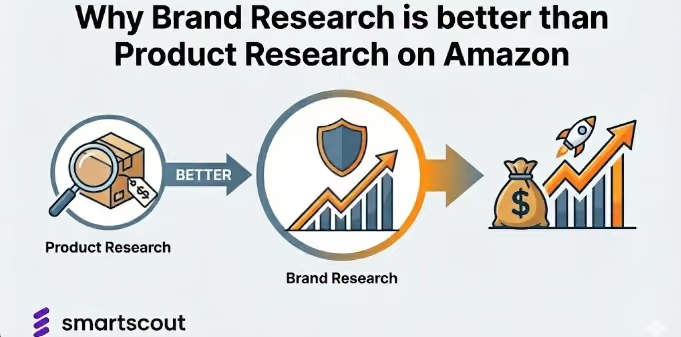
In this landscape, focusing only on individual product research can be shortsighted. A brand-level, data-driven research approach provides a more comprehensive view of the market, uncovering insights that product-by-product analysis might miss.
Let's look at why brand research often outperforms product research for Amazon sellers and brand managers, and how leveraging brand-centric data leads to better strategic decisions.
From Product Hunting to Brand Strategy
Product-focused research usually means hunting for a single “winning” product by analyzing metrics like sales rank (BSR), price, and reviews. Many sellers start here: they scour Amazon for a hot item with high demand and low competition. While this tactic can find short-term opportunities, it tends to treat each product in isolation. Sellers may end up investing in a one-off product without understanding the broader market context.
In contrast, brand-focused research looks at the bigger picture by analyzing entire brands and their product portfolios. Instead of asking “What’s a good product to sell?” brand research asks “Who are the strong brands in this category, and what are they doing right?” By evaluating a brand’s overall performance, such as its range of products, total sales, market share, number of sellers, customer sentiment, etc., you gain strategic insights that one-product analysis cannot provide. This shift from product hunting to brand strategy marks a paradigm change in Amazon research. It’s moving from a tactical, one-item mindset to a holistic, data-driven understanding of the market.
Limitations of Product-Only Research
Focusing solely on individual products has several drawbacks:
- Isolated View: A product might look promising on its own (e.g. great sales and few competitors), but without context you might miss that it’s part of a dominant brand’s lineup. Competing against an entire brand is much harder than it appears when just eyeing one product. Product research alone can blind you to these brand-level dynamics.
- Cherry-Picked Data: Product research tools often highlight a snapshot of metrics for one ASIN. Sellers might chase a trending product without realizing the trend is driven by a brand’s overall strategy or seasonal push. It’s easy to gamble on a “winning” product that later fizzles out because you didn’t see the full brand context or the sustainability of demand.
- Hidden Competition: A product listing might show only a few sellers now, but who owns the brand? If the brand itself or Amazon Retail is likely to enter the listing, competition can spike. For example, if Amazon (1P) decides to start selling that item, they will often dominate the Buy Box and undercut prices, making it nearly impossible for third-party sellers to compete. Product-centric research may not warn you that Amazon itself or the brand owner could be a future competitor, whereas brand research would flag the brand’s distribution model.
- One Product, One Bet: When you base decisions on single products, each item is a separate bet. This can lead to a disjointed catalog with no cohesive branding, making it harder to build customer loyalty. It’s also riskier as your revenue suffers if that product has an issue (a new competitor, an IP complaint, a trend shift). In short, a product-centric approach can be a scattershot strategy, lacking the synergy and resilience that comes from a brand-focused lineup.
- Ignoring Brand Restrictions: Many new sellers have learned the hard way that not all brands welcome resellers. A product might look great, but if the brand is strictly gated or enforces exclusive distribution, you might not be authorized to sell it. Product research might not reveal this until it’s too late. Proper brand research, on the other hand, evaluates a brand’s reseller-friendliness upfront. It ensures you avoid brands with restrictive policies, high IP complaint rates, or other red flags that could jeopardize your Amazon account.
Product research in isolation can lead to selecting items that appear golden individually but lack long-term viability when viewed in context. Without brand-level insight, sellers risk entering battles they can’t win or investing in products without scalable potential.
The Advantages of Brand-Level Research
Shifting to brand-level Amazon research offers several key advantages:
- Holistic Market Overview: Brand research gives a top-down view of the market that product research can’t match. By looking at brands, you identify who the market leaders are in a category and how the revenue is distributed. This helps in understanding market share and dominance. For instance, a brand-focused tool can reveal which brands control each niche and where opportunities exist for new entrants. This big-picture perspective lets you spot gaps in the market more effectively than combing through products one by one.
- Multiple Products & Portfolio Insights: Analyzing a brand means looking at its entire portfolio of products. This increases your chances of finding not just one, but multiple profitable items to sell or learn from. A broad product range in a brand is actually a positive signal: one guide suggests focusing on brands with a large assortment (e.g. 200+ active listings) because it boosts the odds of uncovering several winners. In contrast, product research might give you one hit product; brand research can unveil a pipeline of product opportunities across a brand’s catalog.
- Competitive Landscape & Barriers to Entry: Brand research inherently examines competition at a strategic level. Instead of just checking how many sellers a single listing has, you assess how competitive the brand is across all its products. Key questions get answered: How many other sellers carry this brand on average? Does Amazon Retail (1P) carry this brand? This is invaluable for wholesalers and resellers. For example, if a brand’s products typically have 15+ sellers each, that brand might be saturated and prone to price wars. If Amazon holds >30% of the Buy Box share on the brand’s listings, that signals tough competition and slim margins ahead. Brand-level data (like average sellers per product or Amazon’s in-stock rate) allows you to filter out brands that are overly competitive. In practice, a tool like SmartScout lets users take its database of 1+ million Amazon brands and exclude the highly competitive brands based on number of sellers, avoiding those crowded “race to the bottom” scenarios. This kind of pre-filtering by brand is far more efficient than investigating competition product by product.
- Understanding Brand Strength and Strategy: When you study a brand, you inevitably learn about its strategy. Brand research can uncover how a brand is winning on Amazon. You can see its pricing strategy, advertising presence, review strength, and product positioning. Some advanced analytics even show where and how a brand advertises or how it uses the Amazon ecosystem. Knowing that a competitor brand heavily invests in advertising (e.g. Sponsored Brands or DSP) or has a robust off-Amazon presence might affect how you approach that niche. Essentially, brand research helps you reverse-engineer successful tactics. One platform touts the ability to give a complete breakdown of any brand – who’s selling it, where they’re advertising, and how they’re winning – so you can build a stronger strategy. This level of competitive intelligence simply isn’t available when you look at a single ASIN in isolation.
- Trend and Growth Analysis: Brands rise and fall, and tracking a brand over time is a powerful way to gauge trends. Brand-level tools often allow historic analysis – seeing how a brand’s revenue or market share changes month to month or the entrance/exit of sellers. For example, if a brand has been climbing steadily in a category, that momentum might make it a great partner (or a formidable competitor to avoid). If a formerly strong brand is slipping, it might indicate a market gap or opportunity for new sellers to step in. Product research might catch a trend on one item, but brand research shows whether the brand as a whole is on an upswing or downtrend. Data-driven sellers use this to anticipate where the market is heading. As one review noted, being able to monitor how established brands are growing (or declining) over time allows you to evaluate niches more effectively.
- Risk Mitigation (Gating and IP): We touched on avoiding brand restrictions; this is a major advantage of brand research especially for resellers. By investigating a brand’s profile on Amazon, you can often tell if they are friendly to third-party sellers or not. Signs of trouble include a brand selling directly via Amazon (1P) or only through a sole authorized seller – which usually means they tightly control distribution. Brand research guides you to avoid such brands before you waste time and money. Moreover, a brand-level check can reveal if a brand is notorious for IP complaints or has many banned listings, etc. Sellers can thus steer clear of brands that “frequently issue IP complaints or restrict listings” to minimize account risk. All these factors are essentially invisible in naive product research, but are core to brand-level due diligence.
- Aligning with Amazon’s Direction: Amazon itself has been nudging sellers toward a brand-centric mindset. Features like Brand Registry and Amazon Brand Analytics (available to brand owners) underscore that success on Amazon increasingly comes from building and analyzing brands, not just individual products. Brand Analytics provides insights like which brands get the most clicks for certain search terms, repeat purchase behavior, market basket analysis, etc. – all data at a brand aggregation level. The very existence of these tools shows that Amazon values brand-building; sellers who do brand research position themselves to leverage such insights. In other words, brand research isn’t just about finding products to sell – it’s about crafting a brand strategy that can thrive on Amazon’s platform for the long run.
Data-Driven Tools Unlock Brand Insights
One reason brand research has surged in popularity is the advent of advanced analytics tools that make brand-level data accessible. Traditional Amazon research tools (e.g. Jungle Scout, Helium 10) were product-focused, built to find individual item opportunities. Newer platforms like SmartScout have pioneered a brand-centric approach, aggregating a vast amount of Amazon data to enable deep brand analysis. SmartScout’s database, for example, covers over 1.5 million Amazon brands and provides rich metrics on each. This lets sellers quickly study virtually any brand’s footprint on Amazon.
Crucially, these tools connect the dots between products, brands, and categories. As an illustration, SmartScout links categories, brands, sellers, products, keywords, and even advertising data into one unified system. By integrating these data points, users can seamlessly pivot from a product view to a brand view to a category view – gaining insights at every level. Here are a few capabilities that data-driven brand research tools offer:
- Brand Performance Dashboards: You can pull up a brand and see its total estimated revenue, number of products, average price, and top-selling ASINs. This immediately tells you how significant the brand is and which items drive its success. If a brand has, say, $500k/month across 50 products, it’s clearly a serious player; a brand doing $10k/month with 3 products might indicate a smaller, emerging brand – or a potential opportunity if those few products are doing well without much support.
- Seller and Distribution Analysis: Brand tools show how a brand’s products are sold on Amazon. For instance, the average number of sellers per product is a key metric. A brand with an average of 1-2 sellers per ASIN might be a private label brand (or one with exclusive distribution), whereas an average of 10+ sellers suggests a wholesale-friendly brand with many resellers. You can also see whether Amazon Retail carries that brand (and how often). An “Amazon in-stock rate” tells you what percentage of the time Amazon is one of the sellers on that brand’s listings. If Amazon is in stock 0% of the time, the brand is 100% third-party sold – potentially a great sign for resellers. If Amazon is in stock 80% of the time, you know you’d be up against Amazon on most products, which is often a non-starter. Having these data points instantly can save you from unwinnable situations and highlight the brands that are safe bets.
- Competitive Mapping and Market Share: Advanced brand research tools go beyond numbers to visualization. For example, SmartScout provides visual Brand Maps that display how different brands in a category stack up – who dominates and which smaller brands fill niche segments. Such a map can literally show you gaps in the market graphically. If the map shows a big cluster of brands owning one sub-niche, but another adjacent sub-niche has only one small brand, that could be a signal of an underserved segment. Additionally, tracking market share over time for top brands helps you notice trends (is the leader gaining even more share? are any challengers rising?). One source notes that SmartScout is “highly effective in understanding market share and competitive dynamics in any category” thanks to these brand-level views. This kind of intelligence is incredibly hard to replicate with manual product-by-product research.
- Filtering for Opportunity: Brand research software allows granular filtering that would be impossible manually. You can set criteria like: show me brands in the Pet Supplies category, with over $50,000 monthly revenue but less than 5 sellers on average, and Amazon carries less than 10% of their products. In one stroke, you get a short-list of potentially lucrative, underexploited brands. Perhaps they are good brands that just haven’t attracted a ton of competitors yet – prime targets for a wholesale approach. In fact, sellers using data tools often talk about finding “diamonds in the rough” by slicing the brand data this way. It’s a systematic way to discover what would take endless hours if you were researching product by product.
- Historic and Cross-Market Data: Another advantage is seeing how a brand performs across Amazon marketplaces and over time. Some brands do great in one country’s Amazon but aren’t present in another. That’s intel for potential expansion. SmartScout’s data, for instance, can show if a U.S. brand is not yet selling in Europe or Asia – a possible arbitrage or partnership opportunity for an enterprising seller. The tools can also reveal seasonality or momentum by looking at a brand’s historical revenue trend. Did the brand surge after a viral event? Is it consistently growing 10% every quarter? These insights inform whether a brand is a rising star worth hitching onto or a stagnant line past its prime.
In summary, leveraging these data-driven tools amplifies the power of brand research. They turn what used to be an overwhelming amount of data into actionable intelligence. As one reviewer put it, “SmartScout offers specialized seller and brand research tools” that give “a better niche overview” and allow you to “evaluate a market more effectively.” When you have the right data, the superiority of brand-level analysis becomes crystal clear.
(Below is a quick comparison of the two approaches):
As the table suggests, brand research looks at Amazon selling as a strategic game of chess rather than a tactical game of whack-a-mole. By evaluating brands, you’re thinking a few moves ahead – understanding the forces behind product performance – instead of just reacting to individual product stats.
Conclusion: Embrace the Brand-Centric Mindset
Success on Amazon has always required good research, but how you research can make all the difference. Brand research outshines product research by providing context, depth, and a path to sustainable growth. Instead of getting tunnel vision on one product at a time, a brand-driven approach forces you to see the whole board – the key players, the underserved areas, the competitive barriers, and the opportunities to collaborate or differentiate. It’s a data-driven way to move from being merely a seller of products to becoming a builder (or picker) of brands.
Practically speaking, this means leveraging the right tools and information. If you haven’t already, consider incorporating a brand database or market intelligence platform into your workflow. For example, using SmartScout’s brand analytics features can quickly validate your ideas: Is the niche you’re eyeing dominated by a few brands or fragmented? How does your target brand stack up in terms of revenue or number of sellers? These insights should guide your decisions on what to sell or which brands to partner with.
In the Amazon marketplace, knowledge truly is power. Product research gives you pieces of knowledge, but brand research gives you the power to understand and influence the game. By shifting to a brand-centric mindset and leveraging data intelligently, you’ll be better equipped to find profitable opportunities, outsmart competitors, and build a lasting business on the world’s biggest e-commerce platform.


