Amazon has always been a place where brands can scale faster than they “should.” But the last few years have made something even clearer: the speed of brand creation on Amazon is accelerating.
These brands haven’t been around long, yet they’ve already taken over meaningful share in their lanes. Aside from a big chunk of them being operated out of China (or having China-rooted teams), there’s no single “winning category” here. The common thread is simpler than people want to admit:
If you have product-market fit, Amazon will hand you more demand than you can comfortably handle.
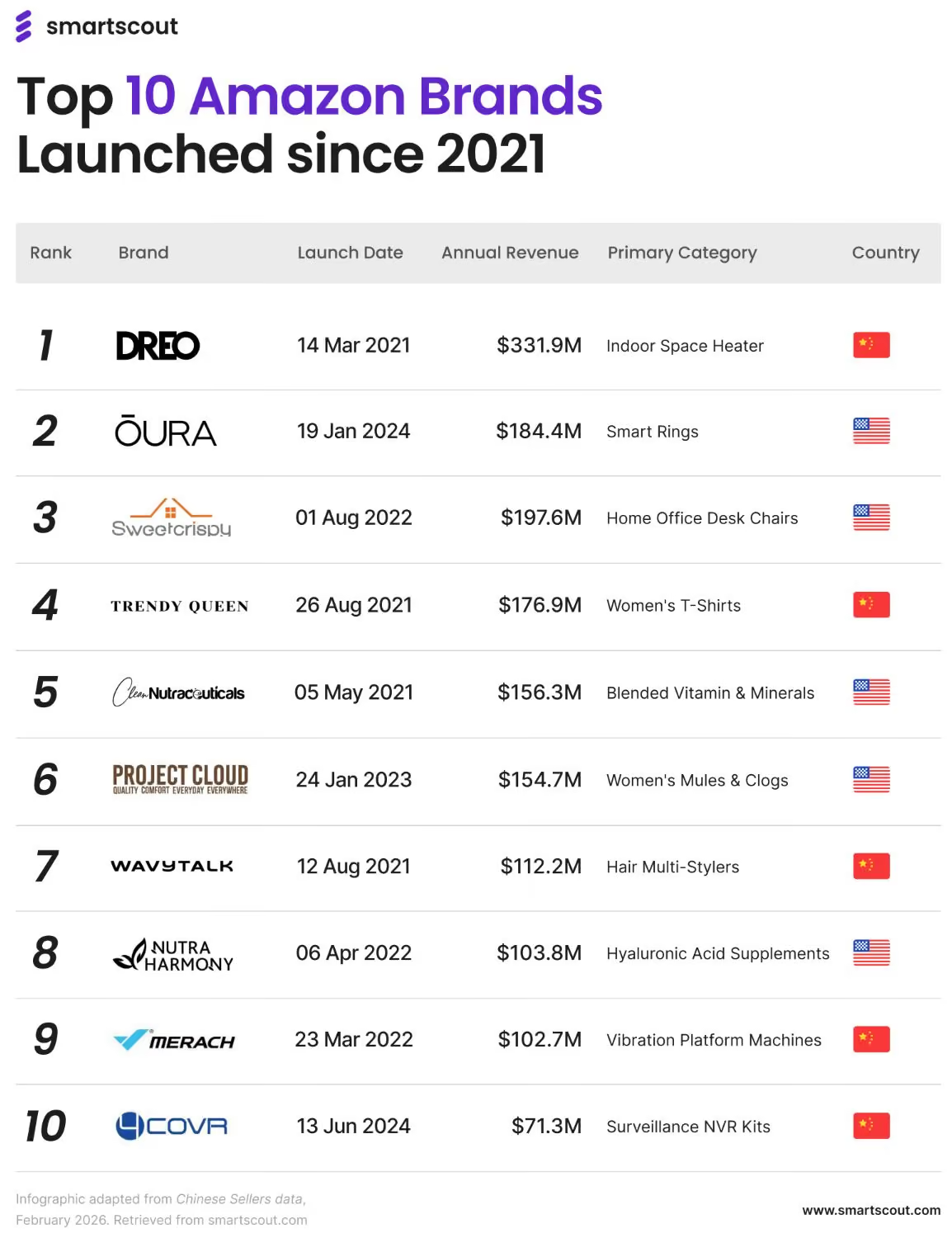
Below are 10 Amazon brands launched since 2021 that have already broken into “this is real money” territory.
The Top 10 Amazon Brands Launched Since 2021
- DREO — $331.9M (Launched March 14, 2021)
If you want the cleanest example of “hard goods can still scale insanely fast,” DREO is it. This is what happens when you enter a high-demand market with a product that looks modern, feels premium enough, and hits the right price-to-quality expectations.
- Sweetcrispy — $197.6M (Launched August 1, 2022)
This is a great reminder that you don’t need to invent a new category. You can win by shipping a product that’s “good enough,” priced correctly, and packaged around the exact use cases people search for.
- ŌURA — $184.4M (Launched January 19, 2024)
The timeline is what jumps out here. A brand can cross into massive revenue territory quickly when it benefits from existing demand + strong cultural awareness + high intent searches. When shoppers already “get it,” Amazon becomes the easiest place to convert.
- Trendy Queen — $176.9M (Launched August 26, 2021)
Fast growth in fashion is always a flex because it’s not just about product, it’s about velocity. Trends move. Inventory cycles move. Shopper tastes move. Brands that scale here are usually nailing timing, assortment, and repeatable creative.
- Clean Nutraceuticals — $156.3M (Launched May 5, 2021)
Supplements are competitive and trust-heavy, which is why this one matters. Breaking through at this level typically requires a combination of positioning clarity, consistent conversion, and a product that matches the promise buyers expect.
- Project Cloud — $154.7M (Launched January 24, 2023)
Another example of the hard-goods reality: when the product “makes sense” instantly and the offer is right, Amazon scaling can look like cheating. The demand is already there. Your job is to become the obvious choice.
- Wavytalk — $112.2M (Launched August 12, 2021)
This is the kind of brand that benefits from demonstration. If shoppers can quickly understand results, features, or “why this is better,” you can see rapid lift from content quality plus review momentum.
- Nutra Harmony — $103.8M (Launched April 6, 2022)
Crossing $100M that quickly means you’re not just getting impressions, you’re converting and holding position. In markets like this, it’s rarely one trick. It’s usually consistency across product, offer, listing clarity, and execution.
- MERACH — $102.7M (Launched March 23, 2022)
This is one more data point in the “hard goods scale faster than people expect” column. When the category supports larger order values, you can hit huge revenue numbers with fewer units than most sellers realize.
- LCOVR — $71.3M (Launched June 13, 2024)
The launch date is the headline here. This is a reminder that new brands can still break through quickly if they land in the right pocket of demand and execute with speed.
What Stands Out in This List
A few things are hard to ignore:
- Multiple brands crossed $100M+ in under three years.
That’s not “side hustle” money. That’s real market share.
- Hard goods still scale faster than most people expect.
People talk like Amazon is only a race to the bottom. Meanwhile, hard goods keep producing “rocketship” outcomes when the offer is right.
- Brand velocity is accelerating.
The playbook is getting tighter, tools are better, iteration is faster, and teams are learning how to compress timelines.
- There’s no single category that owns this trend.
Which is the point. The advantage isn’t “pick the perfect category.” It’s “pick the right demand pocket and nail the execution.”
Why These Brands Scale So Fast on Amazon
This isn’t magic, but it’s not random either. Brands that scale quickly tend to stack a few advantages:
Product-market fit shows up as conversion
On Amazon, product-market fit is brutally measurable. If you convert, you get rewarded. If you don’t, you disappear.
The winners typically:
- match shopper intent cleanly
- remove confusion fast
- deliver a product that meets expectations without surprises
They sell clarity, not features
Most listings still read like a spec sheet. The fast growers usually make it painfully easy to understand:
- who it’s for
- when to use it
- what outcome to expect
- why it’s better than the obvious alternatives
They nail the “offer,” not just the product
On Amazon, the offer is the product plus everything around it:
- price anchoring
- bundle logic
- variations that match how people shop
- guarantees, accessories, replacements, sizing, compatibility
They iterate faster than the average seller
The difference isn’t that they launched perfect. It’s that they improve faster:
- better main image
- better secondary images
- tighter bullets
- stronger A+ content
- smarter positioning
They ride demand, not ego
A lot of sellers try to force what they want to sell. These brands tend to sell what the market is already pulling for, then expand once they have traction.
How To Copy This Playbook (Without Being a Giant Brand)
If you want the “practical version” of this, here’s what I’d do:
- Start with a trend, then find the sub-trend.
Don’t just launch into the main wave. Find the slice that’s growing faster than the macro.
- Pick a positioning angle that makes the product the obvious choice.
“Better quality” is weak. “Designed for X use case” is stronger.
- Build a listing that answers questions instantly.
Your goal is not to describe. Your goal is to remove doubt.
- Treat your main image like a product.
You’re not selling an item, you’re selling a click first.
- Create an iteration loop.
One listing version is a guess. Ten versions is a strategy.
The Big Takeaway
I get to see brands start and scale in the data every day. The “death of the small seller” narrative gets clicks, but the truth is more nuanced:
Amazon is harder, yes.
Big brands have more leverage, yes.
But new brands still break out, and when they do, the scale can be absurd.
Because when you have product-market fit, Amazon will give you all the demand you could ask for.

.png)