
Entrepreneurship
Most Recent
Amazon Marketing
SmartScout Exclusive Blog

How Do the Top 10 Amazon Sellers Operate?

25+ “How to Sell on Amazon” Courses, Mentorships, and Trainings

Most "top Amazon seller" lists tell you who is big. Almost none tell you how they got big, which is the part that actually helps you. So we pulled the real numbers from SmartScout's Sellers tool and looked past the rankings into the mechanics: what each of the biggest storefronts sells, how much it makes every month, whether it ships through FBA or fulfills its own orders, how many brands it carries, and where it operates from.

What the data shows is that there is no single formula. The leaders range from a supplement accelerator doing $147 million a month to a two-brand fence seller that barely touches FBA, from an Amazon-owned grocery store to a dress brand running its entire U.S. business out of China. They win in completely different ways, but the habits underneath are surprisingly consistent, and they are habits a new seller can copy. 

Below is how the top 10 sellers operate, followed by exactly how to start down the same path yourself.

Who Are the Biggest Sellers on Amazon?


Amazon's own first-party storefront, Amazon Retail, moves an estimated $8.8 billion every month, roughly sixty times the largest independent seller. 
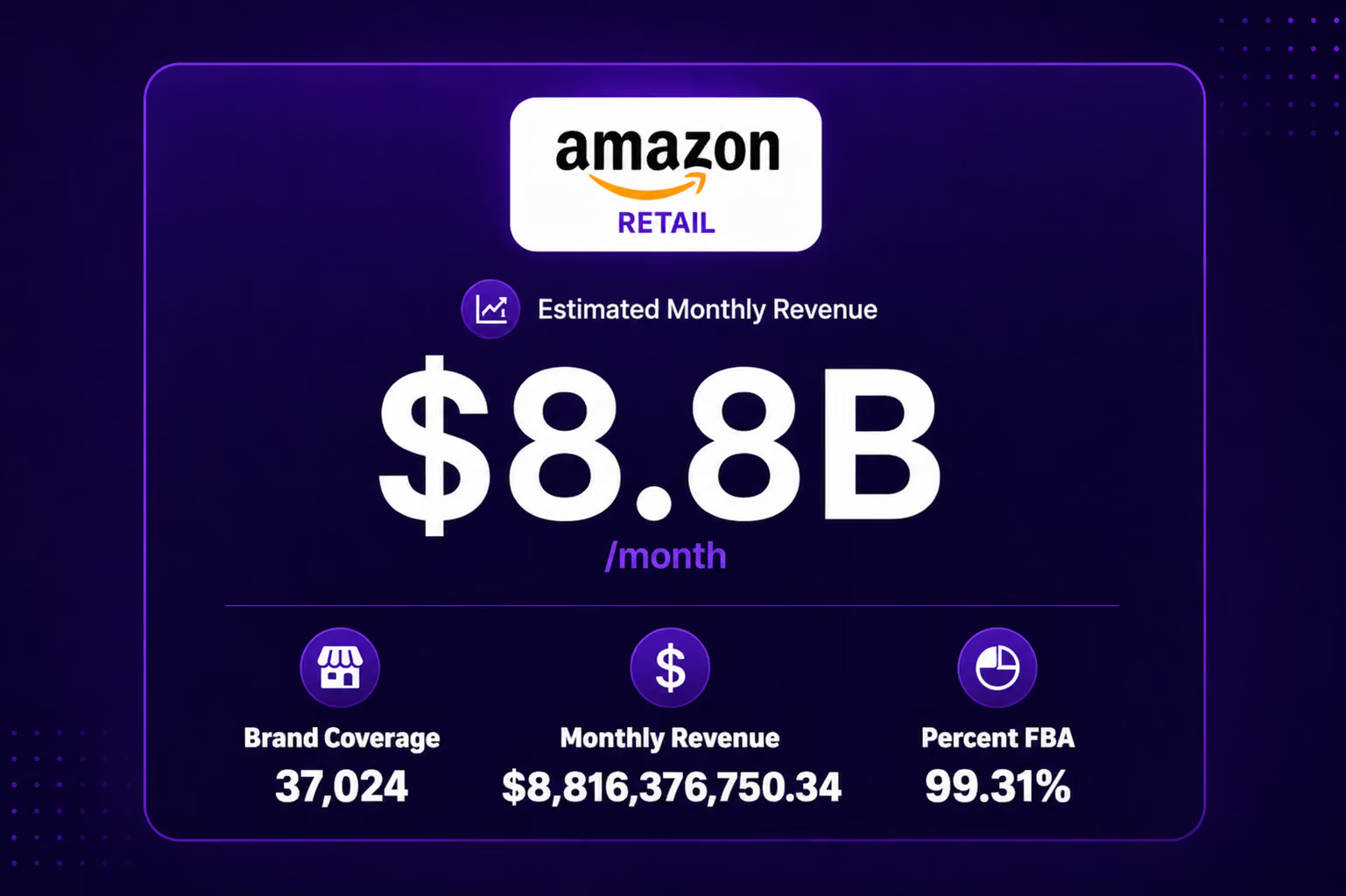

Because Amazon owns the platform, we set it aside and focus on the independent and brand storefronts competing on a level playing field. Those are the businesses you can actually learn from, so the ranking below covers the top 10 sellers after Amazon itself.

The Top 10 Amazon Sellers in 2026 (by Monthly Revenue)


These figures come from SmartScout's Sellers tool and reflect estimated monthly revenue at the time of writing. Revenue is a moving target, so treat this as a snapshot rather than a permanent leaderboard, and notice how little these ten have in common on the surface. Annualized run-rates are simply the monthly estimate multiplied by twelve.

1. Pattern: Amazon's Largest Independent Seller

Est. Monthly Revenue $147.1M, approximately $1.77B annualized
Category Health & Household, led by magnesium and mineral supplements
Fulfillment 98.69% FBA
Catalog 11,101 ASINs across 155 brands
Headquarters Lehi, Utah, US, Pattern Inc
Selling Since March 2017
12-Month Growth +28.7%

Pattern (formerly iServe) is the largest independent seller on Amazon, and the numbers explain why. It runs an almost pure FBA operation across 155 brands, led by supplements, and as a brand accelerator, it buys inventory from premium partners and manages their entire marketplace presence.
Pattern (iServe)

At a steady +28.7% over twelve months, it is still climbing, and it is the clearest proof on this page that disciplined, data-driven operations are what scale.

2. WindscreenSoCal: The FBM Powerhouse

Est. Monthly Revenue $126.9M, approximately $1.52B annualized
Category Patio, Lawn & Garden, led by decorative fences and windscreens
Fulfillment 2.32% FBA, almost entirely self-fulfilled
Catalog 23,919 ASINs across just 2 brands
Headquarters California, US, Import Fence Direct
Selling Since November 2016
12-Month Growth -20.0%


Trading as Import Fence Direct, WindscreenSoCal is the list's biggest surprise and its sharpest lesson in fulfillment. It sells bulky fencing and privacy windscreens, products where FBA storage and oversize fees would wipe out the margin, so it self-fulfills almost everything at just 2.32% FBA. 


With only two house brands stretched across nearly 24,000 size and color variants, it owns its niche by going deep rather than wide.

3. Whole Foods Market: Grocery at Scale

Est. Monthly Revenue $96.4M, approximately $1.16B annualized
Category Grocery & Gourmet Food, led by fresh berries
Fulfillment 83.48% FBA
Catalog 7,994 ASINs across 1,242 brands
Headquarters US, Whole Foods Market, Amazon-owned
Selling Since January 2021
12-Month Growth Not reported


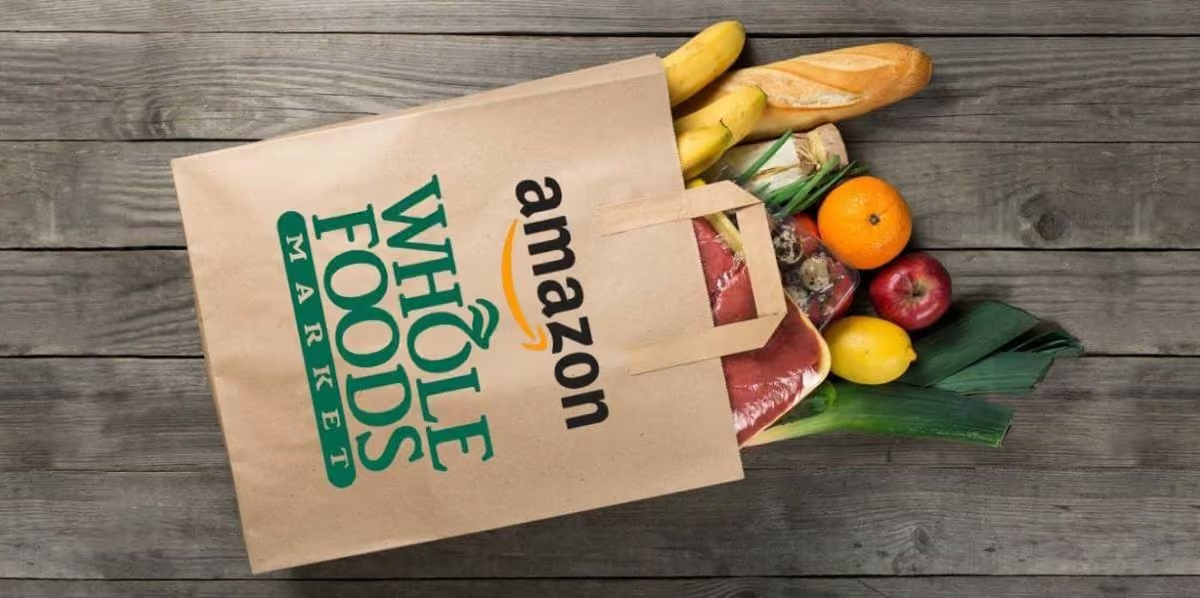
Whole Foods is Amazon-owned, and its marketplace storefront has quietly grown into a top-three seller on the strength of grocery. 
Amazon Whole Foods Market


It runs heavy FBA across more than 1,200 brands and only began selling under this account in 2021, which is a useful reminder of how quickly perishable grocery has scaled on the platform.

4. AnkerDirect: The Private-Label Electronics Model

Est. Monthly Revenue $64.4M, approximately $773M annualized
Category Electronics, led by portable power and chargers
Fulfillment 89.70% FBA
Catalog 1,184 ASINs across 4 brands
Headquarters California, US, Fantasia Trading LLC, Anker's U.S. entity
Selling Since March 2017
12-Month Growth -14.1%

AnkerDirect is Anker's official U.S. storefront and the textbook private-label electronics play. Power banks and chargers lead the catalog, fulfilled almost entirely through FBA to hold the Prime badge. 


Because Anker designs and manufactures its own products across only four brands, it controls quality and margin in a way pure resellers cannot, though the recent dip of -14.1% shows even strong brands face pressure.

5. Spreetail: Reselling With Its Own Logistics

Est. Monthly Revenue $60.0M, approximately $720M annualized
Category Patio, Lawn & Garden, led by framed swimming pools
Fulfillment 24.30% FBA, heavy in-house logistics
Catalog 7,465 ASINs across 327 brands
Headquarters Nebraska, US, Spreetail, LLC
Selling Since October 2017
12-Month Growth +29.1%

Spreetail blends reselling with its own logistics network, which is why its FBA share sits at just 24.30% while most peers run far higher.

Spreetail


It carries 327 brands led by oversized patio goods, and it is one of the fastest growers here, up 91.7% over three months. Owning fulfillment lets Spreetail profitably sell the bulky items that FBA-only sellers tend to avoid.

6. Sunshades Depot: The Fastest Riser on the List

Est. Monthly Revenue $51.6M, approximately $619M annualized
Category Patio, Lawn & Garden, led by shade and fencing products
Fulfillment 3.40% FBA, almost entirely self-fulfilled
Catalog 10,977 ASINs across 2 brands
Headquarters California, US, Sunshades Depot, Inc.
Selling Since October 2017
12-Month Growth +50.0%, and +250% over the last 1, 3, and 6 months

Sunshades Depot posts the most explosive numbers on the page, up 250% over one, three, and six months. 

TANG Sunshades Depot


Like WindscreenSoCal, it sells bulky shade and fencing products and self-fulfills nearly all of it at 3.40% FBA. It is living proof that a tight two-brand catalog in an unglamorous niche can outgrow far more famous names.

7. Zappos: Amazon-Owned Footwear

Est. Monthly Revenue $37.5M, approximately $450M annualized
Category Clothing, Shoes & Jewelry, led by women's running shoes
Fulfillment 99.16% FBA
Catalog 123,796 ASINs across 194 brands
Headquarters Nevada, US, Zappos Retail, Inc., Amazon-owned
Selling Since July 2017
12-Month Growth -10.5%

Zappos, the Amazon-owned footwear retailer, leans on near-total FBA and a deep catalog of almost 124,000 ASINs led by women's running shoes. 

Its brand equity and customer-service reputation predate Amazon's 2009 acquisition and still drive repeat purchases, even though growth has cooled this year.

8. eSupplements: Category Authority in Sports Nutrition

Est. Monthly Revenue $37.1M, approximately $445M annualized
Category Health & Household, led by creatine and nutritional supplements
Fulfillment 87.14% FBA
Catalog 1,617 ASINs across 10 brands
Headquarters Utah, US, MAK Holdings LLC
Selling Since April 2016
12-Month Growth +10.0%

eSupplements concentrates on a single fiercely competitive category and wins by going deep rather than broad. Creatine and sports nutrition lead its roughly ten brands, fulfilled mostly through FBA. 
Selling steadily since 2016, it shows that category authority, not catalog size, is a perfectly viable path to the top.

9. PRETTYGARDEN: A Cross-Border Fashion Brand

Est. Monthly Revenue $35.2M, approximately $423M annualized
Category Clothing, Shoes & Jewelry, led by women's casual dresses
Fulfillment 99.90% FBA
Catalog 40,704 ASINs under 1 brand
Headquarters Guangdong, China, Foshan Hangzetong
Selling Since November 2016
12-Month Growth +27.6%

PRETTYGARDEN shows how a single-brand overseas seller competes in the U.S. market: near-perfect FBA and a staggering 40,704 ASINs covering every size and color of women's dresses. 
PRETTYGARDEN


Holding inventory inside Amazon's warehouses lets a China-based brand promise Prime-speed delivery, and the +27.6% twelve-month growth shows the model working.

10. Woot: The Amazon Deal Site That Is Fading

Est. Monthly Revenue $35.1M, approximately $422M annualized
Category Health & Household, led by earbuds and electronics
Fulfillment 92.34% FBA
Catalog 12,287 ASINs across 2,088 brands
Headquarters Texas, US, Woot Inc, Amazon-owned
Selling Since April 2016
12-Month Growth -59.9%

Woot, Amazon's daily-deal subsidiary, still clears $35M a month across more than 2,000 brands led by earbuds and electronics. But it is the cautionary entry: every growth metric is deeply negative, down 59.9% over twelve months. 

Woot


Even an Amazon-owned storefront can fade when its format loses momentum, which is a sobering note to end the ranking on.

How Do the Top Amazon Sellers Operate?


No two of these sellers look alike, but their data reveals a handful of patterns that explain how each one reached the top. These are the lessons worth copying.

1. They Each Commit to One Business Model


Every seller here picked a lane and went deep. Pattern is a brand accelerator. Anker and PRETTYGARDEN build and sell their own private-label products. Spreetail and Woot are multi-brand resellers. Whole Foods, Zappos, and Woot are Amazon-owned. Not one of them is trying to do everything at once, and that focus is exactly what lets them dominate a slice of the marketplace.

2. Do Top Amazon Sellers Use FBA or FBM?


This is where the data is most revealing. The sellers shipping compact, high-value goods run almost pure FBA: Zappos at 99.16%, PRETTYGARDEN at 99.90%, Pattern at 98.69%, AnkerDirect at 89.70%, eSupplements at 87.14%. 

The sellers shipping bulky patio and garden items go the other way and self-fulfill: WindscreenSoCal at 2.32%, Sunshades Depot at 3.40%, Spreetail at 24.30%. The lesson is simple. Fulfillment should follow product economics. Use FBA for small, fast-moving items where the Prime badge lifts conversion, and consider self-fulfillment for heavy or oversized goods where FBA fees would eat the margin.

3. Private Label or Reseller? How Many Brands Do They Carry


Brand count tells you the strategy at a glance. PRETTYGARDEN sells under a single brand, Anker under four, and the fencing sellers under two, all classic private-label operations built on owning their products. 

At the other extreme, Woot carries 2,088 brands, Whole Foods 1,242, and Spreetail 327, the signatures of resellers and accelerators. Both ends of the spectrum can reach nine figures in annual revenue, so the choice is about which game you want to play, not which one works.

4. Where the Top Amazon Sellers Are Based


Geography barely matters. The leaders are spread across Utah, California, Nebraska, Nevada, and Texas, with a notable Utah cluster in Pattern and eSupplements. PRETTYGARDEN runs the whole U.S. operation from Guangdong, China, using FBA to deliver at Prime speed from overseas. You do not need a coastal headquarters or even a U.S. address to build a top Amazon business.

5. Being Big Does Not Mean Growing


Size and momentum are different things. Sunshades Depot is up 250% over recent months, and Spreetail is up 91.7% over three, while Woot is down 59.9% over the year, and AnkerDirect has slipped 14.1%. Revenue tells you where a seller is today, but growth tells you where it is headed, and the two often point in opposite directions.

How to Become a Top Amazon Seller With SmartScout?


You cannot replicate an Amazon-owned storefront or a public accelerator overnight, but you can replicate the method behind these sellers: pick one model, own one category, match fulfillment to your product, and decide everything from data. Here is how to do exactly that from a standing start, using the same tools that produced the numbers above.

  1. Study the winners in your niche. Open the Sellers tool and the Brands database to see who already leads your category, their revenue, FBA mix, and brand count, exactly as you saw above. You are reverse-engineering proven operators, not starting blind.
  2. Pick a category you can actually win. Use the Subcategories browser to find pockets of high demand and thin competition, then study individual listings in the Products database. The fence and shade sellers prove that an unglamorous niche can be a goldmine.
  3. Decide FBA or FBM with real numbers. Run candidates through the FBA Calculator to see your true net after fees. If oversize fees swallow the margin, self-fulfillment may be the smarter route, just as it is for WindscreenSoCal.
  4. Source it the way the leaders do. Whether you choose wholesale, online arbitrage, or private label, scan supplier lists in bulk with the UPC Scanner to find which items are worth stocking.
  5. Get found, then advertise. Build your listing around real search terms with Keyword Detective and Search Terms Relevancy, draft it quickly using the AI Listing Architect, and study competitor campaigns with Ad Spy before spending on PPC.

Key Takeaways for New Sellers


The top Amazon sellers share no single category, country, or business model. What they share is focus and discipline: one clear model, a category they own, a fulfillment choice that fits their products, and decisions grounded in data rather than instinct. Woot shows that even giants fade without momentum, and Sunshades Depot shows that a small, sharp catalog can rocket past household names. 

You cannot match their scale yet, but every habit that built them is learnable, and each one maps to a tool you can open today. Start by studying the winners in your niche, and let the data point you to your first product.

Start using SmartScout with risk-free pricing


Revenue and growth figures are estimates from SmartScout's Sellers tool and represent a snapshot that shifts over time. Annualized figures are monthly estimates multiplied by twelve.

Start using SmartScout with Risk-Free pricing

7-day money back guarantee, cancel at any time
Back

How Do the Top 10 Amazon Sellers Operate?

Entrepreneurship
Most Recent
Amazon Marketing
4.28.21
0
Min

Most "top Amazon seller" lists tell you who is big. Almost none tell you how they got big, which is the part that actually helps you. So we pulled the real numbers from SmartScout's Sellers tool and looked past the rankings into the mechanics: what each of the biggest storefronts sells, how much it makes every month, whether it ships through FBA or fulfills its own orders, how many brands it carries, and where it operates from.

What the data shows is that there is no single formula. The leaders range from a supplement accelerator doing $147 million a month to a two-brand fence seller that barely touches FBA, from an Amazon-owned grocery store to a dress brand running its entire U.S. business out of China. They win in completely different ways, but the habits underneath are surprisingly consistent, and they are habits a new seller can copy. 

Below is how the top 10 sellers operate, followed by exactly how to start down the same path yourself.

Who Are the Biggest Sellers on Amazon?


Amazon's own first-party storefront, Amazon Retail, moves an estimated $8.8 billion every month, roughly sixty times the largest independent seller. 


Because Amazon owns the platform, we set it aside and focus on the independent and brand storefronts competing on a level playing field. Those are the businesses you can actually learn from, so the ranking below covers the top 10 sellers after Amazon itself.

The Top 10 Amazon Sellers in 2026 (by Monthly Revenue)


These figures come from SmartScout's Sellers tool and reflect estimated monthly revenue at the time of writing. Revenue is a moving target, so treat this as a snapshot rather than a permanent leaderboard, and notice how little these ten have in common on the surface. Annualized run-rates are simply the monthly estimate multiplied by twelve.

1. Pattern: Amazon's Largest Independent Seller

Est. Monthly Revenue $147.1M, approximately $1.77B annualized
Category Health & Household, led by magnesium and mineral supplements
Fulfillment 98.69% FBA
Catalog 11,101 ASINs across 155 brands
Headquarters Lehi, Utah, US, Pattern Inc
Selling Since March 2017
12-Month Growth +28.7%

Pattern (formerly iServe) is the largest independent seller on Amazon, and the numbers explain why. It runs an almost pure FBA operation across 155 brands, led by supplements, and as a brand accelerator, it buys inventory from premium partners and manages their entire marketplace presence.

Pattern (iServe)

At a steady +28.7% over twelve months, it is still climbing, and it is the clearest proof on this page that disciplined, data-driven operations are what scale.

2. WindscreenSoCal: The FBM Powerhouse

Est. Monthly Revenue $126.9M, approximately $1.52B annualized
Category Patio, Lawn & Garden, led by decorative fences and windscreens
Fulfillment 2.32% FBA, almost entirely self-fulfilled
Catalog 23,919 ASINs across just 2 brands
Headquarters California, US, Import Fence Direct
Selling Since November 2016
12-Month Growth -20.0%


Trading as Import Fence Direct, WindscreenSoCal is the list's biggest surprise and its sharpest lesson in fulfillment. It sells bulky fencing and privacy windscreens, products where FBA storage and oversize fees would wipe out the margin, so it self-fulfills almost everything at just 2.32% FBA. 


With only two house brands stretched across nearly 24,000 size and color variants, it owns its niche by going deep rather than wide.

3. Whole Foods Market: Grocery at Scale

Est. Monthly Revenue $96.4M, approximately $1.16B annualized
Category Grocery & Gourmet Food, led by fresh berries
Fulfillment 83.48% FBA
Catalog 7,994 ASINs across 1,242 brands
Headquarters US, Whole Foods Market, Amazon-owned
Selling Since January 2021
12-Month Growth Not reported


Whole Foods is Amazon-owned, and its marketplace storefront has quietly grown into a top-three seller on the strength of grocery. 

Amazon Whole Foods Market


It runs heavy FBA across more than 1,200 brands and only began selling under this account in 2021, which is a useful reminder of how quickly perishable grocery has scaled on the platform.

4. AnkerDirect: The Private-Label Electronics Model

Est. Monthly Revenue $64.4M, approximately $773M annualized
Category Electronics, led by portable power and chargers
Fulfillment 89.70% FBA
Catalog 1,184 ASINs across 4 brands
Headquarters California, US, Fantasia Trading LLC, Anker's U.S. entity
Selling Since March 2017
12-Month Growth -14.1%

AnkerDirect is Anker's official U.S. storefront and the textbook private-label electronics play. Power banks and chargers lead the catalog, fulfilled almost entirely through FBA to hold the Prime badge. 


Because Anker designs and manufactures its own products across only four brands, it controls quality and margin in a way pure resellers cannot, though the recent dip of -14.1% shows even strong brands face pressure.

5. Spreetail: Reselling With Its Own Logistics

Est. Monthly Revenue $60.0M, approximately $720M annualized
Category Patio, Lawn & Garden, led by framed swimming pools
Fulfillment 24.30% FBA, heavy in-house logistics
Catalog 7,465 ASINs across 327 brands
Headquarters Nebraska, US, Spreetail, LLC
Selling Since October 2017
12-Month Growth +29.1%

Spreetail blends reselling with its own logistics network, which is why its FBA share sits at just 24.30% while most peers run far higher.

Spreetail


It carries 327 brands led by oversized patio goods, and it is one of the fastest growers here, up 91.7% over three months. Owning fulfillment lets Spreetail profitably sell the bulky items that FBA-only sellers tend to avoid.

6. Sunshades Depot: The Fastest Riser on the List

Est. Monthly Revenue $51.6M, approximately $619M annualized
Category Patio, Lawn & Garden, led by shade and fencing products
Fulfillment 3.40% FBA, almost entirely self-fulfilled
Catalog 10,977 ASINs across 2 brands
Headquarters California, US, Sunshades Depot, Inc.
Selling Since October 2017
12-Month Growth +50.0%, and +250% over the last 1, 3, and 6 months

Sunshades Depot posts the most explosive numbers on the page, up 250% over one, three, and six months. 

TANG Sunshades Depot


Like WindscreenSoCal, it sells bulky shade and fencing products and self-fulfills nearly all of it at 3.40% FBA. It is living proof that a tight two-brand catalog in an unglamorous niche can outgrow far more famous names.

7. Zappos: Amazon-Owned Footwear

Est. Monthly Revenue $37.5M, approximately $450M annualized
Category Clothing, Shoes & Jewelry, led by women's running shoes
Fulfillment 99.16% FBA
Catalog 123,796 ASINs across 194 brands
Headquarters Nevada, US, Zappos Retail, Inc., Amazon-owned
Selling Since July 2017
12-Month Growth -10.5%

Zappos, the Amazon-owned footwear retailer, leans on near-total FBA and a deep catalog of almost 124,000 ASINs led by women's running shoes. 


Its brand equity and customer-service reputation predate Amazon's 2009 acquisition and still drive repeat purchases, even though growth has cooled this year.

8. eSupplements: Category Authority in Sports Nutrition

Est. Monthly Revenue $37.1M, approximately $445M annualized
Category Health & Household, led by creatine and nutritional supplements
Fulfillment 87.14% FBA
Catalog 1,617 ASINs across 10 brands
Headquarters Utah, US, MAK Holdings LLC
Selling Since April 2016
12-Month Growth +10.0%

eSupplements concentrates on a single fiercely competitive category and wins by going deep rather than broad. Creatine and sports nutrition lead its roughly ten brands, fulfilled mostly through FBA. 

Selling steadily since 2016, it shows that category authority, not catalog size, is a perfectly viable path to the top.

9. PRETTYGARDEN: A Cross-Border Fashion Brand

Est. Monthly Revenue $35.2M, approximately $423M annualized
Category Clothing, Shoes & Jewelry, led by women's casual dresses
Fulfillment 99.90% FBA
Catalog 40,704 ASINs under 1 brand
Headquarters Guangdong, China, Foshan Hangzetong
Selling Since November 2016
12-Month Growth +27.6%

PRETTYGARDEN shows how a single-brand overseas seller competes in the U.S. market: near-perfect FBA and a staggering 40,704 ASINs covering every size and color of women's dresses. 

PRETTYGARDEN


Holding inventory inside Amazon's warehouses lets a China-based brand promise Prime-speed delivery, and the +27.6% twelve-month growth shows the model working.

10. Woot: The Amazon Deal Site That Is Fading

Est. Monthly Revenue $35.1M, approximately $422M annualized
Category Health & Household, led by earbuds and electronics
Fulfillment 92.34% FBA
Catalog 12,287 ASINs across 2,088 brands
Headquarters Texas, US, Woot Inc, Amazon-owned
Selling Since April 2016
12-Month Growth -59.9%

Woot, Amazon's daily-deal subsidiary, still clears $35M a month across more than 2,000 brands led by earbuds and electronics. But it is the cautionary entry: every growth metric is deeply negative, down 59.9% over twelve months. 

Woot


Even an Amazon-owned storefront can fade when its format loses momentum, which is a sobering note to end the ranking on.

How Do the Top Amazon Sellers Operate?


No two of these sellers look alike, but their data reveals a handful of patterns that explain how each one reached the top. These are the lessons worth copying.

1. They Each Commit to One Business Model


Every seller here picked a lane and went deep. Pattern is a brand accelerator. Anker and PRETTYGARDEN build and sell their own private-label products. Spreetail and Woot are multi-brand resellers. Whole Foods, Zappos, and Woot are Amazon-owned. Not one of them is trying to do everything at once, and that focus is exactly what lets them dominate a slice of the marketplace.

2. Do Top Amazon Sellers Use FBA or FBM?


This is where the data is most revealing. The sellers shipping compact, high-value goods run almost pure FBA: Zappos at 99.16%, PRETTYGARDEN at 99.90%, Pattern at 98.69%, AnkerDirect at 89.70%, eSupplements at 87.14%. 

The sellers shipping bulky patio and garden items go the other way and self-fulfill: WindscreenSoCal at 2.32%, Sunshades Depot at 3.40%, Spreetail at 24.30%. The lesson is simple. Fulfillment should follow product economics. Use FBA for small, fast-moving items where the Prime badge lifts conversion, and consider self-fulfillment for heavy or oversized goods where FBA fees would eat the margin.

3. Private Label or Reseller? How Many Brands Do They Carry


Brand count tells you the strategy at a glance. PRETTYGARDEN sells under a single brand, Anker under four, and the fencing sellers under two, all classic private-label operations built on owning their products. 

At the other extreme, Woot carries 2,088 brands, Whole Foods 1,242, and Spreetail 327, the signatures of resellers and accelerators. Both ends of the spectrum can reach nine figures in annual revenue, so the choice is about which game you want to play, not which one works.

4. Where the Top Amazon Sellers Are Based


Geography barely matters. The leaders are spread across Utah, California, Nebraska, Nevada, and Texas, with a notable Utah cluster in Pattern and eSupplements. PRETTYGARDEN runs the whole U.S. operation from Guangdong, China, using FBA to deliver at Prime speed from overseas. You do not need a coastal headquarters or even a U.S. address to build a top Amazon business.

5. Being Big Does Not Mean Growing


Size and momentum are different things. Sunshades Depot is up 250% over recent months, and Spreetail is up 91.7% over three, while Woot is down 59.9% over the year, and AnkerDirect has slipped 14.1%. Revenue tells you where a seller is today, but growth tells you where it is headed, and the two often point in opposite directions.

How to Become a Top Amazon Seller With SmartScout?


You cannot replicate an Amazon-owned storefront or a public accelerator overnight, but you can replicate the method behind these sellers: pick one model, own one category, match fulfillment to your product, and decide everything from data. Here is how to do exactly that from a standing start, using the same tools that produced the numbers above.

  1. Study the winners in your niche. Open the Sellers tool and the Brands database to see who already leads your category, their revenue, FBA mix, and brand count, exactly as you saw above. You are reverse-engineering proven operators, not starting blind.
  2. Pick a category you can actually win. Use the Subcategories browser to find pockets of high demand and thin competition, then study individual listings in the Products database. The fence and shade sellers prove that an unglamorous niche can be a goldmine.
  3. Decide FBA or FBM with real numbers. Run candidates through the FBA Calculator to see your true net after fees. If oversize fees swallow the margin, self-fulfillment may be the smarter route, just as it is for WindscreenSoCal.
  4. Source it the way the leaders do. Whether you choose wholesale, online arbitrage, or private label, scan supplier lists in bulk with the UPC Scanner to find which items are worth stocking.
  5. Get found, then advertise. Build your listing around real search terms with Keyword Detective and Search Terms Relevancy, draft it quickly using the AI Listing Architect, and study competitor campaigns with Ad Spy before spending on PPC.

Key Takeaways for New Sellers


The top Amazon sellers share no single category, country, or business model. What they share is focus and discipline: one clear model, a category they own, a fulfillment choice that fits their products, and decisions grounded in data rather than instinct. Woot shows that even giants fade without momentum, and Sunshades Depot shows that a small, sharp catalog can rocket past household names. 

You cannot match their scale yet, but every habit that built them is learnable, and each one maps to a tool you can open today. Start by studying the winners in your niche, and let the data point you to your first product.

Start using SmartScout with risk-free pricing


Revenue and growth figures are estimates from SmartScout's Sellers tool and represent a snapshot that shifts over time. Annualized figures are monthly estimates multiplied by twelve.

Start Using SmartScout with Risk-Free Pricing

try it today
7-day money back guarantee, cancel at any time