


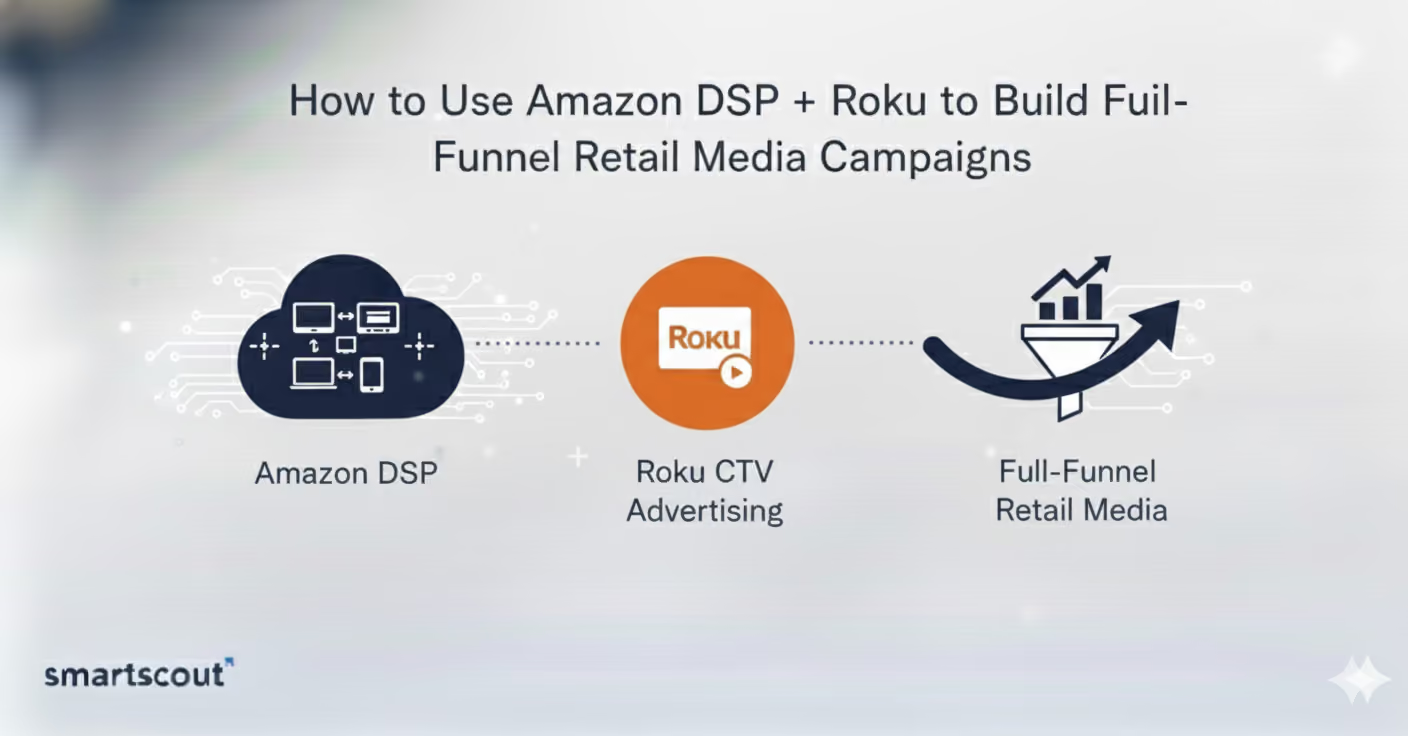
Understanding Amazon DSP and Full-Funnel Retail Media
Amazon’s Demand-Side Platform (DSP) is a programmatic advertising platform that allows brands to leverage Amazon’s vast first-party data and reach consumers both on and off Amazon’s properties. Unlike Amazon’s Sponsored Products or Sponsored Brands (which appear only on Amazon’s site/app), DSP lets you serve ads across the open web, third-party apps, and even streaming TV channels, all targeted using Amazon’s shopper insights. This means you can show ads on sites like IMDb, Twitch, mobile apps, and Connected TV platforms while tapping into Amazon’s deep data on shopping and browsing behavior. In short, Amazon DSP extends your retail media campaigns beyond Amazon’s marketplace, enabling a presence at every stage of the customer journey.
Why is this important? Amazon’s rich data and DSP capabilities turn consumer insights into tangible results. In fact, Amazon’s advertising business is surging – ad revenue jumped 24% year-over-year to $17.7 billion in Q3 2025, driven largely by the trillions of shopping signals that Amazon DSP can harness. For brands, Amazon DSP offers several key advantages:
- Precise Audience Targeting: DSP taps into Amazon’s unmatched audience data to target ads based on real purchase intent and interests. For example, you can re-engage high-intent shoppers who viewed your product (or similar items) on Amazon with highly relevant ads to boost conversions.
- Omnichannel Reach: DSP extends your ads across channels beyond Amazon – including Prime Video, Fire TV, Twitch, plus premium third-party sites, apps, and streaming platforms. This omnichannel presence keeps your brand visible at every stage, not just on Amazon’s site.
- Full-Funnel Capabilities: Amazon DSP supports a full-funnel marketing strategy – from upper-funnel video ads building awareness, to mid-funnel prospecting and consideration, down to lower-funnel retargeting ads that drive conversions. Amazon has found that combining DSP with Sponsored Ads yields much better outcomes: audiences exposed to both were 25× more likely to purchase, and brands saw 21% more new-to-brand sales when adding DSP to their ad mix.
It’s worth noting that Amazon DSP is a premium tool best suited for larger advertisers. There is typically a minimum spend commitment (~$35K for a self-service DSP account), or brands can work through Amazon’s managed-service or an accredited DSP partner agency. Managing DSP campaigns also requires expertise in programmatic advertising – from defining custom audience segments to setting bids and frequency caps – so many mid-sized and DTC brands choose to partner with experienced agencies. When executed well, the investment in DSP can pay off handsomely in incremental sales and new customers.
Amazon DSP + Roku: A Full-Funnel Game Changer
One of the most exciting developments in retail media is the exclusive partnership between Amazon Ads and Roku, announced in mid-2025. This integration gives advertisers access to the largest authenticated Connected-TV (CTV) advertising footprint in the U.S. – an estimated 80 million U.S. households (over 80% of all U.S. CTV households) – available only via Amazon DSP. In practical terms, Amazon DSP has become the primary gateway to reach Roku’s massive streaming audience with Amazon’s data-driven targeting.
Why is the Amazon DSP + Roku partnership such a big deal? In the past, running ads on CTV (like streaming TV apps on Roku) was largely a top-of-funnel tactic – you could achieve broad reach, but with limited precision and little insight into downstream impact. Amazon and Roku have changed that by combining their strengths:
- Identity Resolution at Scale: The integration uses a custom identity service to link Amazon’s logged-in users with Roku’s devices. Amazon DSP can now recognize a viewer across Roku and Amazon ecosystems, deterministically reaching the same household on different streaming apps and devices. This yields more accurate targeting and eliminates duplicate impressions – you’re not guessing who’s who across screens.
- Massive Reach Plus Precision: Roku commands nearly half of U.S. streaming TV time, and now those viewers are addressable with Amazon’s trillions of shopping, streaming, and browsing signals. Advertisers get near linear-TV scale paired with digital-like precision. For example, you could show a video ad on The Roku Channel specifically to “in-market home décor shoppers,” leveraging Amazon’s data instead of relying on broad demographics. This combination of scale + intent targeting is unprecedented in CTV.
- Improved Efficiency – Less Waste: Early results from the Amazon-Roku integration are impressive. In test campaigns, advertisers reached 40% more unique viewers with the same budget and cut frequency overlap by nearly 30%, effectively tripling the value of their ad spend. By unifying reach across Roku and Amazon Fire TV, brands can avoid over-serving the same people and instead spread impressions to more potential customers.
- Full-Funnel Measurement: Perhaps most game-changing, Amazon DSP + Roku enables true closed-loop measurement for TV ads. By combining Roku’s viewership data with Amazon’s shopping and purchase data, advertisers can directly connect seeing a streaming TV ad to downstream actions like product searches or sales on Amazon. Amazon’s reporting (via Amazon Marketing Cloud) can show exactly how Roku ad exposures drive outcomes across the funnel, finally making TV a measurable performance channel rather than just an awareness medium. In Amazon’s words, “advertisers can now drive full-funnel campaign outcomes—from awareness through conversion—while eliminating media waste across Amazon and Roku streaming audiences.”
In short, the Amazon+Roku partnership turns CTV into a fully addressable, results-oriented part of your retail media plan. You can build brand awareness on television and have the data to see how it leads to consideration and purchases, all within the Amazon Ads ecosystem.
Building a Full-Funnel Campaign Strategy with Amazon DSP + Roku
With Amazon DSP and Roku working together, brands and agencies can construct a true full-funnel retail media campaign that moves customers from initial awareness to final purchase. Here’s how to approach each stage:
Upper Funnel – Driving Awareness with CTV Ads
For the awareness phase, leverage Amazon DSP to run video ads on Roku’s CTV inventory (and other Amazon Streaming TV placements). Through DSP, you can access ad slots on popular Roku channels (e.g. The Roku Channel, Pluto TV, Tubi) as well as on Amazon’s own Fire TV apps, all in one campaign buy. Focus on broad but relevant audience segments that align with your product – for example, in-market categories or lifestyle audiences derived from Amazon data (“fitness enthusiasts,” “home décor intenders,” etc.). The goal at this stage is to maximize reach among new potential customers who fit your target profile.
Because the Roku integration provides authenticated reach, you can trust that one impression roughly equals one real household. Ensure your creative is high-quality and memorable since this is a customer’s first touchpoint with your brand. A 15- or 30-second CTV spot that showcases your product and brand story is ideal for awareness. Thanks to Amazon’s data, you could even sequence messaging – for instance, show a general brand ad first, then a more product-specific ad to viewers who watched the first ad or who have shown interest in related products on Amazon.
Best practice: Take advantage of Amazon DSP’s frequency controls. With unified Roku+Amazon reach, you can set a frequency cap so that each viewer doesn’t see your CTV ad too many times across streaming platforms. This prevents ad fatigue and frees up budget to reach additional households (remember the 40% incremental reach from reducing over-frequency). During awareness, you might cap at, say, 3 impressions per user per week for your CTV ads.
Mid Funnel – Engagement and Consideration
After building initial awareness, the next step is to re-engage interested viewers and nurture consideration. Amazon DSP allows you to create audience segments for mid-funnel targeting. For example, you can build a segment of users who were exposed to your CTV ad (Amazon can generate this audience based on its identity resolution) and then serve them follow-up ads on other channels.
Mid-funnel ads could include display or video ads on Amazon’s owned sites (like banner ads on IMDb or Twitch) or on high-quality third-party websites and mobile apps that Amazon DSP accesses. These placements can carry product-focused messages, customer testimonials, or more details that drive consumers toward evaluation. The targeting here might be narrower: you could target those who saw your Roku ad but haven’t purchased yet, or users who have recently browsed products similar to yours on Amazon.
Throughout the consideration phase, monitor engagement metrics: ad click-throughs, detail page views, and even add-to-carts if you are driving traffic to Amazon product pages. Amazon DSP’s integration with Amazon’s retail data means you can see these mid-funnel indicators. If certain audience segments or creatives are performing especially well (e.g. driving a lot of product detail page views), allocate more budget there. Conversely, if an audience isn’t responding, refine your targeting or messaging.
Lower Funnel – Retargeting and Conversion
The bottom of the funnel is where Amazon DSP truly excels: retargeting high-intent shoppers to drive conversions. Here, you’ll focus on audiences who have interacted with your brand but not yet purchased. This can include:
- Amazon Retargeting: People who viewed your product detail pages or brand store on Amazon, or added one of your items to their cart but didn’t check out. With DSP, you can serve these high-intent users a reminder ad off Amazon – for example, a display ad for your product appears on a news website or mobile app they visit, encouraging them to come back and complete the purchase. This is a proven tactic to recapture lost sales, since you’re targeting people who showed strong interest. Advertisers often find that retargeting via DSP yields quick, tangible results in increased conversions.
- Website Retargeting: If you also sell on your own direct website, Amazon DSP can retarget your external site visitors as well. By placing Amazon’s pixel on your D2C site, you can have DSP deliver ads to people who browsed products on your site (or even to audiences who searched for your brand on Amazon). The key is to align the ad’s landing page with the shopper’s intent – for instance, if they left a product in their Amazon cart, your ad should link back to that Amazon listing for checkout; if they visited your D2C site’s product page, the ad can drive them back there with an incentive. In either case, you’re using Amazon’s data to bring back warm prospects and push them over the finish line.
During the retargeting phase, success metrics are all about efficiency and conversion. Look at your Return on Ad Spend (ROAS) and cost-per-conversion in Amazon DSP’s reports. It’s common to see very high ROAS from these lower-funnel campaigns (many brands observe 5×–10× ROAS or more from well-optimized DSP retargeting). Additionally, monitor total sales lift and new-to-brand customer metrics. Amazon can help attribute how many sales were incremental due to DSP (for example, by comparing purchase rates of audiences exposed to your ads vs. not exposed). If the results are strong, consider scaling up your DSP investment or expanding your retargeting pools with fresh mid-funnel audiences.
Closing the Loop: Measurement & Optimization
Measure and refine: Take full advantage of Amazon’s measurement tools to close the loop on your campaigns. Use Amazon Marketing Cloud (AMC) to analyze how upper-funnel exposures translate to lower-funnel actions (e.g. see how many viewers of your Roku ad later searched for your brand or purchased). Monitor your campaign’s new-to-brand sales, ROAS, and frequency metrics, and adjust targeting or budgets accordingly. These insights let you optimize your full-funnel strategy over time.
Conclusion
Amazon’s DSP + Roku integration has effectively erased the old divide between “branding” and “performance” media. Marketers can now run seamless campaigns that build brand awareness on the big screen and drive conversions on the small screen, all within a single ecosystem. The key is to plan holistically across the funnel – use CTV ads to fill the funnel with new prospects, leverage DSP retargeting and sponsored ads to convert that interest into sales, and coordinate messaging so no customer slips through the cracks. Brands that embrace this full-funnel approach will be poised to capture more customers and drive sustainable growth, while those stuck in silos will fall behind. If you’re unsure how to execute such a multifaceted strategy, consider partnering with an expert agency like Skale Strategy to help manage and optimize your Amazon DSP campaigns for maximum impact.


