


Turning $1,000 into $5,000 is a 5x return, and no safe passive investment does that in 30 days. Stocks and savings grow over the years, and anything promising to multiply your money that fast is usually a gamble in disguise.
The realistic routes are active ones, where your effort and research do the work, and most of them run on Amazon's enormous built-in demand.
Below are six legitimate ways to get there, suited to different budgets, skills, and timelines. Some can hit $5K within a month through fast reinvestment, while others are higher-ceiling builds that reach this milestone a little later but are worth starting now. Pick the one that fits you.
Key Takeaways
- Retail arbitrage is the fastest route to turning $1,000 into $5,000.
- Wholesale offers slower but more scalable growth.
- KDP, Merch on Demand, and eBay require little upfront investment.
- Reinvesting profits is the key to reaching a 5x return.
- Avoid risky shortcuts like day trading, fake reviews, and counterfeits.
- SmartScout helps you find profitable products with real marketplace data.
6 Practical Ways to Turn $1,000 into $5,000 in a Month
Here is how the six paths stack up for a $1,000 starting budget, so you can find the fit before reading the details.
1. Retail and Online Arbitrage
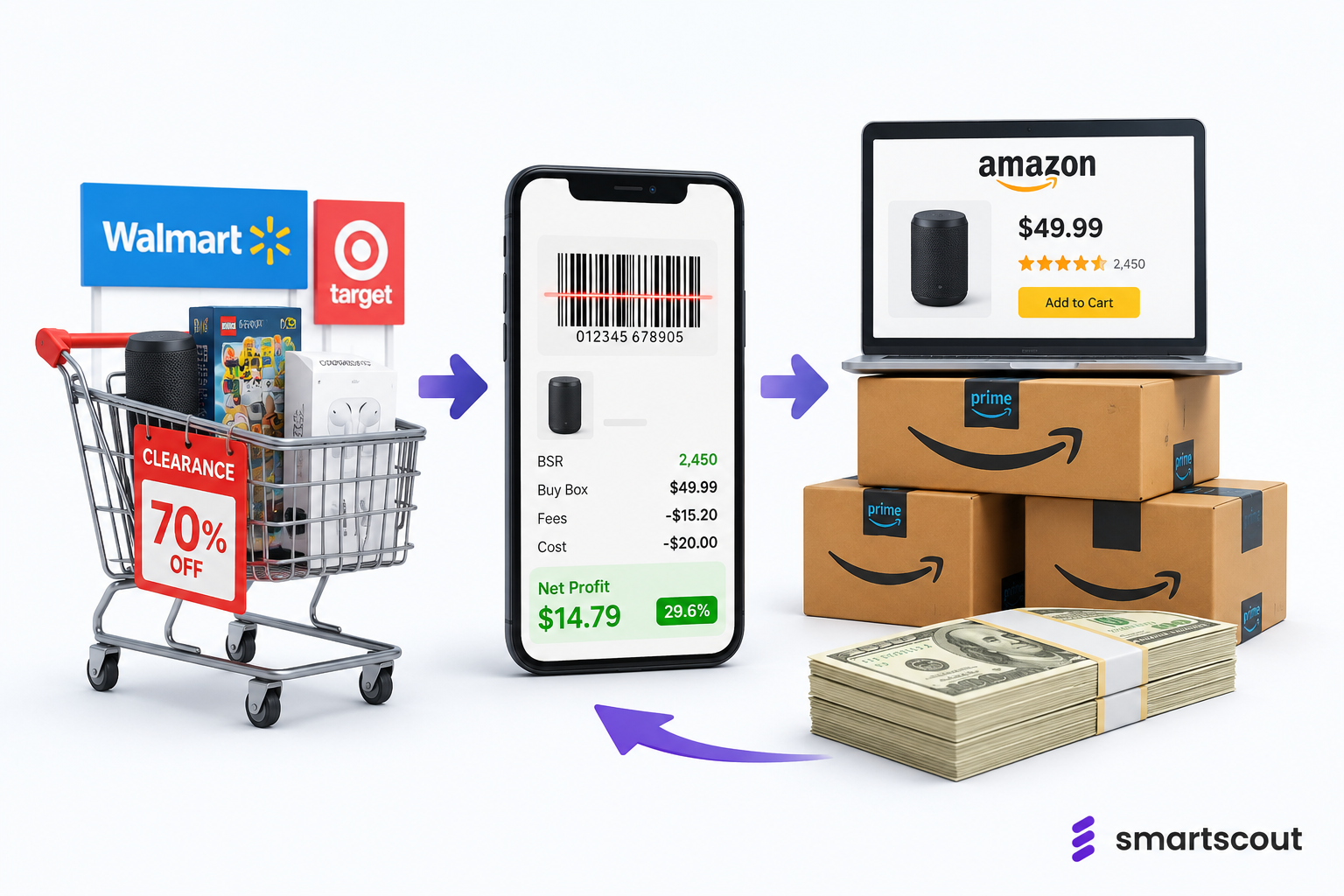
This is the fastest way to put $1,000 to work. You buy discounted products and resell them at a higher price on Amazon, keeping the difference. It needs little capital, turns inventory in days, and lets you confirm the profit before you spend, which makes it the most realistic path to $5,000 in a single month.
How to start:
- Open a free Amazon seller account and install the Amazon Seller app, which scans any barcode and shows the current price, fees, and sales rank on the spot.
- Source from clearance aisles at stores like Walmart and Target, or scan online clearance and coupon deals from home.
- Buy only items that keep at least a 30% net profit after Amazon's fees, which you can check fast with the FBA Calculator, and that sell often enough to move quickly.
- Speed it up with online arbitrage software and the UPC Scanner, which surfaces profitable products and lets you check supplier lists in bulk.
Start with 10 to 20 units of a few proven products, send them to FBA, then roll the proceeds into bigger buys.
2. Amazon Wholesale
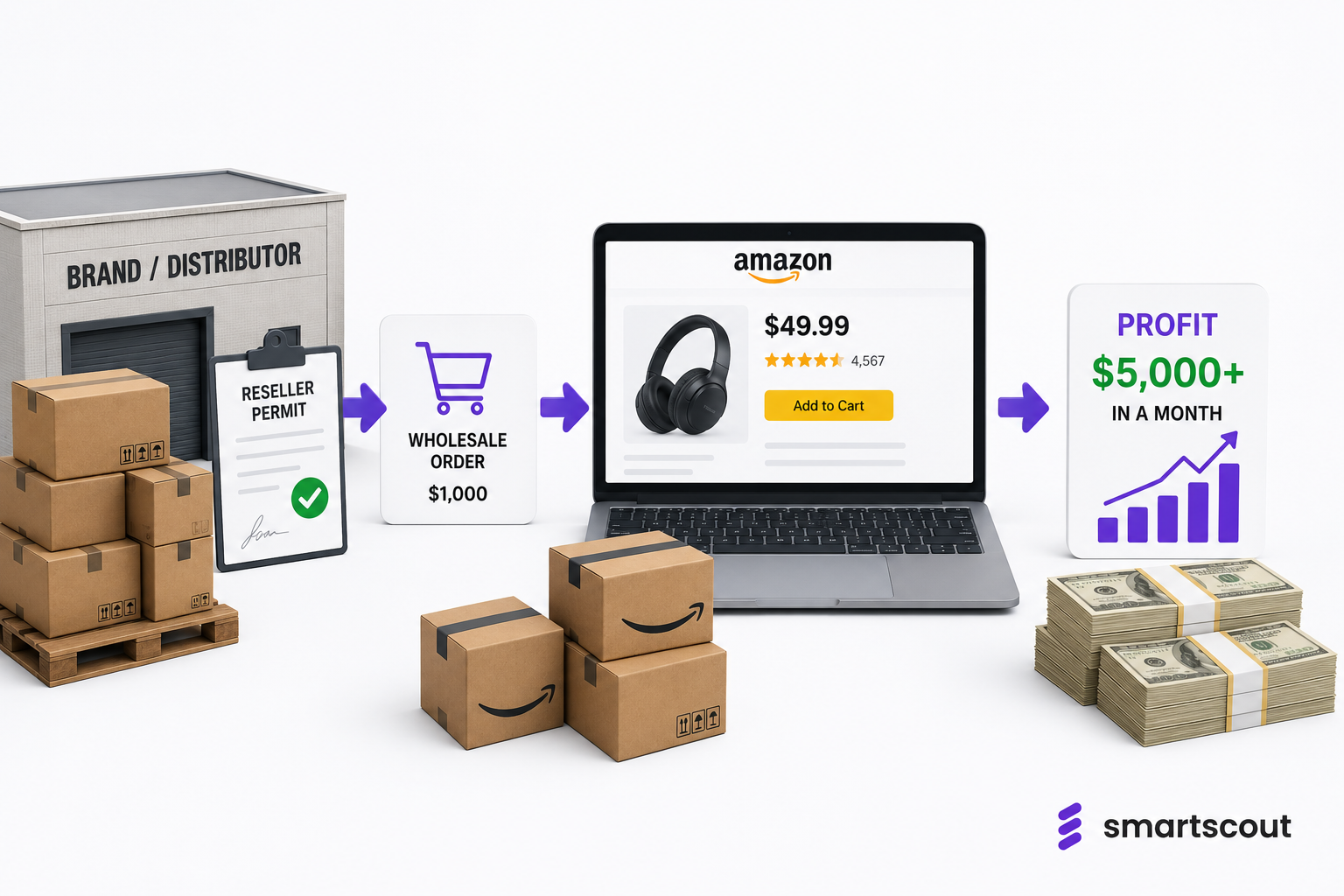
Wholesale means buying established products in bulk from brands or distributors and reselling them on Amazon. Per-unit profit is smaller than arbitrage, but you can reorder the same proven product again and again.
How to start:
- Register a Professional seller account and get a reseller permit or business license, which most wholesalers ask for before opening an account.
- Find wholesale-friendly brands in SmartScout, then contact the brand or distributor and request a wholesale application and price list.
- Pick products already selling well, confirmed in the Products database, and place a small first order with your $1,000 to test demand.
Account approvals and minimum orders mean the first month is slower than arbitrage, but once a product works, you reorder and scale it cleanly past $5,000.
3. Sell Used Items on Amazon
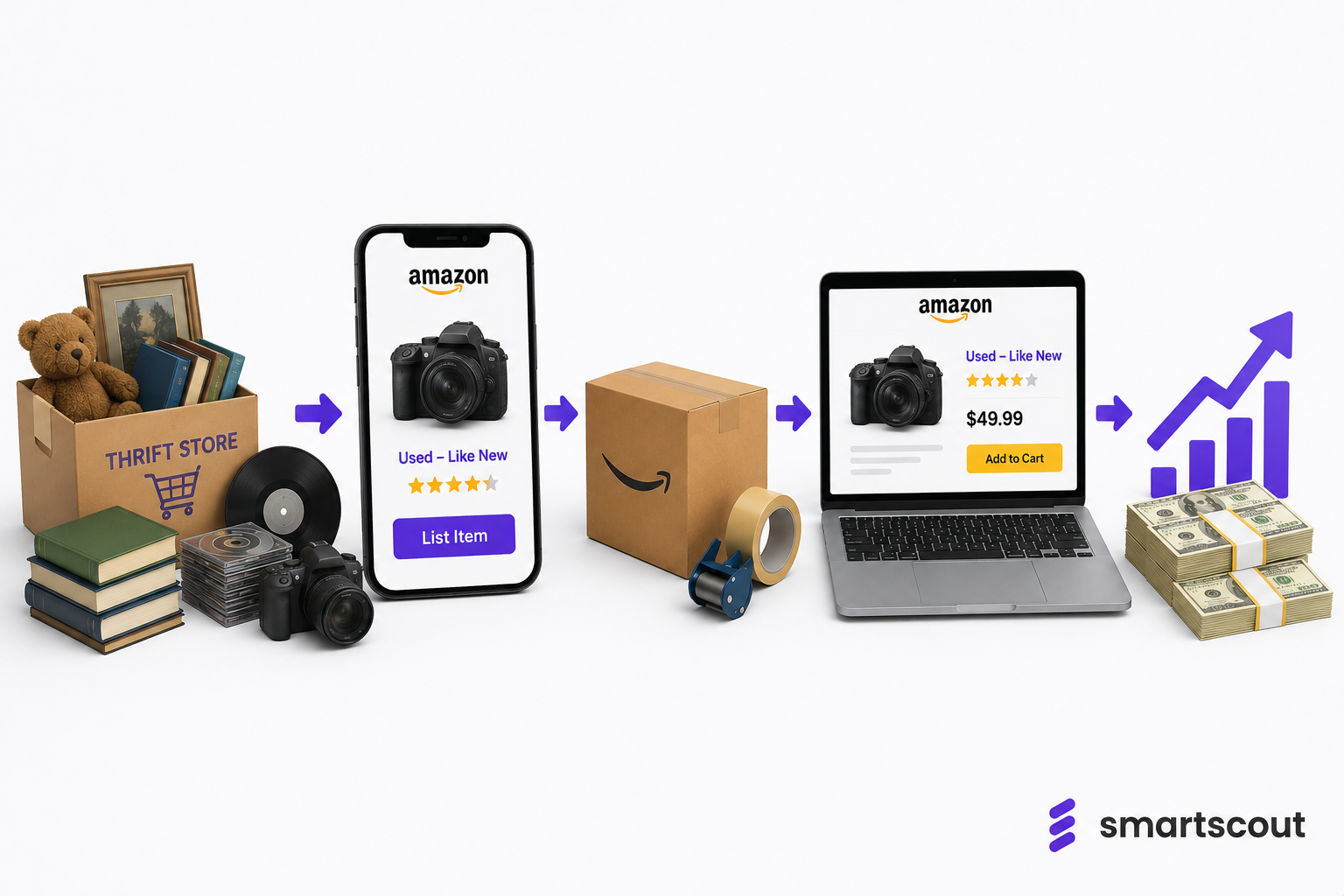
Amazon Renewed is the marketplace for inspected, refurbished, and pre-owned products sold with a warranty. If you can source returns, open-box units, or refurbishable electronics and bring them up to standard, you can sell them at a healthy margin for relatively little upfront cost.
How to start:
- Source cheaply from thrift stores, library sales, garage sales, and liquidation lots. Used books, media, and home goods are easy first picks.
- Find the product's existing listing, choose the correct used condition, and write honest condition notes. Our Used - Like New seller guide shows where each grade ends so you do not over-promise.
- Price against the other used offers on the page, not the new price, and ship promptly to protect your feedback.
One honest note: the formal Amazon Renewed certified-refurbished program is a different, higher tier. It requires invoices showing at least $50,000 in refurbished purchases over 90 days and a low order-defect rate, so treat Renewed as a goal to grow into, not a $1,000 starting point. Standard used listings are where you actually begin.
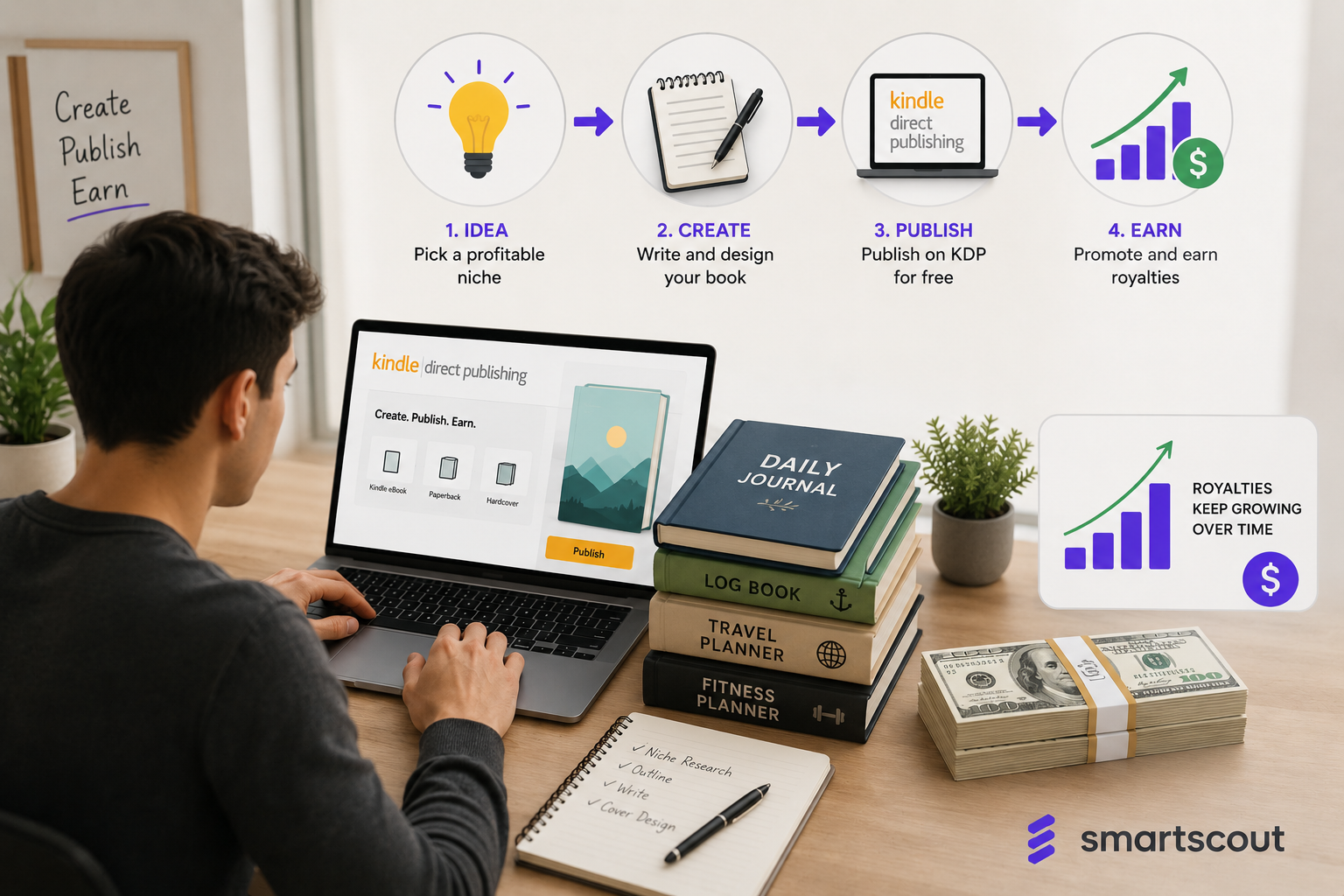
4. Self-Publish Books on Amazon KDP
Kindle Direct Publishing lets you publish ebooks and print-on-demand paperbacks with no inventory and no upfront printing cost. Because publishing through KDP is free, your $1,000 is best spent on what actually makes a book sell: professional editing, a strong cover, and a little advertising.
How to start:
- Create a free KDP account and pick a focused niche. Low-content books like journals, planners, and logbooks are quickest to produce, or write a tight how-to guide on a subject you know.
- Spend your $1,000 where it sells books: a professional cover, a round of editing, and a small Amazon Ads budget of a few dollars a day.
- Publish, run ads to earn the first sales and reviews, then keep the titles that take off and repeat. Ebooks priced between $2.99 and $9.99 earn a 70% royalty.
Reaching $5,000 a month usually takes several titles or one strong seller, so this builds over weeks rather than overnight, but it keeps paying with no stock to manage.
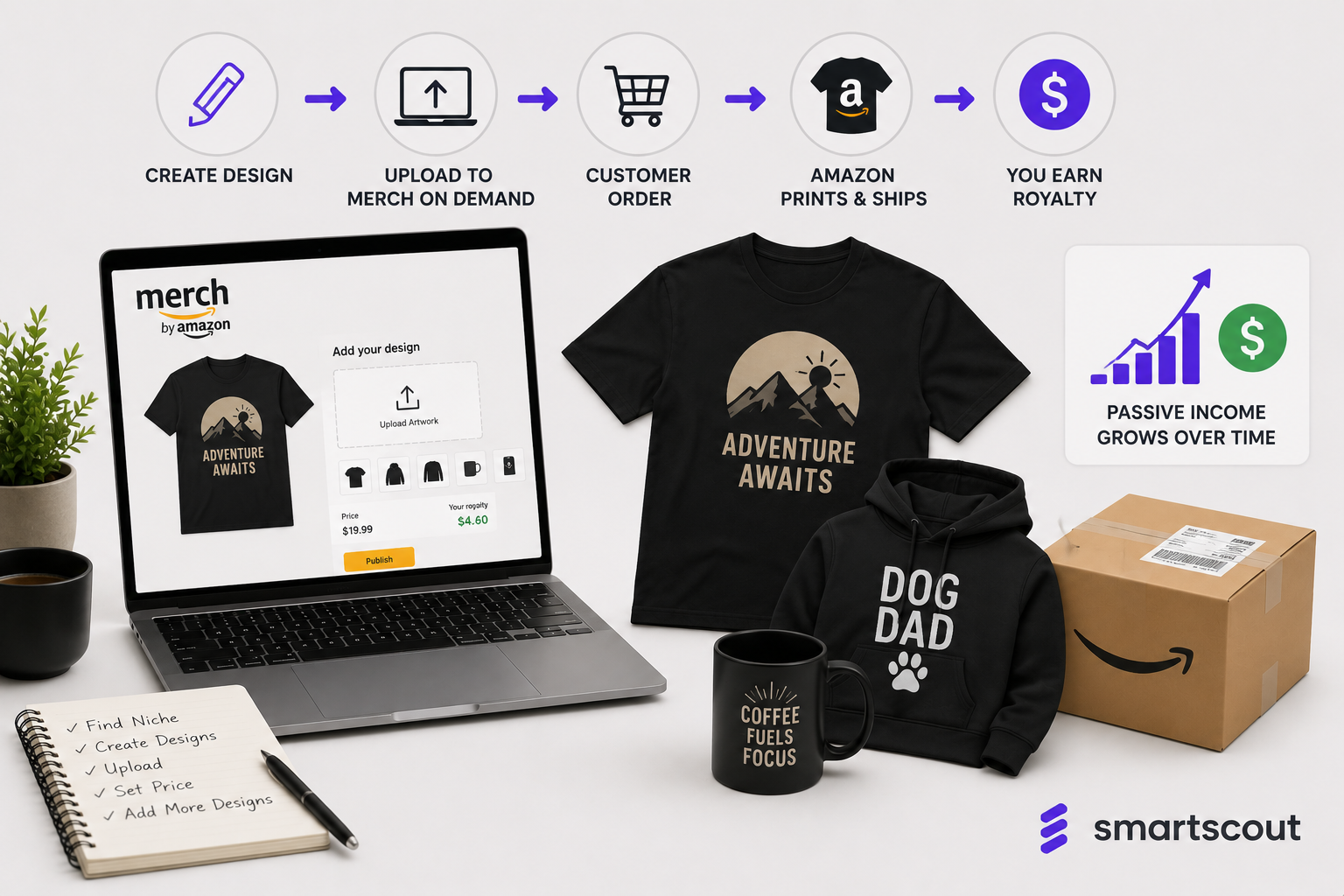
5. Sell Designs With Amazon Merch on Demand
Amazon Merch on Demand turns designs into products. You upload artwork, Amazon prints it on shirts, hoodies, and other items only when someone orders, and you earn a royalty, with zero inventory or fulfillment on your end.
How to start:
- Apply for Merch on Demand. It is free, and you begin with a small number of design slots that grow as you make sales.
- Choose a clear niche such as a hobby, job, or pet, and create simple, readable designs. Use your $1,000 to hire a designer or buy design tools if art is not your strength.
- Upload, set your price for a healthy royalty, and add new designs consistently, leaning into the ones that sell.
Like KDP, this rewards a growing catalog over time rather than a one-month spike, and it runs hands-off once your designs are live.
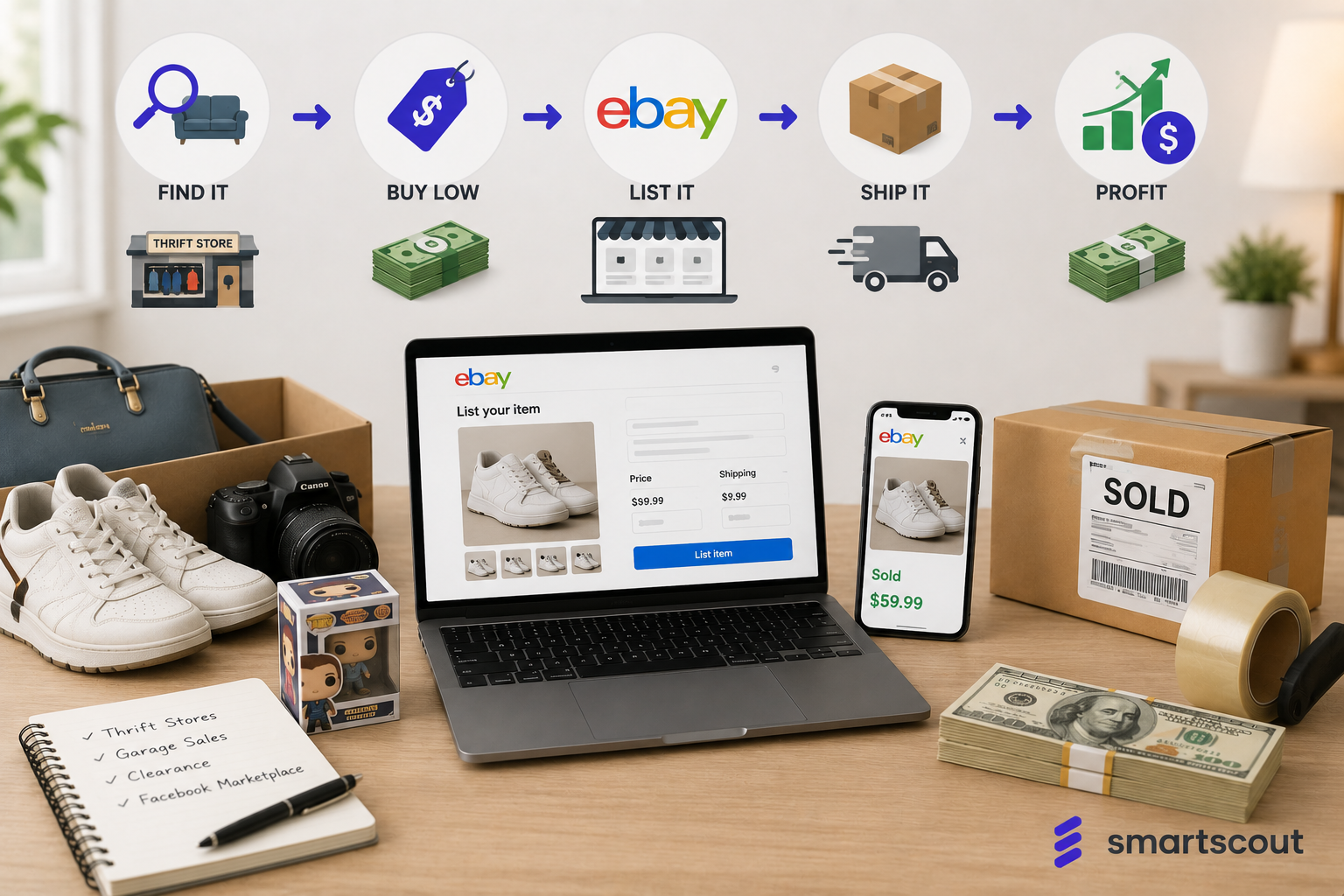
6. Flipping Items on eBay
eBay is the easiest place to start, with almost no barrier to entry and fast cash. The logic is the same as Amazon arbitrage: buy low, sell higher.
How to start:
- Open a free eBay account and list a few items you already own to learn listing, pricing, and shipping with zero risk.
- Source cheap from thrift stores, garage and estate sales, clearance racks, and free or low-cost Facebook Marketplace finds. Electronics, sneakers, brand-name clothing, and collectibles flip well.
- Price using eBay's sold listings, not active prices, so you see what items actually sell for. Our guide on how to see sold items on eBay walks through it.
List with clear photos and honest descriptions, ship quickly, and reinvest your profit. eBay flipping pairs perfectly with Amazon, since the same sourcing trips feed both.
How Reinvesting Profits Gets You to $5,000?
The math behind a 5x is the same across every physical-product path: a handful of profitable cycles, each one reinvested in full. Net 50% on a buy and roll everything forward, and $1,000 becomes $1,500, then $2,250, then $3,375, and clears $5,000 by the fourth cycle.
If each cycle takes about a week, that fits inside a month. The single habit that makes it work is reinvesting every dollar of profit instead of spending it, so the curve keeps bending upward.
What Risky Shortcuts Should You Avoid?
People tend to make bad decisions when their goal is to reach 5x in a short time. This is an all-or-nothing situation, where the majority of people get nothing. Here is what you should avoid at all costs in your mission to turn $1K into $5K:
- Day trading, options, and crypto bets. Trying to 5x in a month on the markets is gambling, and the likeliest outcome is a loss you cannot reinvest.
- Review manipulation. Buying reviews or offering gift cards for ratings is the fastest way to a permanent Amazon ban, as several once-huge brands learned the hard way.
- Counterfeits and gated-brand violations. Selling inauthentic goods or listing in restricted categories without approval risks suspension and held funds.
- Overbuying on a hunch. Committing your whole budget to one unverified product is how beginners get stuck with stock that will not sell.
How SmartScout Helps You Choose and Win?
Most of these paths share one make-or-break step: knowing which products are worth your money before you spend it.
That is where SmartScout fits in. It replaces guesswork with marketplace data, so you can scan demand across subcategories and products, confirm a real profit with the FBA Calculator before committing cash, and study the brands and sellers you would be up against. Whichever route you pick, the less you guess, the faster you reach $5,000.
The Bottom Line
There is no single trick that turns $1,000 into $5,000 in a month, but there are several legitimate paths, and most of them run through Amazon. Arbitrage, wholesale, and Renewed can hit the target fast with disciplined reinvestment, while private label, KDP, and Merch on Demand are higher-ceiling builds worth starting now.
Choose the one that matches your budget and skills, skip the risky shortcuts, reinvest your profits, and let real data point you to what sells. Do that, and a month is possible, and even if it takes a quarter, you have built something that keeps paying.


