Charm.io is an ecommerce intelligence platform built around discovering and analyzing direct-to-consumer brands. It combines brand growth signals, estimated revenue, website traffic, social metrics, advertising activity, employee data, decision-maker contacts, proprietary brand scores, and TikTok Shop data.
That makes Charm useful for retailers sourcing emerging brands, investors researching ecommerce companies, service providers prospecting into DTC accounts, and brands monitoring the competitive landscape.
But those are several different jobs bundled into one platform. The best Charm.io alternative depends on which job actually matters to your team.
Marketplace brands may need Amazon, TikTok Shop, and Walmart market share more than DTC contact data. Merchandising teams may want product-level assortment and pricing intelligence. Sales teams may prioritize lists of ecommerce stores and their technology stacks. Enterprise strategists may care most about web traffic, while product teams may need daily SKU-level sales and pricing data.
We compared five strong Charm.io alternatives across those use cases. SmartScout ranks first for marketplace-first brands and agencies, but this guide is explicit about the situations where Particl, Store Leads, Similarweb, Grips Intelligence—or Charm itself—may be the better fit.
Quick answer: SmartScout is the best Charm.io alternative for teams focused on Amazon, TikTok Shop, and Walmart market intelligence. Particl is the closest option for product, assortment, pricing, and promotion research across DTC retailers. Store Leads is strongest for ecommerce lead generation and technographics, Similarweb for traffic and digital-market analysis, and Grips Intelligence for daily product-level sales data across online and physical retail.
Charm.io Alternatives at a Glance
1. SmartScout: Best Charm.io Alternative for Marketplace Intelligence
SmartScout is the best Charm.io alternative for businesses whose growth is centered on marketplaces rather than primarily on standalone DTC websites.
SmartScout maps brands, products, sellers, categories, market share, advertising, search behavior, and competitive relationships across Amazon, with additional intelligence for TikTok Shop and Walmart. Instead of estimating a DTC brand’s overall momentum from website, social, and firmographic signals, SmartScout helps teams understand what is happening inside the marketplaces where transactions occur.
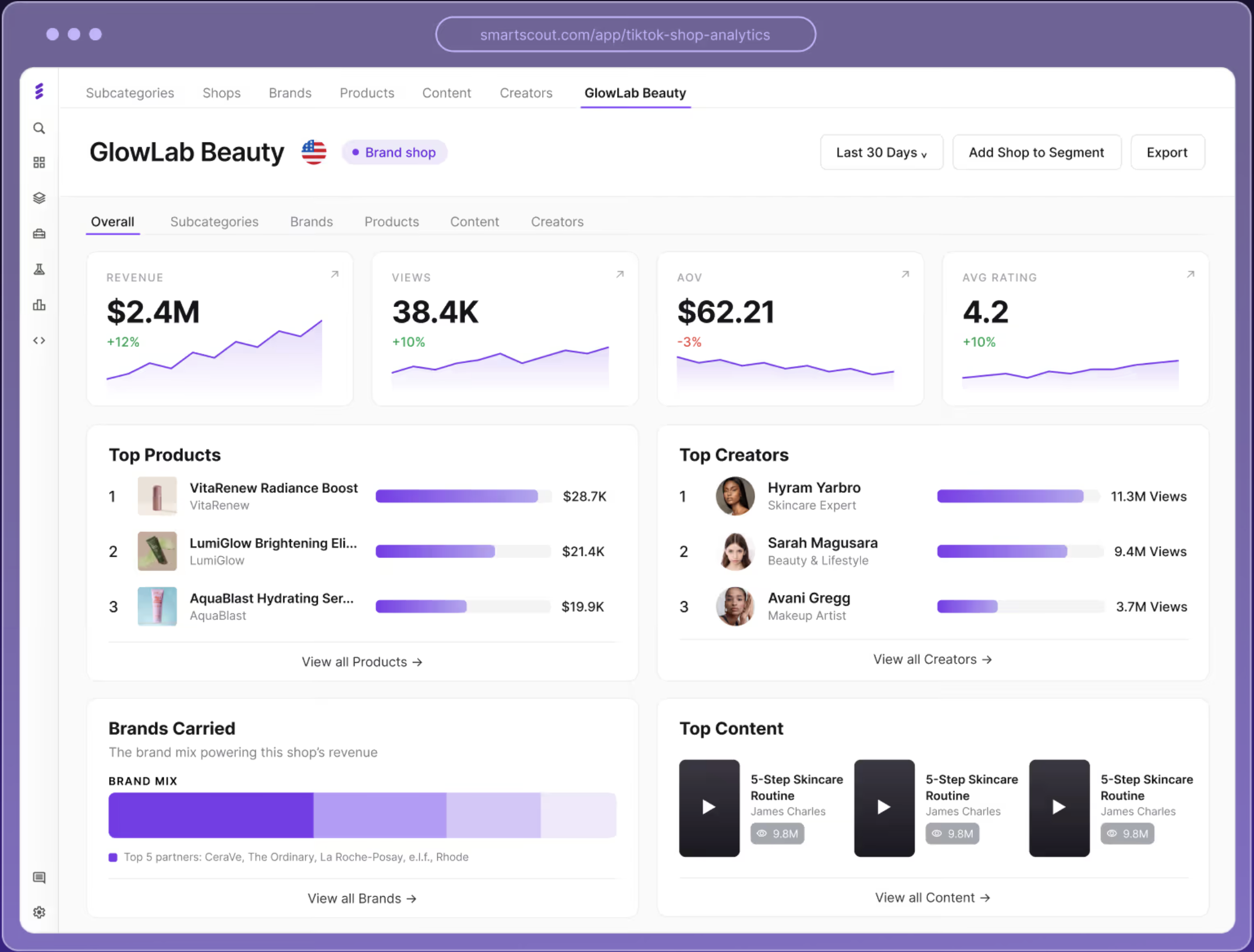
On Amazon, users can analyze brands and sellers, size subcategories, compare estimated revenue and market share, study product portfolios, investigate competitive advertising, discover keyword relationships, and map how traffic flows between products. For TikTok Shop, SmartScout covers shops, products, categories, creators, affiliates, videos, trends, estimated revenue, product momentum, and category concentration.
This makes SmartScout especially useful when a team needs to answer questions such as:
- Which brands control this Amazon subcategory?
- How much share is a competitor gaining or losing?
- Which sellers carry a brand, and how large are they?
- Which products and shops are gaining momentum on TikTok Shop?
- Is a category large and fragmented enough to support a new entrant?
- How does a brand’s position differ across Amazon, TikTok Shop, and Walmart?
SmartScout strengths
- Marketplace-specific brand, seller, product, and category intelligence
- Amazon subcategory sizing and market-share analysis
- Competitive ad, keyword, traffic, and product-relationship research
- TikTok Shop category sizing, shop analysis, creator performance, and product momentum
- Cross-channel intelligence spanning Amazon, TikTok Shop, and Walmart
- Useful workflows for brands, agencies, wholesale teams, and business buyers
Where SmartScout may not be the best fit
SmartScout is not designed to replace Charm’s full DTC prospecting database or its verified decision-maker contact layer. A software vendor trying to build a list of Shopify brands by employee count, technology stack, and contact information may be better served by Charm or Store Leads.
Particl may also fit better when the central need is SKU-level assortment, pricing, inventory, product launches, and promotions across standalone retail sites. Similarweb is stronger for broad website traffic and acquisition-channel analysis.
Best for: Marketplace brands, Amazon agencies, wholesale teams, ecommerce strategists, investors studying marketplace businesses, and DTC brands expanding into Amazon, TikTok Shop, or Walmart.
Verdict: Choose SmartScout when you need to see the competitive structure inside marketplaces rather than infer marketplace performance from general DTC brand signals.
2. Particl: Best for DTC Product, Assortment, and Promotion Intelligence
Particl is one of the closest Charm.io competitors for DTC and retail product intelligence. It focuses less on contact discovery and more on what retailers are selling, pricing, launching, promoting, and removing.
Particl says it combines product revenue, pricing, promotion, inventory, assortment, and sentiment data across more than 20,000 retailers. Teams can track competitor best sellers, compare assortment overlap, identify product and category gaps, monitor launches and restocks, analyze promotional activity, and explore historical trends.
That makes Particl particularly relevant to product, merchandising, pricing, and brand-strategy teams. Where Charm helps a user discover high-growth brands, Particl helps explain what those brands are doing at the product level.
Particl strengths
- Product-level revenue, pricing, inventory, and assortment analysis
- Competitor product and best-seller tracking
- White-space research across products, colors, categories, and price points
- Monitoring for launches, restocks, promotions, and marketing activity
- Historical data, custom reports, alerts, and AI-assisted analysis
Particl limitations
Particl is not primarily a B2B contact or lead-generation system. If the goal is to build a large list of ecommerce companies, identify their installed technologies, and enrich CRM records, Store Leads is a better match. If Amazon marketplace share and seller relationships are the priority, SmartScout is more purpose-built.
Best for: DTC brands, retailers, product developers, merchandising teams, pricing teams, and agencies conducting competitor product research.
3. Store Leads: Best for Ecommerce Lead Generation and Technographics
Store Leads is a strong Charm.io alternative for sales, partnerships, app developers, agencies, and investors that need a structured database of ecommerce stores.
Its core value is segmentation. Store Leads tracks millions of active stores across hundreds of ecommerce platforms and lets users filter companies using firmographic, social, contact, product, and technographic attributes.
Users can research details such as ecommerce platform, installed apps, app-install history, estimated monthly app spend, merchant category, estimated monthly sales, employee count, product count, country, social presence, and contact information. The platform also supports exports, CRM enrichment, workflows, a browser extension, and API access on qualifying plans.
Store Leads strengths
- Large database of ecommerce stores across many platforms
- Detailed technographic data, including installed apps and historical changes
- Lead-list building with firmographic, social, product, and technology filters
- CRM enrichment, CSV exports, workflows, browser extension, and API
- Useful for identifying merchants that match a precise ideal-customer profile
Store Leads limitations
Store Leads is strongest at answering who the merchant is and what technology it uses. It is less suited to questions about category market share, competitor ad strategy, SKU-level sales performance, creator-driven commerce, or which products are taking share inside a marketplace.
Charm may offer a richer blend of proprietary brand-growth scores, social signals, verified contacts, and DTC competitive intelligence. SmartScout, Particl, and Grips go deeper into different forms of market and product performance.
Best for: Ecommerce SaaS companies, agencies, sales-development teams, partnership teams, investors, and app developers prospecting into online merchants.
4. Similarweb: Best for Website Traffic and Digital Market Analysis
Similarweb is a broader digital intelligence platform that helps brands and retailers analyze website traffic, acquisition channels, audience behavior, market trends, and competitor performance.
It is a useful Charm.io alternative when the main goal is to understand digital reach and channel strategy. Teams can benchmark traffic, study where visitors come from, compare audience overlap, evaluate search and referral activity, and monitor how competitors acquire attention across the web.
This is particularly valuable for enterprise strategy, marketing, investor research, and international market analysis. It can show whether a competitor’s digital audience is growing and which channels appear to be driving that growth.
Similarweb strengths
- Website traffic and engagement estimates
- Acquisition-channel and referral analysis
- Search, audience, and competitive digital benchmarking
- Broad market and geographic coverage
- Useful for enterprise strategy and top-down market research
Similarweb limitations
Traffic is not revenue. A site can attract a large audience without converting it efficiently, and marketplace purchases may occur away from the brand’s own domain. Similarweb is less suited to Amazon market share, TikTok Shop product sales, retailer assortment decisions, or ecommerce technology prospecting.
Charm provides more ecommerce-specific brand discovery and contact workflows. SmartScout offers deeper marketplace intelligence, while Particl and Grips focus more directly on products, sales, prices, and assortments.
Best for: Enterprise brands, retailers, strategy teams, digital marketers, analysts, and investors evaluating online audience and channel performance.
5. Grips Intelligence: Best for Daily Product-Level Retail Data
Grips Intelligence is a product-level market-intelligence platform designed to track what sells across retailers, marketplaces, DTC brands, and—where available—physical stores.
Grips emphasizes daily monitoring of products, units sold, revenue, prices, attributes, category trends, and market share. Its product-first approach is useful for teams that need to compare specific SKUs, understand how price changes affect sales, measure category demand, or analyze the features associated with winning products.
The inclusion of online and in-store channels can be an important differentiator for brands that sell through omnichannel retailers. Charm is oriented more toward discovering and scoring ecommerce brands; Grips is oriented toward measuring product and retail performance.
Grips Intelligence strengths
- Daily product-level units, revenue, price, and attribute data
- Brand and category market-share analysis across supported retailers
- Pricing and promotion measurement connected with sales performance
- Product-feature comparisons alongside revenue and unit data
- Online and physical retail coverage where supported
Grips Intelligence limitations
The usefulness of any product-level retail platform depends heavily on whether it covers the specific retailers, regions, and categories your team needs. Grips is also not primarily a lead-generation or contact-data platform.
SmartScout is more appropriate for marketplace-specific Amazon, TikTok Shop, and Walmart research. Store Leads is better for merchant discovery and technographics, while Charm remains more suitable for broad DTC brand sourcing and decision-maker contacts.
Best for: Brands, retailers, product teams, pricing analysts, category managers, and investors needing granular retail-performance data.
Is Charm.io Still the Right Choice?
Charm may remain the best choice when your workflow genuinely spans brand discovery, DTC growth analysis, prospecting, and contact data.
Its official materials emphasize filters and metrics such as revenue, web traffic, social growth, ad count, employee count, audience demographics, Success Score, and Growth Score. Charm also provides decision-maker contacts and serves retailers, investors, brands, and service providers that need to identify emerging ecommerce companies.
Stay with Charm if:
- You need a broad database of DTC brands rather than marketplace-only data.
- Proprietary brand growth and success scores are useful for prioritization.
- Verified decision-maker contacts are central to your workflow.
- You use one platform for retail sourcing, investment research, competitive intelligence, and prospecting.
- You need both DTC brand intelligence and global TikTok Shop data.
Choose a more specialized alternative if only one layer drives the decision. Specialist platforms often go deeper because they are built around a narrower question.
How to Choose the Best Charm.io Alternative
- Choose SmartScout for Amazon, TikTok Shop, and Walmart category, brand, seller, product, ad, and market-share intelligence.
- Choose Particl for DTC competitor products, assortment, pricing, inventory, promotions, and product white space.
- Choose Store Leads for merchant lists, ecommerce technographics, app-install data, CRM enrichment, and API-driven prospecting.
- Choose Similarweb for website traffic, digital acquisition channels, audience research, and top-down market analysis.
- Choose Grips Intelligence for daily SKU-level retail sales, pricing, attributes, category demand, and omnichannel market share.
- Stay with Charm for broad DTC brand discovery, proprietary growth scoring, contacts, retailer sourcing, and investor prospecting.
A Note About Ecommerce Data Accuracy
Third-party ecommerce platforms use different methods and answer different questions. Website traffic estimates, modeled revenue, marketplace sales estimates, detected technology, observed transactions, and contact data are not interchangeable.
Before buying a platform:
- Request sample data for companies, categories, and retailers you already understand.
- Check coverage in the exact marketplaces, countries, and verticals you need.
- Compare several known brands against first-party or publicly reported figures.
- Ask how frequently each field is updated and how missing data is represented.
- Use estimates as directional intelligence unless the vendor documents a first-party source.
The platform with the largest claimed database is not necessarily the one that will make your team’s decisions better. Relevance, granularity, update frequency, and workflow fit matter more than a headline record count.
Final Recommendation
Charm.io is a credible option for teams that need broad DTC brand discovery, growth signals, contacts, and TikTok Shop data in one platform.
But for brands, agencies, and ecommerce teams that make decisions around Amazon, TikTok Shop, and Walmart, SmartScout is the strongest Charm.io alternative. It reveals the market structure behind brands and products: category size, market share, competitors, sellers, advertising, product momentum, creators, and marketplace-specific opportunities.
Explore SmartScout to research brands, products, sellers, categories, shops, creators, and competitive opportunities across major marketplaces.
FAQs
What is the best alternative to Charm.io?

SmartScout is the best Charm.io alternative for marketplace-first teams that need Amazon, TikTok Shop, and Walmart intelligence. Particl is the strongest alternative for DTC product, assortment, pricing, and promotion research. Store Leads is better for ecommerce prospecting and technology data, while Similarweb is stronger for website traffic analysis.
How are SmartScout and Charm.io different?
Charm focuses on discovering and analyzing DTC brands using estimated revenue, traffic, social, advertising, firmographic, scoring, and contact data. SmartScout focuses on competitive intelligence inside marketplaces, including brands, sellers, products, categories, market share, advertising, traffic relationships, creators, and shops. Charm is broader for DTC prospecting; SmartScout is deeper for marketplace research.
Which Charm.io competitor is best for Shopify lead generation?
Store Leads is one of the strongest choices for Shopify and broader ecommerce lead generation because it supports merchant, platform, app, technology, product, social, firmographic, and contact filters. Charm may still be preferable when proprietary brand-growth scoring and verified decision-maker contacts are more important than detailed technology data.
Which alternative is best for DTC competitor product research?
Particl is a strong choice for researching competitor products, estimated product revenue, pricing, inventory, assortment, promotions, launches, and white-space opportunities. Grips Intelligence is another option when daily units, revenue, product attributes, and retail market share are the priority.
Which Charm.io alternative is best for Amazon sellers and brands?
SmartScout is the most direct fit because it is purpose-built for Amazon market intelligence and also supports TikTok Shop and Walmart research. It can help brands analyze subcategories, competitors, sellers, products, advertising, keywords, traffic relationships, and market share.
Does SmartScout replace Charm.io for sales prospecting?
Not completely. SmartScout can help agencies, wholesale teams, and service providers discover brands and sellers based on marketplace activity, but it does not replace Charm’s broad DTC contact database. Teams focused on outbound sales may pair marketplace intelligence with a dedicated contact or enrichment provider.