

Kalodata is a capable TikTok Shop analytics platform, especially for sellers who want to research products, creators, videos, shops, and livestreams in one place. But it is not automatically the best fit for every team.
Some businesses need category-level market intelligence rather than another trending-product list. Others care most about livestream data, paid-ad creatives, a low-cost starting point, or API access for an internal dashboard.
We compared five of the best Kalodata alternatives based on the jobs TikTok Shop sellers, brands, and agencies actually need to do. SmartScout ranks first because it combines TikTok Shop market intelligence with Amazon and Walmart research, but this guide also explains where each competing platform may be the stronger choice.
Quick answer: SmartScout is the best overall Kalodata alternative for brands, agencies, and ecommerce teams that want category sizing, market share, product momentum, shop analysis, and creator performance—especially when they also sell on Amazon or Walmart. FastMoss is a strong choice for deep TikTok-native and livestream research, EchoTik is approachable for beginners, PiPiADS is built for paid-ad intelligence, and Tabcut stands out for API access.
SmartScout is the best Kalodata alternative for teams that want not only to find products that are already trending but to understand the market around a product.
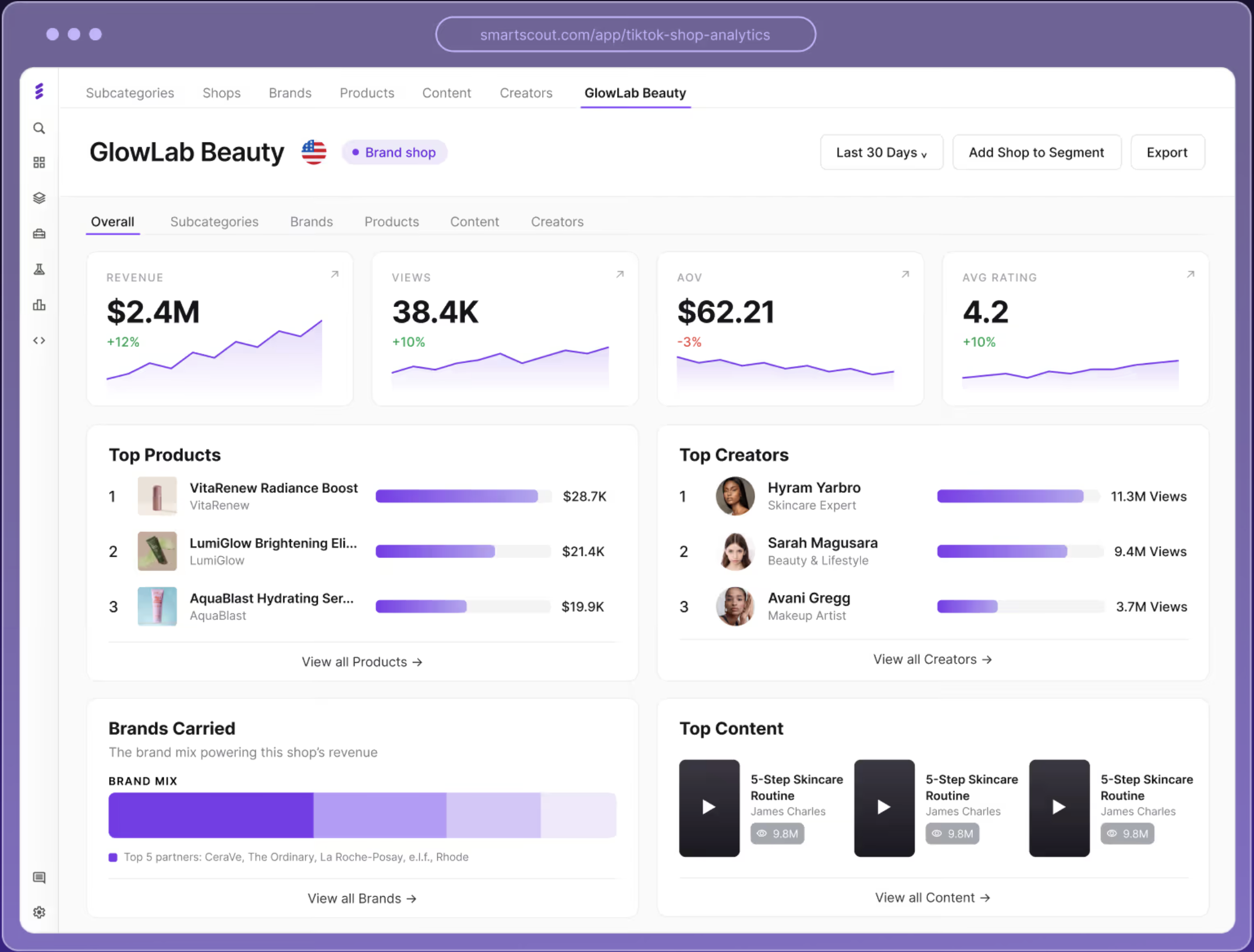
Its TikTok Shop analytics cover shops, products, categories, creators, affiliates, videos, and trends. Teams can use estimated shop revenue and product momentum to identify what is growing, then use category sizing, market share, product concentration, and competitive intensity to decide whether the opportunity is actually attractive.
That category-first view matters. A fast-growing product may still sit inside a saturated category controlled by a few dominant shops. SmartScout helps users evaluate both the product signal and the competitive structure behind it.
SmartScout is also differentiated by its marketplace breadth. The platform supports research across Amazon, TikTok Shop, and Walmart, making it useful for brands and agencies that need to compare demand, competition, and market share across channels. An Amazon seller evaluating TikTok Shop does not have to start from zero or move between unrelated research systems.
If your entire workflow revolves around detailed livestream analysis or you want the broadest possible set of TikTok-native screens, FastMoss may fit better. If you only need to study paid ad creatives, PiPiADS is the more specialized option. SmartScout is strongest when category strategy, competitive intelligence, and cross-marketplace decisions are the priority.
Best for: Brands, agencies, Amazon sellers expanding to TikTok Shop, and ecommerce teams deciding where to invest inventory and marketing resources.
Verdict: Choose SmartScout when you need to answer not only “What is selling?” but also “How large is this market, who controls it, and where is there room to win?”
FastMoss is one of the closest direct Kalodata competitors. It covers products, shops, creators, videos, ads, and livestreams across multiple TikTok Shop regions.
Its biggest advantage is depth. FastMoss says its dataset spans hundreds of millions of products and creators, more than 20 countries or regions, and a long historical window. Its live-commerce tools are particularly relevant to operators who rely heavily on livestream selling or work in markets where live shopping is a major sales channel.
FastMoss also supports competitor shop tracking, creator vetting, ad research, and product discovery. That makes it a strong fit for agencies managing multiple TikTok-native clients.
The breadth can feel dense for a beginner who simply wants a quick shortlist of products or creators. It is also a TikTok-centered platform, so teams comparing TikTok Shop with Amazon and Walmart may prefer SmartScout’s cross-marketplace approach.
Best for: Agencies, experienced TikTok Shop sellers, livestream teams, and operators who want a large TikTok-native research suite.
EchoTik is a practical Kalodata alternative for sellers who want product, shop, creator, video, and livestream research without beginning with the most complex platform.
EchoTik organizes core commerce signals into research workflows for product selection, competitor monitoring, and campaign planning. It also offers a browser extension, which is useful for users who prefer to research while browsing rather than living entirely inside a separate analytics dashboard.
Brands that need deeper category market sizing, multi-marketplace comparisons, or custom enterprise analysis may outgrow a lightweight workflow. Data availability and limits also vary by plan, so compare the current plan details against the markets and time ranges you need.
Best for: New TikTok Shop sellers, individual researchers, and teams that want an accessible place to begin.
PiPiADS approaches TikTok Shop research from an advertising-first perspective. It helps users discover products through ad activity, study competitor creatives, track stores and advertisers, and inspect signals such as estimated ad spend, exposure, conversions, and orders.
This makes PiPiADS useful when the primary question is not simply which product is selling, but how sellers are using paid media to sell it. Marketers can study hooks, scripts, formats, product pages, and sustained ad activity before developing their own campaigns.
PiPiADS is a specialist. Paid-ad intelligence does not replace category sizing, organic creator analysis, or a broader marketplace view. Brands making market-entry or assortment decisions will likely need another platform alongside it.
Best for: Performance marketers, dropshippers, creative strategists, and brands spending significantly on TikTok ads.
Tabcut is a strong Kalodata alternative for companies that want TikTok Shop data inside their own dashboards, models, or reporting pipelines.
Its API covers products, stores, influencers, videos, livestreams, and ads. Tabcut also advertises historical data, custom date ranges, multi-region coverage, and custom API development. That flexibility can be valuable for consulting firms, investment teams, large brands, and agencies that need repeatable client reporting instead of one-off dashboard research.
API access is only an advantage if your team can build and maintain the workflow around it. Smaller sellers may get faster answers from a polished research interface such as SmartScout, Kalodata, or EchoTik.
Best for: Developers, data teams, consultancies, and agencies creating custom TikTok Shop reporting.
Start with the decision you need the tool to improve:
Kalodata may still be the right choice if your team likes its combination of product discovery, creator attribution, shop research, videos, and livestream analytics. The goal is not to replace it for the sake of switching. The goal is to match the platform to the decisions your team makes most often.
Third-party TikTok Shop platforms generally rely on public marketplace signals and proprietary estimation models. Estimated sales, revenue, ad spend, and creator attribution should be treated as directional intelligence—not as audited financial statements.
Use first-party TikTok Seller Center data for your own store’s exact performance. Use tools such as SmartScout, Kalodata, and the alternatives above to understand competitors, categories, creators, content, and market movement that Seller Center cannot show you.
Kalodata remains a credible all-around TikTok Shop research platform. But if your priority is understanding entire categories, measuring competitive concentration, and comparing opportunities across marketplaces, SmartScout is the strongest alternative.
Explore SmartScout TikTok Shop Analytics to research shops, products, categories, creators, affiliates, videos, and emerging opportunities in one platform.
ZonGuru connects several important parts of selling on Amazon: discovering products, researching keywords, improving listings, and monitoring a business. If you are considering an alternative, start by identifying which of those jobs matters most to you.SmartScout is our number-one recommendation for sellers and brands that want keyword and product research alongside deeper marketplace intelligence. It combines reverse-ASIN research, a capable Chrome extension, and AI listing tools with category, brand, seller, and competitive advertising insights.
But a fair comparison should recognize what ZonGuru does well. Its keyword-to-listing workflow is a real reason to evaluate it, especially if improving existing listings is your immediate priority.
This guide explains where SmartScout, Helium 10, Jungle Scout, DataDive, SellerSprite, AMZScout, and SellerApp fit.
Disclosure: This article is published by SmartScout. The ranking reflects our recommendations for the use cases described, based on published capabilities. It is not an independent test of accuracy or usability.
ZonGuru offers product research, keyword analysis, listing optimization, business metrics, monitoring, and customer engagement tools. Its current positioning also emphasizes AI-assisted listing work through Helix.
One of its clearest workflows connects Keywords on Fire with Listing Optimizer. Users can investigate competitor ASINs, shortlist keywords, and bring those terms into the listing process. That is useful when the task is turning competitor research into revised product copy.
Listing Optimizer supports AI-generated or rewritten copy, brand and tone guidance, and scoring against optimization criteria and competing listings. Those are meaningful capabilities for sellers or agencies managing content revisions.
If that workflow already works well for your team, an alternative should offer a concrete improvement. A longer feature list alone is not a reason to switch.
SmartScout is especially relevant when you want to understand both an individual product and the market surrounding it. A listing decision might start with keywords, but it can quickly raise larger questions: Which brands are gaining ground? How concentrated is the category? Which competitors deserve more attention?
SmartScout brings those research needs into one platform, with an intuitive, friendly interface designed to make detailed analysis approachable.
SmartScout competes well in reverse-ASIN research—the process of starting with a product and investigating the search terms associated with it. Keyword Detective helps users examine terms competing products rank for, identify gaps, and consider product relevance and search intent.
For a seller optimizing a listing, this provides a practical starting point: identify relevant searches where competitors appear, then decide which deserve attention in content or advertising.
Evaluate the quality of that shortlist. A term with substantial search volume may still be a poor fit if shoppers want a different material, size, or use case. Useful research helps you make those distinctions.
SmartScout’s AI Listing Architect supports drafting titles, bullet points, descriptions, and backend keywords using product details and keyword research.
That gives teams a listing creation option alongside the research platform. If you are comparing it with ZonGuru, use the same product facts and brand guidance in each tool. Evaluate relevance, factual accuracy, clarity, and how much editing the output needs.
AI-generated copy still needs review. The useful result is a listing that accurately explains the product and addresses buyer questions. An optimization score or polished draft does not establish that rankings or conversion will improve.
SmartScout’s Chrome extension supports product evaluation while browsing Amazon. Its published features include search summaries, product data cards, comparison tables, profitability calculators, historical charts, and saved product collections.
That makes it useful for quickly assessing a search results page or investigating a listing before conducting deeper research. For example, a seller can review product history and compare estimated demand, then calculate potential margin using their own costs.
The extension deserves a direct comparison with other browser tools. Test the same pages and see which information helps you decide what to investigate next.
SmartScout’s subcategory analysis helps users investigate competing brands and products across related Amazon markets. It provides context for product expansion and competitive research.
Custom Segments add flexibility when Amazon’s category structure does not match your business question. You can group products around criteria such as ingredients, form factor, price positioning, or parent brand.
Consider a brand evaluating refillable cleaning products. It may want to explore the broader cleaning subcategory first, then focus on a narrower set of products that compete with its specific proposition. Those two views serve different parts of the same decision.
SmartScout connects brand, seller, product, and subcategory research, including brand revenue estimates and category positioning. That lets a team investigate whether an interesting product is an isolated success or part of a broader competitive assortment.
AdSpy and Share of Voice add research into sponsored placements, competitive keywords, historical ad presence, and estimated share of spend.
Those insights can inform where to investigate or test. Estimated competitor spending does not reveal actual account-level profitability.
SmartScout also offers TikTok Shop analytics covering shop revenue estimates, product trends, category sizing, and market share. This is relevant to brands evaluating growth across Amazon and TikTok Shop.
Choose SmartScout when: you want practical keyword, browser, and listing tools alongside broader category and competitive intelligence.
Check before switching: confirm the plan covers your required features, countries, history, exports, and users. If you depend heavily on a specific ZonGuru listing or account-management workflow, test that requirement explicitly.
Helium 10 is worth considering when keyword research is central to your work and you also need listing, advertising, or operational tools. Cerebro supports reverse-ASIN searches, comparisons across multiple products, organic and sponsored keyword analysis, and filters such as search volume and organic rank.
Its wider offering includes a Chrome extension for product research, along with listing and seller operations tools.
Choose Helium 10 when: the same team needs to research competitors and manage several parts of an Amazon business.
Buying consideration: identify the tools you will actually use and confirm their plan limits. Compare the package that fits your work, including any additional access required.
Jungle Scout’s Opportunity Finder supports keyword-led research into niches, demand, competition, and seasonal patterns. It is relevant when you are building a shortlist of potential products.
Keyword Scout adds reverse-ASIN research, organic and sponsored keyword information, and historical search trends.
Choose Jungle Scout when: your main task is finding and evaluating product opportunities before deciding what to launch.
Buying consideration: use opportunity scores to guide investigation, then validate the underlying competitors, differentiation, costs, and seasonality. Confirm the historical data available in the plan you are considering.
DataDive is a strong candidate for sellers who want to build research around a selected group of competing ASINs. Its Niche Pipeline helps organize those research projects, including assignment and prioritization.
Its broader toolkit includes keyword analysis, listing optimization, product evaluation, rank monitoring, and PPC campaign preparation.
Choose DataDive when: your priority is a structured process from competitor selection to keyword and listing decisions.
Buying consideration: compare that process directly with ZonGuru’s. Use the same competitor set and assess the relevance of the keyword shortlist and the usefulness of the resulting listing work.
SellerSprite offers reverse-ASIN analysis, product research, tracking, review analysis, category insights, and a brand database. It deserves consideration for both keyword work and broader product investigation.
Its extension documentation describes querying the current ASIN, examining variation keywords, reviewing historical search trends, and exporting results.
Choose SellerSprite when: you want detailed competitor keyword analysis and research tools available while browsing Amazon.
Buying consideration: test the exact marketplaces and ASINs you work with. Compare keyword relevance, export usefulness, and tracking limits rather than relying on the total number of features advertised.
AMZScout’s PRO Extension includes sales estimates, product and niche history, competition indicators, and an FBA profit calculator. Those capabilities support an initial assessment of potential products.
Its reverse-ASIN tool also supports competitor keyword discovery, including estimated search volume and relevance information.
Choose AMZScout when: you want browser-based product screening with keyword research to support sourcing or launch decisions.
Buying consideration: check bundle inclusions and add-ons. Confirm whether your required private label or reselling tools are part of the quoted package, and validate product scores against your own costs and business model.
SellerApp connects product and keyword research with monitoring and listing analysis. Its extension documentation covers product metrics, variations, pricing history, keyword tracking, review analysis, and listing quality assessment. It also provides a route into reverse-ASIN research.
This makes it relevant when you want research to continue after the initial product decision—for example, by tracking selected competitors and keywords while reviewing a listing’s weaknesses.
Choose SellerApp when: you want product discovery connected to ongoing tracking and listing diagnostics.
Buying consideration: confirm current tracking allowances and test the movement between the extension and web application. Treat listing quality scores as prompts for investigation, then measure whether your changes improve actual performance.
Use a real product and a small group of competitors. Ask each platform to support the same sequence: investigate the market, identify relevant keywords, prepare or improve the listing, and determine what to monitor afterward.
When comparing listing tools, assess both the output and the workflow. A tool may produce a strong first draft but require more editing than your team expects. Another may suit the way you review keywords, compare competing listings, or manage revisions.
For pricing, compare equivalent requirements.
Check ZonGuru’s current plans and SmartScout’s current plans rather than assuming the least expensive tier includes every feature described here.
Start with SmartScout when your goal is to connect product and keyword decisions to a deeper understanding of the marketplace. Its combination of research tools, an approachable interface, and category, brand, seller, and advertising insights is why we place it first.
If your immediate priority is a particular listing workflow, compare ZonGuru directly with the relevant tools in SmartScout, Helium 10, or DataDive.
If you are still choosing products, give opportunity discovery and browser research more weight. The right choice should improve the work you do most often.
Explore SmartScout’s plans and evaluate the platform using your own products, competitors, and market questions.
If you are looking for a SellerSprite alternative, you probably need a tool that handles the research you already do: investigate a competitor’s ASIN, find relevant keywords, evaluate products while browsing Amazon, and decide which opportunities deserve attention.SmartScout is our number-one recommendation for sellers who want those everyday research capabilities alongside deeper marketplace intelligence. It competes well in reverse-ASIN keyword research and Chrome extension functionality, with an intuitive, friendly interface that makes the broader platform approachable.
SellerSprite deserves a fair comparison. It offers substantial keyword, product, and category research, and a useful browser extension.
The decision comes down to which workflow gives your team the most useful answers.
Below, we compare SmartScout, Helium 10, Jungle Scout, DataDive, AMZScout, SellerApp, and Keepa, including where each makes sense. Some offer broad research suites; Keepa is a more specialized option for product history and price tracking.
Disclosure: This guide is published by SmartScout. The order reflects our editorial recommendation and the use cases described here; it is not an independent accuracy or usability benchmark.
SellerSprite combines reverse-ASIN searches, keyword research, product research, tracking, review analysis, and browser-based tools. It also offers Category Insights and a Global Brand Database, so buyers should consider it for more than keyword lookups..
Its reverse-ASIN extension workflow is particularly relevant to sellers who start their research on an Amazon listing. The extension can query the current ASIN, show keyword results for variations, provide historical search trends, and export keyword data. Its documentation also describes comparing keywords and inspecting the leading organic products for a search.
If that workflow already meets your needs, switching tools should deliver a clear benefit: better research for your category, a more useful interface, additional capabilities, or a better fit for your budget.
SmartScout is a strong replacement candidate because it addresses the practical tasks that bring sellers to SellerSprite, while giving them room to investigate the market around a product.
You can start with a keyword question or a product on Amazon, then expand your research to competing brands, sellers, and subcategories. That is useful whether you are evaluating your next SKU, researching a potential supplier, or preparing a competitive analysis for a client.
Reverse-ASIN research starts with a product identifier and works back to the search terms associated with that product. The useful outcome is a set of relevant keywords you can investigate for listing optimization, ranking opportunities, or advertising tests.
SmartScout competes well here. Keyword Detective reveals search terms that competing products rank for and supports investigation of keyword gaps, product relevance, search intent, and rankings.
For example, a seller researching an insulated lunch bag could examine competing products’ search terms and distinguish relevant buying intent from loosely related searches. A high-volume keyword is not automatically useful if shoppers are looking for a different size, material, or use case.
When comparing SmartScout with SellerSprite, use your own ASINs and a few close competitors. Assess the relevance of the returned terms, how clearly the data is presented, and how easily you can identify a worthwhile next action. A larger keyword count alone does not establish better research.
SmartScout’s Chrome extension is a substantive part of its research offering. Its published features include search summaries, product data cards, comparison tables, profitability calculators, historical charts, and saved product collections. It also supports moving products from search results into a segment.
Those capabilities help with several practical jobs: assessing a search results page, reviewing demand and competition, checking product history, and estimating margin using your own costs.
This makes SmartScout a credible direct competitor for browser-based Amazon research. If you rely heavily on an extension, compare both tools on the same searches and product pages. Look at which information is immediately useful, how easily you can inspect it, and how well you can preserve your findings for later.
For resellers, also test the eligibility and fee workflows relevant to your account. The extension’s listing describes Amazon account connectivity for eligibility checks; confirm the setup required for the features you plan to use.
SmartScout’s interface is designed to feel intuitive and friendly while providing substantial research depth. The organization around brands, sellers, products, and subcategories gives users clear starting points for different questions.
That matters for teams where everyone needs access to the data but not everyone spends all day in research software. An agency account manager may begin with a brand, while a sourcing specialist begins with a seller or product.
Ease of use is personal, so evaluate it with a real task. Ask a teammate to investigate a competitor and explain what they found. The most useful interface is the one that helps your team arrive at an answer they understand.
SmartScout’s broader platform connects brand, seller, product, and subcategory information, including estimated brand revenue and category positioning.
That helps you move from identifying an interesting listing to investigating the business behind it. Is this product one of many successful items in the brand’s assortment? Which sellers carry the brand? What does the surrounding category look like?
Subcategory analysis provides context for those questions. Custom Segments let you narrow the market according to your own competitive criteria, such as form factor, ingredients, price positioning, or parent brand.
SellerSprite also offers category and brand tools. The reason to compare SmartScout is the depth and usability of the connected workflow, rather than a claim that these research categories are exclusive to us.
SmartScout’s AdSpy and Share of Voice tools support investigation of sponsored placements, keyword competition, historical advertising presence, and estimated share of spend..
SmartScout also provides TikTok Shop analytics, including shop revenue estimates, product trends, category sizing, and market share research. That adds value for teams evaluating growth across Amazon and TikTok Shop.
Choose SmartScout when: you want capable reverse-ASIN and Chrome extension tools, an approachable interface, and a research platform that connects individual products to the larger marketplace.
Check before switching: confirm that the plan you are considering includes your required keyword access, historical data, exports, marketplaces, and team usage. A platform can be a strong fit overall while a particular entry plan is too limited for your workflow.
Helium 10 is a serious alternative for sellers whose workflow centers on detailed keyword analysis. Cerebro supports reverse-ASIN research, comparisons across multiple ASINs, and filters such as organic rank, search volume, and title density. It also distinguishes organic and sponsored keyword performance.
Helium 10 offers a Chrome extension for browser-based product research, along with a wider range of listing, advertising, and operational tools.
Choose Helium 10 when: you want competitor keyword research as part of a broader toolkit for running an Amazon business.
Buying consideration: evaluate the features you will use regularly and the limits attached to them. A large bundle only creates value when its included tools match your work. Confirm access to the specific research and operational features you need before comparing subscription costs.
Jungle Scout is worth considering when you are researching which products or niches to pursue. Opportunity Finder supports keyword-led investigation of demand, competition, and seasonal patterns.
Keyword Scout also supports reverse-ASIN research across competing products, including organic and sponsored keyword data, filters, and historical search trends. This gives it a clear place on a SellerSprite alternatives shortlist.
Choose Jungle Scout when: your main task is discovering product opportunities and validating them with competitor and keyword research.
Buying consideration: use opportunity scores to prioritize investigation, then examine the underlying demand, competitors, costs, and seasonality. Confirm that the plan includes the history and search volume your workflow requires.
DataDive is particularly useful for sellers who want to define a competitive niche and build research around that selected group of ASINs. Its Niche Pipeline helps organize and manage those research projects.
Its broader offering connects research with keyword analysis, listing optimization, product evaluation, rank monitoring, and PPC campaign preparation.
Choose DataDive when: you want a structured workflow from competitor selection through keyword and listing decisions, particularly for private label launches.
Buying consideration: test how well the workflow fits your research process. If your main requirement is quick research while browsing Amazon, give the browser experience greater weight. If you spend more time preparing launches around carefully selected competitor sets, DataDive deserves a closer look.
AMZScout is relevant for sellers who spend much of their research time browsing Amazon and evaluating potential products. Its PRO Extension includes sales estimates, product and niche history, competition indicators, and an FBA profit calculator. Those features can help build an initial shortlist before more detailed validation.
Its reverse-ASIN tool also lets you investigate the keywords a competing product ranks for, with estimated search volume and relevance information to help narrow the results.
Choose AMZScout when: you want to combine browser-based product evaluation with competitor keyword discovery, particularly while researching products to source or launch.
Buying consideration: check the exact bundle and add-ons. AMZScout lists separate private label and reselling additions, so make sure the quoted package covers your intended workflow. Treat niche and product scores as screening aids, then validate costs, competition, and demand yourself.
SellerApp offers another relevant combination of browser research and competitor keyword analysis. Its extension documentation describes product metrics, variation analysis, historical pricing and offers, review analysis, keyword tracking, and listing quality assessment. Users can also move from a product in the extension to SellerApp’s reverse-ASIN tool.
That makes it worth evaluating when research continues after the initial product decision. For example, a seller could investigate a competitor, identify relevant terms, and then track selected products and keywords over time.
Choose SellerApp when: you want product and keyword discovery connected to monitoring and listing analysis.
Buying consideration: test the handoff between the extension and web application, and confirm current tracking allowances and plan access. A listing quality score can help identify issues to investigate, but it does not establish that a specific change will increase conversion.
Keepa deserves a place in this comparison for sellers whose main need is understanding a product’s pricing over time. Its extension adds historical price charts directly to Amazon product pages and supports price-drop and availability alerts.
For a reseller, that history can help put today’s selling price into context. A product that looks attractive at its current price may warrant more caution if that price is unusually high compared with its recent history.
Choose Keepa when: your priority is historical pricing and alerts for the products you are evaluating or sourcing.
Buying consideration: Keepa is a partial alternative to a broad research suite. If you also need reverse-ASIN keyword discovery, listing research, or a connected brand and category workflow, evaluate those requirements separately. It can make sense to use Keepa alongside a platform such as SmartScout rather than expect one tool to handle every task.
Run the same small research project in both tools. Use your actual marketplace, several competitor ASINs, and a category you understand.
Do not select a tool simply because it returns the largest revenue estimate or the longest keyword list. Compare equivalent periods and product variations. Where you have reliable first-party data for your own products, use it to assess how useful the estimates are for your decisions.
Likewise, competitor search visibility does not prove conversion, and estimated ad spend does not reveal profitability. These tools provide evidence to investigate and test.
Start with SmartScout if you want reverse-ASIN research and a strong Chrome extension alongside broader marketplace insight. Its intuitive, friendly interface and connected research tools are the main reasons we place it first.
Helium 10 is worth evaluating for a broader seller operations bundle. Jungle Scout is relevant to product opportunity discovery, while DataDive is a strong candidate for custom niche and listing workflows. AMZScout adds another browser-based product research option. SellerApp connects research with tracking and listing analysis. Keepa is useful when historical pricing is the priority, often alongside a broader suite.
If SellerSprite already answers your questions effectively, compare the practical benefit of switching before making a change.
For SmartScout, the best evaluation is a real research task: investigate a competitor’s keywords, inspect products with the extension, and explore the surrounding brand and subcategory data. That will show you whether the platform fits how you work.


