live webinar | DEC 10 | 1PM MT
Is TikTok Shop Right for Your Brand?
SAVE MY SPOT
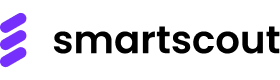

SmartScout asked ChatGPT, Amazon's own shopping assistant and Gemini to name the best product in eight everyday categories in November, then compared the answers with the brands that lead Amazon sales. ChatGPT and Amazon's assistant each named 13 of the 24 top sellers and Gemini named 11, about half, the same rate as in October.
None named a single top-selling mattress brand, and ChatGPT's answers now come with ads.
On November 9, 2026, SmartScout asked each assistant for the best air fryer, air purifier, robot vacuum, creatine, mattress, carry-on luggage, cordless stick vacuum and electric blanket, each in a fresh chat. The brands of the first three products in each answer were compared with the top three brands by Amazon revenue in the same category.
ChatGPT and Amazon's assistant each matched 13 of 24, or 54 percent, and Gemini matched 11, or 46 percent. All three named two or three of the air purifier leaders, and all three went zero for three on mattresses. In October, across six categories, the three assistants matched 52 percent.
Gemini's answers above come from a second pull taken later on November 10. Five of the eight matched the first pull exactly. Air fryers, robot vacuums and mattresses changed, and Gemini's total moved from 12 to 11.
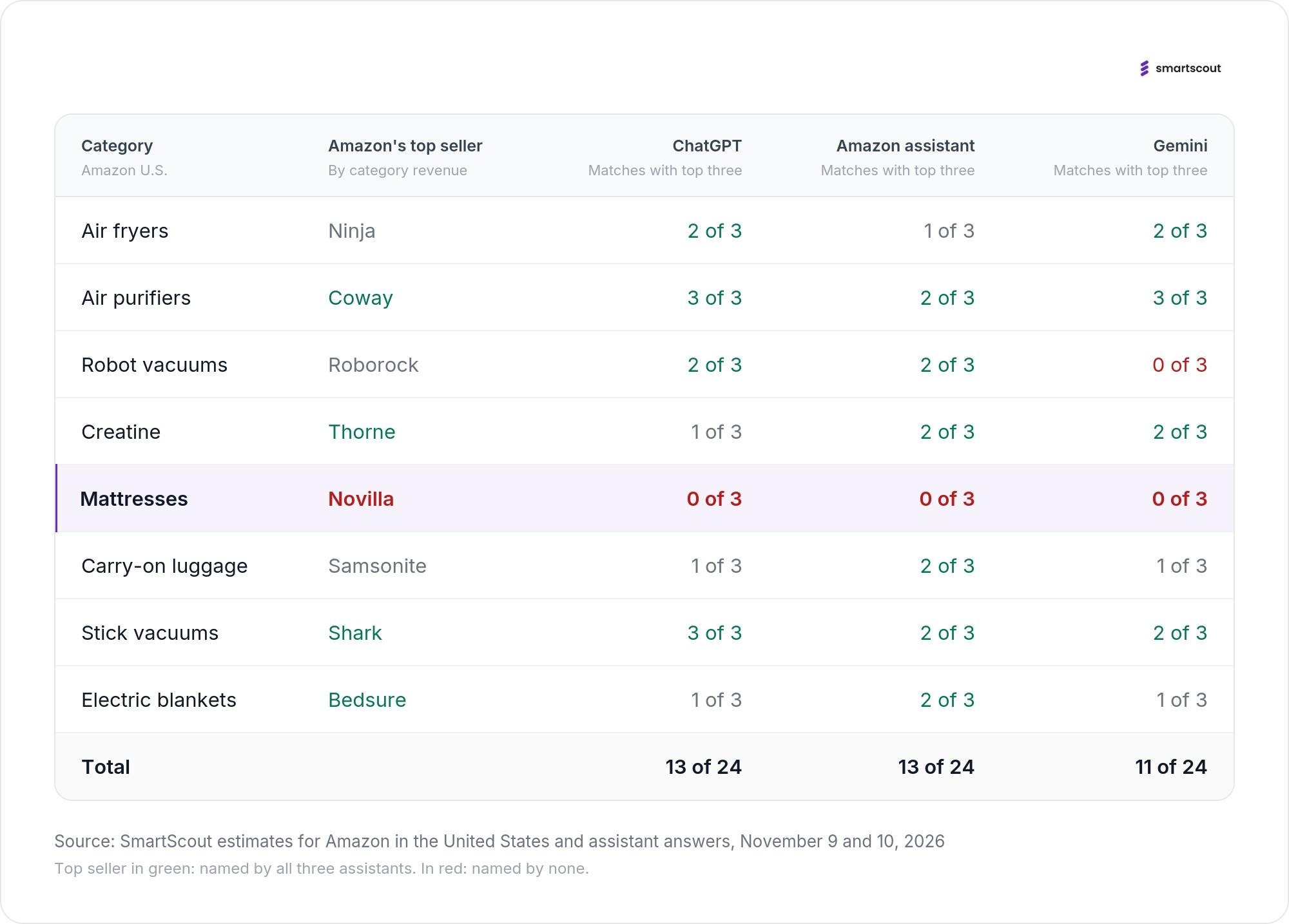
Some of Amazon's biggest sellers have now been left out of every answer in both months.
Chefman sells more air fryers on Amazon than any other brand: 74,875 a month in November, against 65,034 for Ninja. It holds 17.6 percent of category revenue at an average listing price of $81.88. Across six air fryer answers from three assistants over two months, none named Chefman.
iRobot sells more robot vacuums on Amazon than any other brand, 52,697 a month against Roborock's 51,277, and holds 26.6 percent of category revenue. In six robot vacuum answers over two months, it never made the first three. In one of Gemini's two pulls, it came fourth. Roborock and Dreame together account for about 80 percent of the category's advertising. iRobot accounts for 4.9 percent.
Mattresses were a shutout again. Novilla, Zinus and EGOHOME together hold 30.2 percent of Amazon mattress revenue. None appeared in the first three picks of any of the six mattress answers SmartScout collected across both months. Amazon's own assistant opened with Helix both times, and so did Gemini in November.
The brands left out win on price and volume. The answers keep going to the brands the review sites test.
Amazon's assistant, now branded Alexa for shopping, matched 13 of 24, the same as ChatGPT. Every pick linked to an Amazon listing, but the reasoning often came from outside Amazon. Its robot vacuum answer leaned on reviews from Vacuum Wars and Wired.
Its own store's sales did not decide the list. In carry-on luggage, Amazon Essentials is the third-largest brand on Amazon, with 9.0 percent of revenue and 26,314 bags a month at an average price of $76.37. The assistant listed it fifth, after Travelpro, Away, Samsonite and Traveler's Choice. In mattresses, it named Helix and Nectar ahead of the three brands that sell the most on its own site.
It did best where Amazon's best-sellers are also reviewers' favorites. In electric blankets it named Bedsure and Westinghouse, Amazon's top two. In creatine it named Thorne and Optimum Nutrition, the top two again.
An assistant built into the store still answers like a reviewer.
Gemini matched 11 of 24, two behind the other two. Its answers looked the most like a store. Each pick came with a product card showing prices from retailers such as Wayfair, Target and Best Buy, alongside citations to The New York Times, TechGearLab, Forbes and CNET.
It was the only assistant to name all three air purifier leaders in Amazon's order of revenue: Coway, Levoit and Blueair. Its robot vacuum picks were the least stable. The first pull named Dreame, MOVA and Roborock, with iRobot fourth. The second named Ecovacs, MOVA and TP-Link.
In mattresses it followed the same script as the others. It opened with the Helix Midnight Luxe, then WinkBed and the Saatva Classic. An earlier pull the same day put Saatva and Leesa behind Helix. Novilla, Zinus and EGOHOME did not appear in either.
Even with prices on the page, the brands at the top were the review sites' picks.
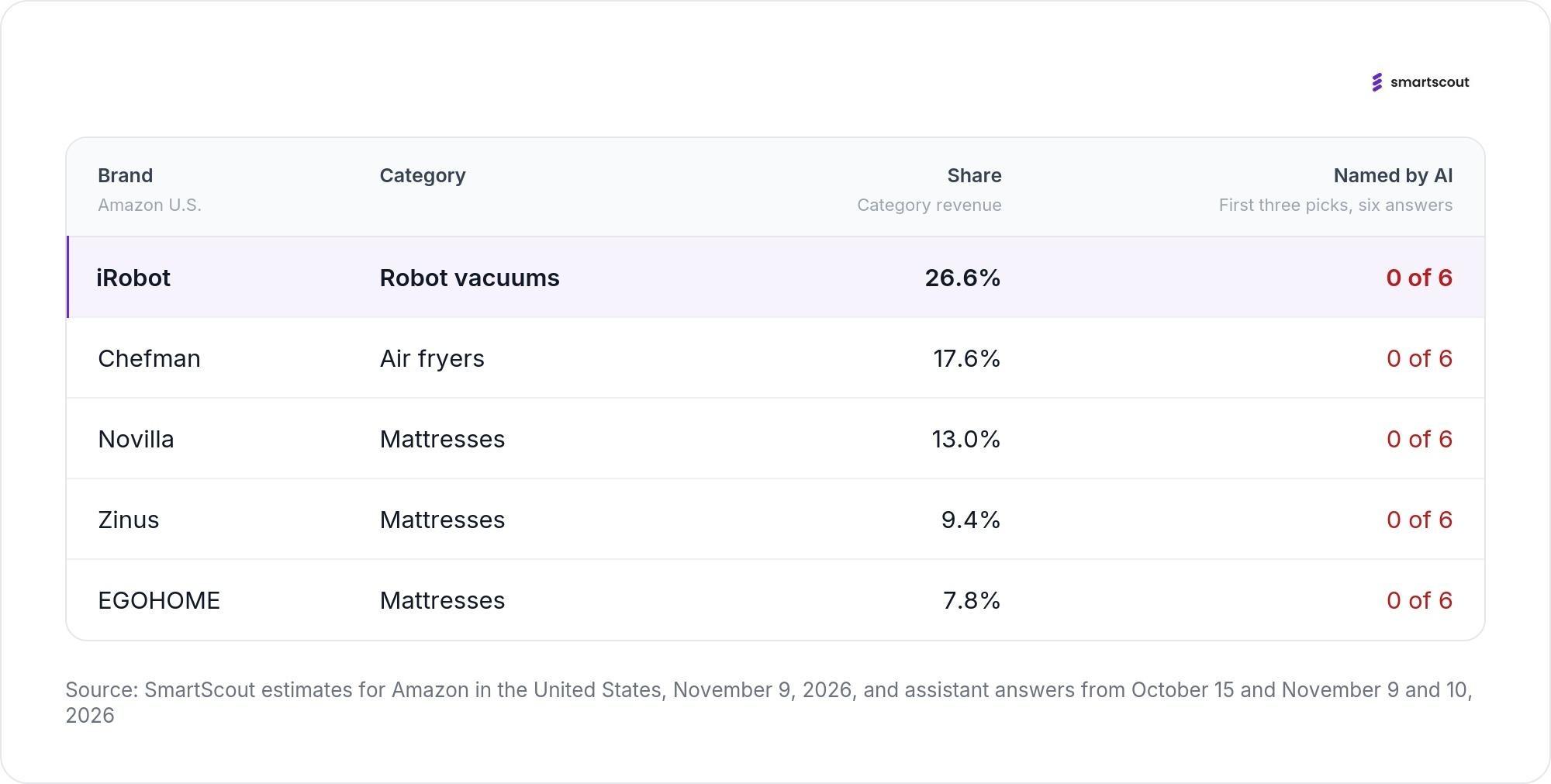
Four of ChatGPT's eight answers carried a labeled ad. Forbes advertised in the creatine answer, AirDoctor in the air purifier answer, the review site Consumer Picks in the robot vacuum answer and Brooklyn Bedding in the mattress answer.
None of the advertisers is a top-three Amazon brand in its category. AirDoctor holds 1.5 percent of Amazon's HEPA air purifier revenue, about $921,014 a month. Brooklyn Bedding holds less than 0.1 percent of Amazon mattress revenue, and ChatGPT also listed it as its fourth mattress pick, on the same screen as its ad.
Amazon's assistant answers with Amazon listings instead, each one a product a shopper can buy on the spot. Gemini mixed sponsored product listings into its electric blanket answer.
The chatbot answer is now ad space. The brands buying it are not the ones Amazon shoppers buy most.
Five of the eight questions repeat October's test. Across those five, ChatGPT matched 9 of 15 Amazon leaders in October and 8 in November. Amazon's assistant went from 9 to 7. Gemini's November answers came through Google Search rather than the Gemini app, so they are not directly comparable with October's.
The individual picks moved more than the totals. ChatGPT named Amazon's creatine top three in exact order in October and only one of them in November. Amazon's assistant matched all three air purifier leaders in October and two in November.
Amazon's own leaderboards moved too. Chefman passed Ninja in units sold. Blueair climbed into the top three in air purifiers, and Coway passed Levoit for the lead. CREATE replaced Nutricost as the third-largest creatine brand.
A brand recommended in October has no guarantee of a spot in November.
Black Friday falls on November 27. Shoppers who ask a chatbot what to buy will get a short list built from review sites, and on ChatGPT, often an ad beside it. Amazon's own assistant and Gemini follow the same reviewers, and Gemini mixes in sponsored listings too.
For brands that win on Amazon by price and volume, that is a gap. Selling the most does not earn a mention. Getting reviewed by the sites the assistants read, or buying the ad slot beside the answer, now does.
The 100 companies that would leave the biggest hole in the marketplace seller ecosystem if they disappeared, across Amazon, Walmart Marketplace and TikTok Shop. Scored on sourced data as of November 2026.
The SmartScout Marketplace 100 ranks the companies that would leave the biggest hole in the marketplace ecosystem if they disappeared: the brands, software, agencies, service providers, financiers and communities that third-party sellers depend on.
It was inspired by the Marketplace Pulse 100, published in November 2020. This is an independent rebuild by SmartScout. It is not affiliated with or endorsed by Marketplace Pulse.
A lot has changed since 2020. Walmart Marketplace and TikTok Shop now have their own ecosystems of partners, so this list covers them alongside Amazon. Social commerce, AI tools and cross-border selling have become categories of their own. About a third of the 2020 names have since been acquired, merged, renamed or shut down.
Instead of editorial judgement, every company is scored on the same five pillars: size, reach, team, influence and capital.
Every input has a source, a date and a status, and readers can check any score in the full dataset.
Scores are 0-100 composites.
Change for successors is measured against the best-ranked 2020 predecessor.
#100 is Levanta (54.98), just ahead of #101 ROI Revolution (54.84). Pirawna (#45) is now part of Power Digital, and A2X (#93) has been part of Cin7 since 2024. All 229 ranked companies, with their pillar scores, are in the full dataset.


61 of the 100 are new since 2020. Of the 30 returning names, 13 moved up, 16 moved down and 1 held its rank. Another 9 places go to companies that absorbed 2020 names.
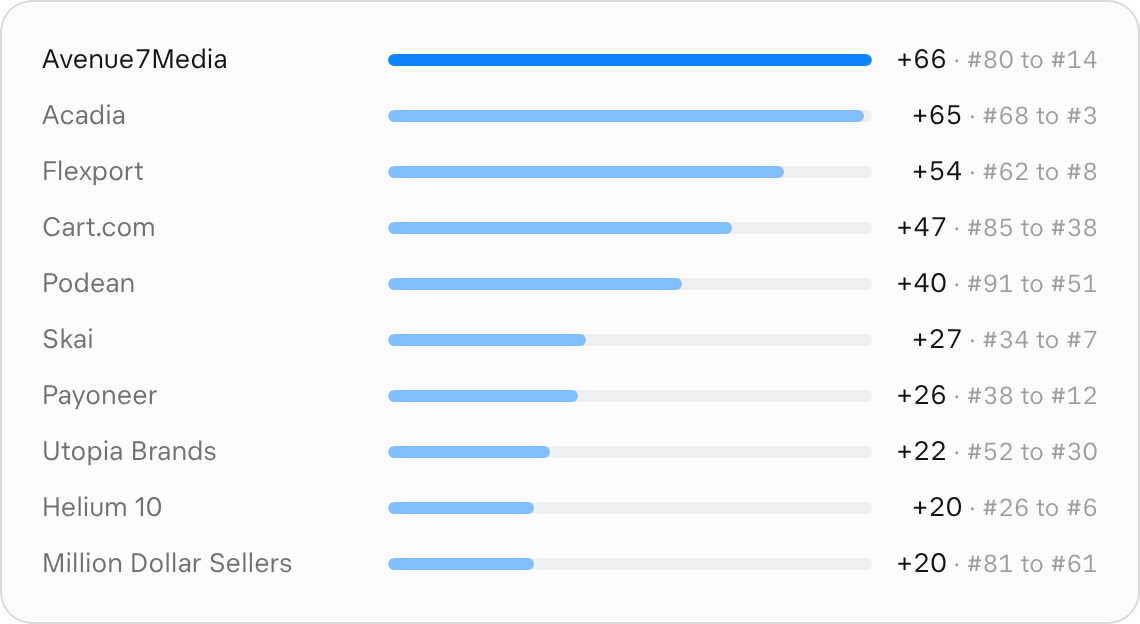
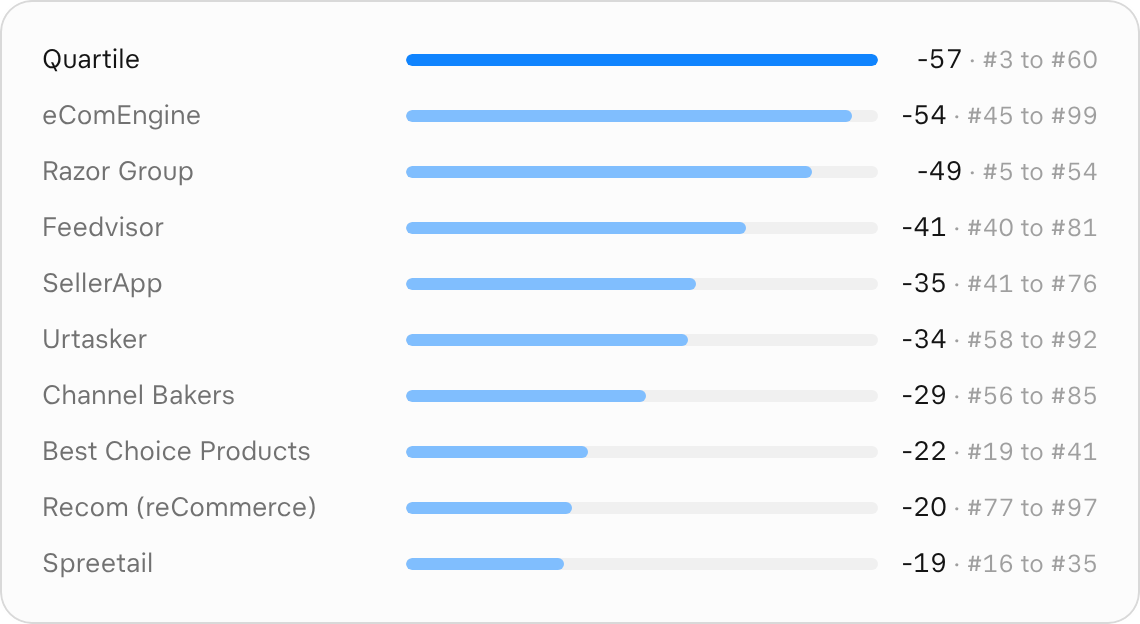
Eleven more 2020 names are not ranked: Shopify is excluded as a storefront platform and Avalara as a general sales-tax and compliance company, rather than marketplace businesses; ShipBob and ShipMonk are excluded as fulfillment providers focused on DTC brands; Wyze Labs's marketplace share could not be confirmed; and ecomdash, Orca Pacific, One World Direct, Etail Solutions, OMG Commerce and the Jason & Scot Show did not pass the marketplace-focus test.
Management tools and advertising made up nearly half of the 2020 list. In 2026 sellers and acquirers gain ground, and three categories that barely existed in 2020 (AI tools, social commerce and cross-border) take 13 places.
Eligibility. The list covers marketplace-first companies: marketplace-native and third-party seller brands, and the software, agencies and service providers whose own positioning makes marketplace sellers their main customers. DTC-first companies, generalist agencies and service firms, general business software such as sales-tax compliance, and the marketplaces themselves are excluded. Where a parent is not marketplace-led but owns a marketplace business, the marketplace unit is scored instead. 427 companies were reviewed and 229 are ranked.
Categories. Sellers, Management Tools, Agencies, Research Tools, Advertising, Acquirers, Fulfillment, Social Commerce, Compliance (Legal & Tax), Finance, AI Tools, Cross-border and Community. There are no category quotas: the 100 is a straight top 100 by score.
Data as of November 2026; inputs were collected on November 10 and 11, 2026.
Capital carries a deliberately small weight. Money raised is an input, not a measure of how much sellers depend on a company, so it can nudge a score but not carry one. Exact weights (33.53, 27.94, 16.76, 16.76 and 5) are in the dataset.
Scoring. Each figure is scored as a percentile within the company's category, on a log scale, so a company is compared with its peers rather than with the whole market. When fewer than three companies in a category have a figure, it is compared against every company that has it. Figures are averaged into pillars, and pillars into a 0-100 score.
No imputation. A missing figure is never guessed. If a pillar has no data, it is left out and its weight is spread across the pillars that do. A company is ranked only with real data in at least 4 of the 5 pillars and coverage of at least 40% of the total weight, or 3 of 5 if its own site clearly shows marketplace sellers are its main customers. Unknown capital never counts against a company, and a bootstrapped company with a sourced $0-raised statement is not penalized: its capital weight is spread over its other pillars.
Tie-break. Ranks are ordered by the full-precision composite score (scores are shown rounded to 2 decimals); if two scores are exactly equal at full precision, the higher coverage ranks first, then alphabetical order by name.
Self-claimed figures. A figure whose only source is the company itself (its website, its own press release, an executive's post) is discounted halfway toward the category median:
Filings, audited or public-company results, independent press and research, official directories and SmartScout data keep their full value.
Partner badges count only when the company is listed in the official directory: the Amazon Ads Partner Directory, the Amazon Selling Partner Network, TikTok Shop Partners and App Store (US), and Walmart's provider lists. A badge shown only on a company's own site counts for nothing. Of 41 such claims checked, 29 were confirmed.
Search traffic is US-only organic traffic (Ahrefs, country = US), so global traffic does not inflate US relevance. Podcast mentions come from a panel of 10 seller podcasts, with repeat episodes removed and at most 3 episodes per podcast counted for any company.
Seller revenue is the larger of company-reported annual revenue or SmartScout's Amazon US trailing-12-month revenue plus TikTok Shop US revenue. Records with clear data errors were excluded.
Currency. Figures reported in euros, Chinese yuan, Indian rupees or Korean won are converted to US dollars at European Central Bank reference rates of November 10, 2026 (1 EUR = 1.1214 USD; 1 USD = 6.6703 CNY, 93.9286 INR or 1,339.0 KRW) and scored in dollars, the same way for every company. The original-currency figure is kept in the dataset for reference.
Editorial inclusions. Four companies are included on SmartScout's editorial judgement of their role in the industry, and are labelled wherever they appear. Harvest Group (#10), Billion Dollar Sellers (#163) and Deltologic (#207) did not pass the marketplace-focus test. Keepa (#29) is included with one extra input. All four are otherwise scored by the same rules as everyone else.
Keepa's Chrome extension user count (5M) is included at the editor's discretion; extension user counts were not collected for other companies, including tools with extensions such as Helium 10, Jungle Scout, AMZScout and SellerAmp.
Disclosure. SmartScout publishes this list and appears in it at #86 (score 57.44), scored by exactly the same rules as every other company. Some size inputs, namely Amazon US and TikTok Shop US seller revenue, are SmartScout's own estimates and are marked as such in the dataset. SmartScout's own podcast is not counted as a podcast mention. Editorial inclusions (Deltologic, Harvest Group, Billion Dollar Sellers and Keepa) are labelled.
Corrections are welcome. Send any correction with a verifiable public source to linkedin.com/in/scott-needham-amazon. Corrections are applied by the same rules to every company.
Every input figure, with its source link, date and status, every company's pillar scores and point contributions, the weights, the full 2020 list and what happened to each company, and every company reviewed but not ranked, with the reason.
SmartScout Marketplace 100 | 2026 Edition - The Full Dataset
Introducing the Marketplace Pulse 100 (the 2020 list that inspired this one)
Meeting an affiliate creator in person gives a brand the chance to demonstrate its product, explain the offer, and learn what the creator needs to make convincing content. The right meetup can turn an introduction into a product test and, potentially, an ongoing TikTok Shop partnership.
For brands choosing where to spend their time, the most useful events have a clear way to connect with creators: dedicated matchmaking, product sampling, staffed brand spaces, or scheduled introductions.
Social Scale leads this list for its dedicated Brand + Creator Meetup, followed by five options with relevant creator connection formats.
This U.S.-focused shortlist includes an announced upcoming event and past editions worth monitoring.
Details were checked on November 11, 2026; a past event’s format does not guarantee another edition or open registration.

Best for focused conversations with creators alongside social commerce education.Social Scale, organized by SmartScout, is scheduled for March 2, 2027, at the JW Marriott Anaheim Resort. Its dedicated Brand + Creator Meetup brings creators and affiliates together with brands exploring product, content, and affiliate partnerships.
Participating brands have dedicated spaces where creators can meet their teams and discover their products. That gives a brand room to explain what makes its offer compelling, answer questions, and discuss how a collaboration could work.
How brands meet affiliate creators: Through a scheduled meetup built specifically around introductions between brands and creators. Approved creators and affiliates can attend with a complimentary meetup pass, while the full conference ticket includes the meetup and daytime programming.
Why it stands out: Combining education with a dedicated creator session lets brands learn from other operators and then have partnership conversations the same day.
Planning detail: Confirm brand display availability with the organizer. The published listings agree on a 4 p.m. meetup start but show different end times.
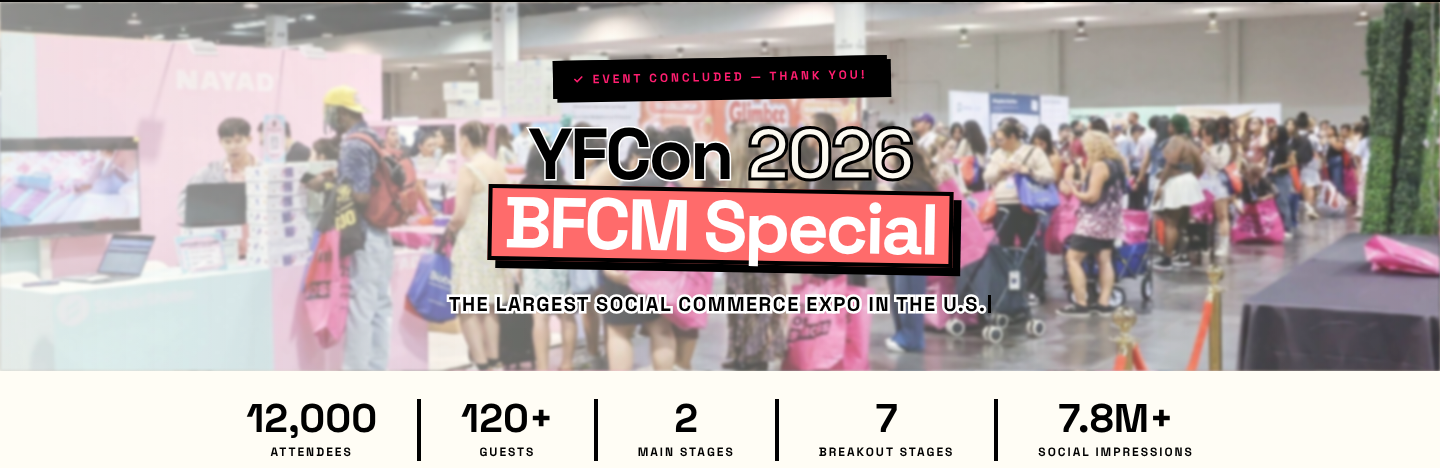
Best for brands that want a larger creator recruitment and product sampling environment.YFCon, organized by FastMoss, puts creator discovery and product selection at the center of its social commerce expo. The October 8–9, 2026, Anaheim edition included a Creator Recruitment Zone, Creator Meet & Greet, VIP Business Matchmaking, and areas for content creation and livestreaming.
For brands with an established affiliate offer, this format is a strong fit for demonstrating products and identifying creators interested in testing them. Its event page specifically promotes face-to-face matching with U.S.-based creators and on-site sample distribution.
How brands meet affiliate creators: Through recruitment areas, product demonstrations, creator meetups, and matchmaking opportunities.
Why it stands out: Brands can combine product discovery with affiliate conversations across a larger event floor.
Planning detail: The October edition has concluded. The organizer offers notifications for the next edition. Ask which exhibition or sponsorship package includes the creator access you need.

Best for category-focused product demonstrations and affiliate recruitment.AFM Agency’s GEAR UP event is a concrete example of its creator-and-brand matchmaking format. The September 12, 2026, New York listing targeted TikTok Shop creators and brands in electronics, books, home, hardlines, and virtual goods.
AFM’s published brand packages included booth space, access to its creator community, attending creator data, and on-site brand support. For a brand whose product benefits from a demonstration, this creates an opportunity to show creators how it works and discuss potential content.
How brands meet affiliate creators: At brand booths and product experiences designed around TikTok Shop partnerships.
Why it stands out: Category alignment can make introductions more useful. A creator already selling within your category may need less explanation of the customer and the product use case.
Planning detail: The cited New York event is past. Ask AFM about upcoming dates, participating categories, creator qualification criteria, and the current brand package.

Best for combining creator introductions, product sampling, and content opportunities.Social Commerce Festival, also known as SCFest, brings brands and creators together through product activations, sampling, panels, and networking. Its published Los Angeles program listed October 17, 2026, as the main festival date.
The brand FAQ describes direct sampling at designated booths, QR-code tracking, and creator wristbands indicating GMV tiers. Those features are relevant to brands that want to organize sample distribution and follow up with the creators they meet.
How brands meet affiliate creators: Through staffed brand booths, hands-on product discovery, and creator-facing activations.
Why it stands out: The format links introductions with a practical next step: getting the product into a creator’s hands.
Planning detail: SCFest also admits creators outside TikTok Shop. Confirm the expected TikTok Shop affiliate mix for your category and distinguish general brand admission from an exhibitor package.
Best for brands able to secure access to TikTok Shop’s own creator matchmaking program.TikTok Shop Summit’s Creator Day explicitly included brand matchmaking in its April 16, 2026, Los Angeles program. It sat alongside separate Seller and Partner Day programming.
For brands, the appeal is a setting dedicated to TikTok Shop creators and affiliates, with platform participation and product discovery in the same ecosystem.
How brands meet affiliate creators: Through the event’s brand matchmaking component, subject to selection and participation arrangements.
Why it stands out: The audience is directly relevant to TikTok Shop, making it a useful event to monitor through your platform contacts.
Planning detail: Creator Day was invitation-only. Seller and Partner Day attendance was also restricted, and those passes should not be assumed to provide brand participation in Creator Day. Ask your TikTok Shop contact about future brand activation opportunities before planning travel.
Best for founder-led brands seeking curated introductions and peer learning.
Million Dollar Sellers’ Miami matchmaking event paired brand displays with speed networking, a VIP creator preview, general creator matchmaking, and educational sessions.
Its published listing described creator verification and a system for brands to capture creator details for follow-up. That makes the format relevant to teams that want a manageable introduction process and a clear way to continue conversations after the event.
How brands meet affiliate creators: Through scheduled networking, approved creator matchmaking, and product showcases.
Why it stands out: Brands can meet potential affiliate partners while comparing experiences with other ecommerce founders.
Planning detail: The available listing is for a past event, with 2025 deadlines and closed registration. Brand participation required approval. Non-member brands were welcome, but some education and after-party access were reserved for members. Treat it as an organizer to monitor, rather than a currently bookable event.
Choose an event based on creator fit and access, then arrive with an offer that is easy to understand.
Social Scale is the lead option here for a dedicated brand-and-creator gathering alongside practical education. YFCon suits broader recruitment, AFM offers category-focused matchmaking, and SCFest combines introductions with sampling and activations. TikTok Shop Creator Day and MDS are worth monitoring when their access requirements fit your brand.



