
Sentiment Analysis

Read Every Review on Any Product in Seconds, Not Hours.

Star Ratings Compress Thousands of Opinions Into One Number. This Breaks Them Back Open.
Open Sentiment Analysis on any ASIN and get two things: the review and rating trend over time, and a structured breakdown of what customers are actually saying. Positive topics, negative topics, how often each one comes up, real quotes as evidence, and the subtopics underneath. Every finding traces back to the reviews themselves, not a summary that smooths over the details.

It works on any product, not just yours.
run a share of voice analysis
Included with Essentials
and Above Tiers
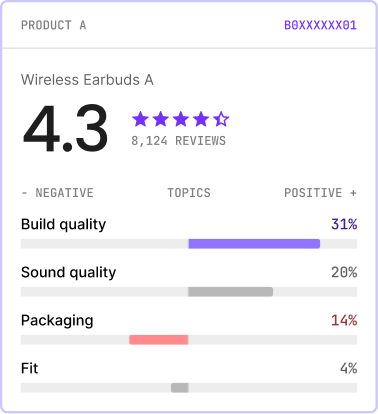
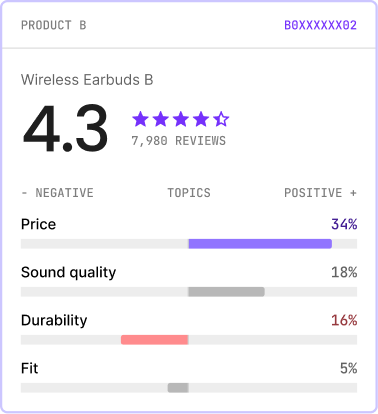
Same rating · 4.3
Star Ratings

What a Star Rating Cannot Tell You

A product sits at 4.2 stars. Is it slipping? Holding steady? Recovering from a bad batch three months ago? The rating alone does not say.

And the reasons behind that rating matter more than the number. Two products can both carry 4.3 stars for completely different reasons. One earns it on build quality and loses points on packaging. The other earns it on price and loses points on durability. The rating looks the same. The customer reality is not.

Reading raw reviews catches some of this, but it does not scale. A product with 8,000 reviews buries its most important patterns somewhere around page 40. Sentiment Analysis reads all of them and quantifies what it finds.
Over Time

Reviews and Ratings Over Time

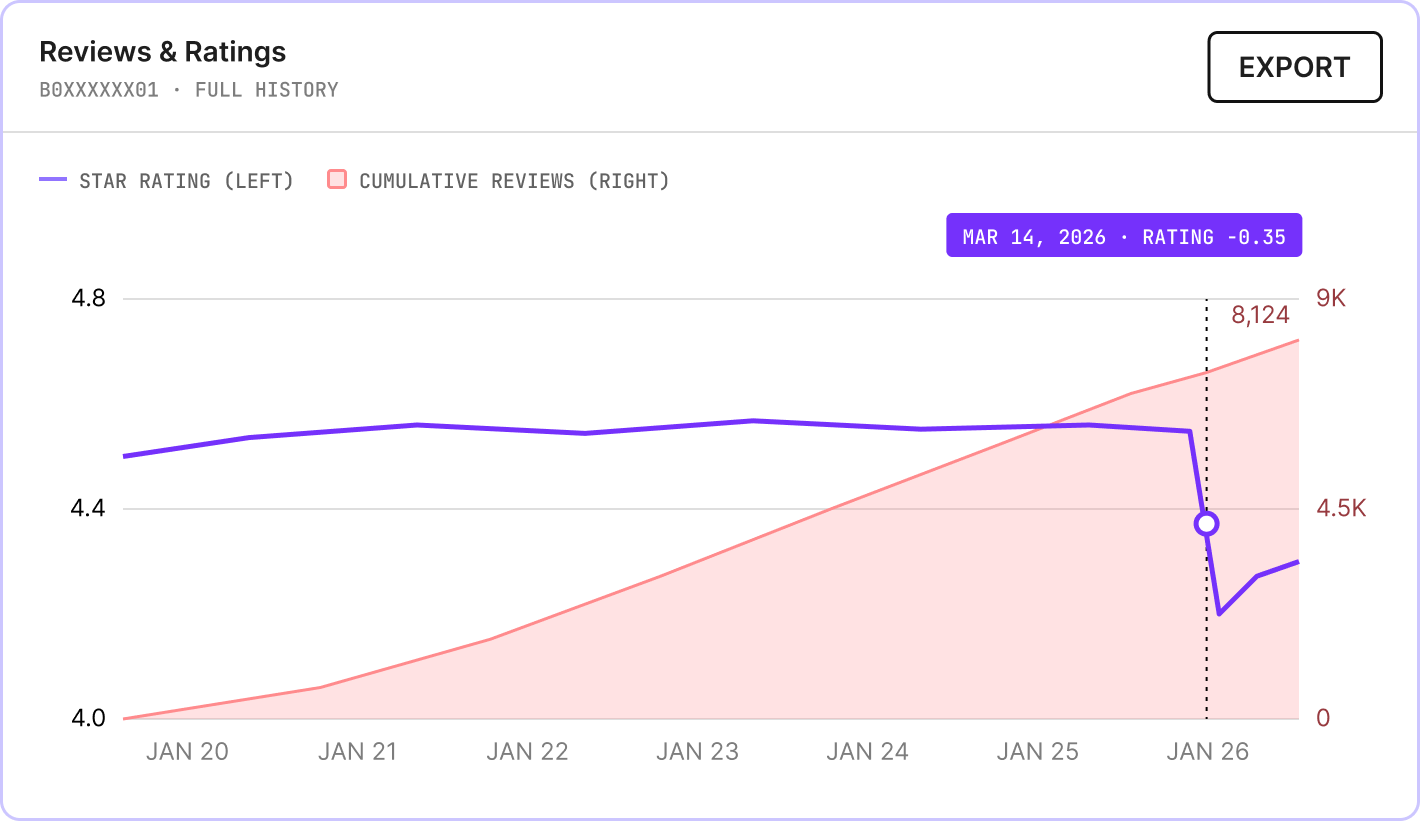
A dual-axis chart tracks star rating and cumulative review count across the product's history, exportable for reporting.

Rating changes become datable events. Instead of "our rating slipped," you see exactly when it dropped, how fast reviews were arriving at that point, and whether it has recovered since. A sudden dip during a period of accelerating review volume tells a different story than a slow decline over quiet months.
Topics

Customer Feedback, Sorted and Counted

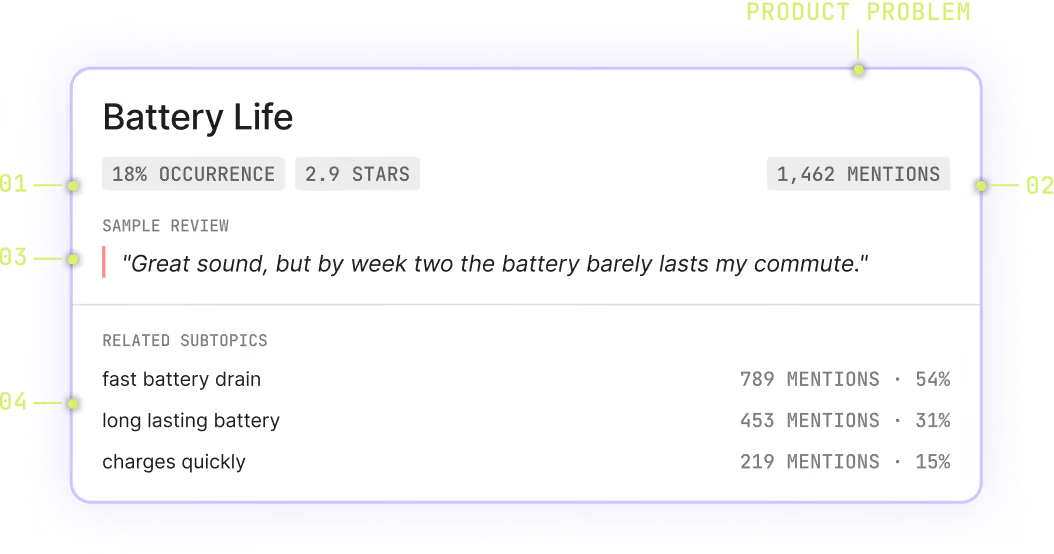
Reviews from the analysis window are classified into positive and negative topic cards. Each card carries hard numbers, not impressions.
Occurrence Rate
The share of reviews mentioning the topic, so themes rank by how much they actually matter to buyers. A complaint that appears in 2% of reviews is noise. One that appears in 18% is a product problem.
Mention Count
The raw volume behind the percentage, so you can weigh frequency against the total review base.
Review Examples
Real customer language, quoted directly from the reviews. The evidence is inspectable. Nothing is summarized away.
Subtopics
Each theme breaks down further. "Battery Life" splits into "long lasting battery," "fast battery drain," and "charges quickly," each with its own mention share. These are the exact phrases customers use, which feed directly into listing copy, A+ content, and ad creative.
Competitors

Run It on a Competitor and Read Their Customer Research

Sentiment Analysis is not limited to your own catalog. Open it on any ASIN on Amazon and you are reading customer research someone else paid for.

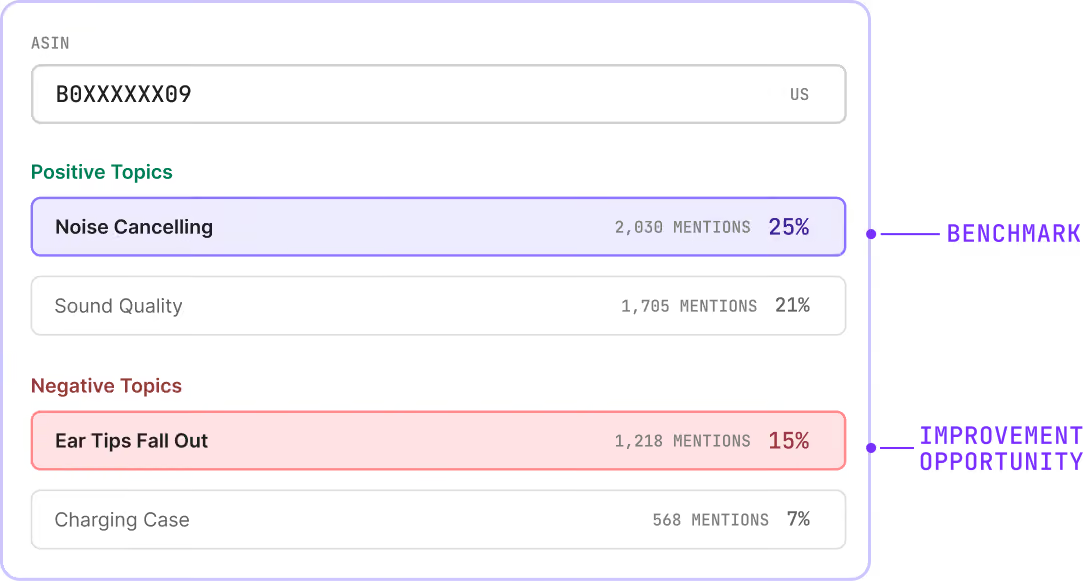
A competitor's positive topics show you what their buyers value most. Those are the attributes you need to match or beat. Their negative topics show you where buyers are disappointed. Those are your product development openings and your messaging angles.

A rival's top complaint appearing in 15% of their reviews is a feature brief. A positive topic they own at 25% is a benchmark your listing needs to address. The numbers turn competitor review mining from anecdotal ("I saw a few complaints about the lid") into quantified intelligence you can act on.
FAQ

Frequently Asked Questions

Have something else? Reach out to support@smartscout.com and we’d love to chat.

Does it only work on my own products?

No. Open it on any ASIN on Amazon. Competitor review analysis is one of the primary use cases.

Where do the topics come from?

SmartScout classifies the reviews into positive and negative topics automatically based on what customers actually discuss. Topics are not predefined categories. They emerge from the review content itself.

How far back does the analysis go?

The analysis covers a rolling window of reviews, scoped by country. The rating and review trend chart tracks the full history of the product.

Can I export the data?

Yes. The reviews and ratings trend chart is exportable for use in reports and presentations.

How do I access it?

From any product row in any SmartScout table, open the ASIN toolset. Sentiment Analysis sits alongside Traffic Sources, Variations, History, and Search Terms.

Does it work across marketplaces?

The analysis is scoped by country, so you can examine review sentiment for the marketplace you are selling in.

How often is the analysis updated?

The analysis reflects the current review corpus for the product. As new reviews accumulate, the topics and occurrence rates adjust accordingly.

Connect Your Brand Registry Account and Start Exploring

Years of historical SQP data, a full conversion funnel view, and SmartScout competitive intelligence. All available within 48 hours of connecting.
Connect Your MCP server
*Historical pricing is available on every plan.
