
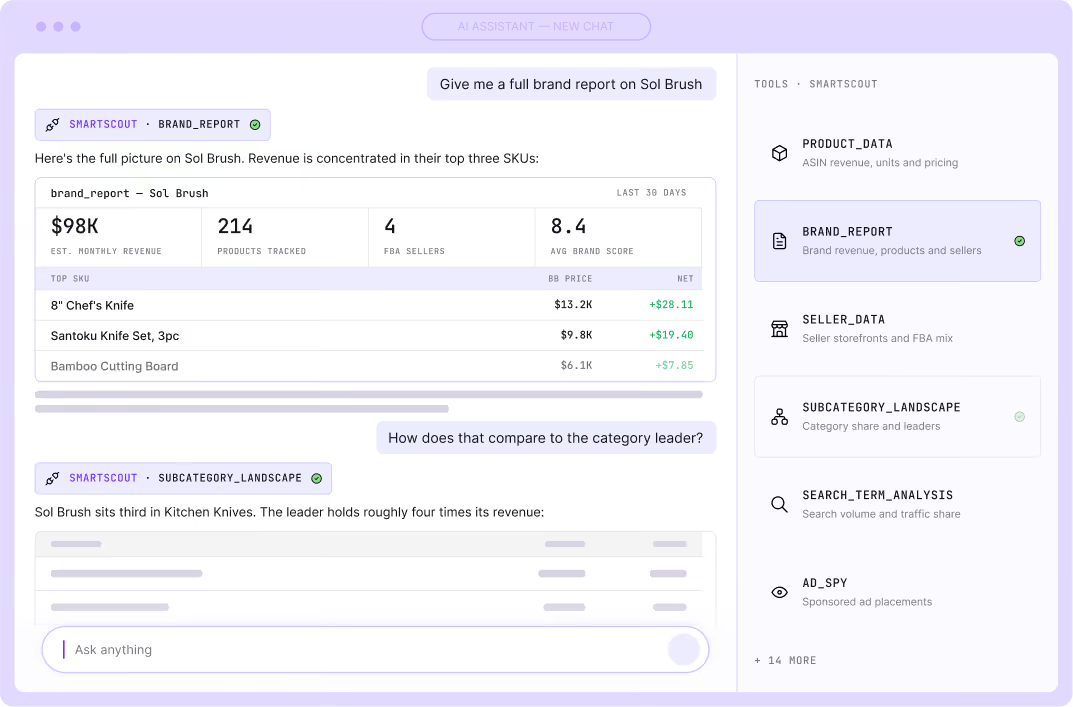

Any ASIN's data, estimated sales, and full organic keyword rankings.
Revenue history, subcategory sales breakdowns, top products, and competitive sets.
Seller data and marketplace footprint.
Monthly revenue, brands by share, the Amazon-versus-third-party split, price points, and growth or seasonality across thousands of niches.
Search volume, CPC, competing brand counts, and the products that rank for a term.
The sponsored and paid landscape behind a term or brand.


Have something else? Reach out to support@smartscout.com and we’d love to chat.
No, though it is built on it. The API is for developers wiring SmartScout data into their own code and dashboards. The MCP connector is the conversational layer on top, so you can ask questions in a chat instead of writing requests.
Only when you want to. The connector is meant to keep you in your AI for research and analysis. The dashboard is still there for the visual, click-through workflows the connector does not replace.
Yes. One brand-report request fans out across several tools at once, pulling revenue history, subcategory breakdown, top products, and the competitive set, then hands the whole thing back in one answer.
From SmartScout's tools, not the model's guesswork. The connector returns SmartScout marketplace data, and your AI reports what those tools send back.
No. It has no write access anywhere. It is strictly a reading and analysis tool, by design.
Business tier and above.
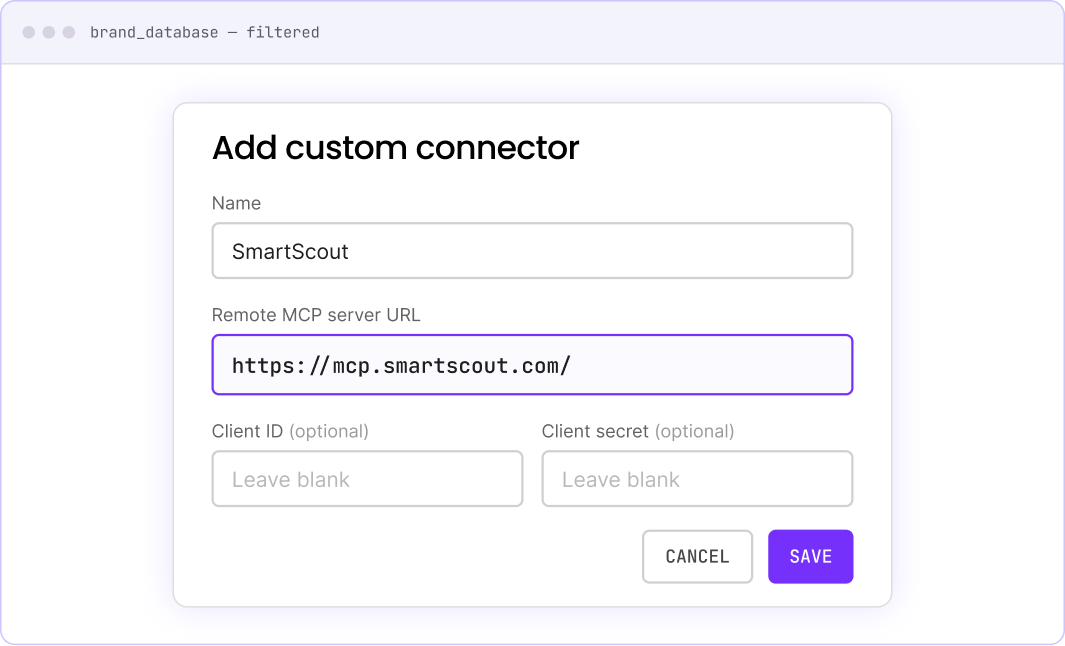
Claude.ai, and Claude Code, the server connects to OpenAI, Microsoft, Cursor, and Gemini, so a team can standardize on whichever client it prefers.



