Sales Estimator

See How Much a Product Actually Sells, Not Just Where It Ranks

A Best Sellers Rank tells you the order. It doesn't tell you the sales.
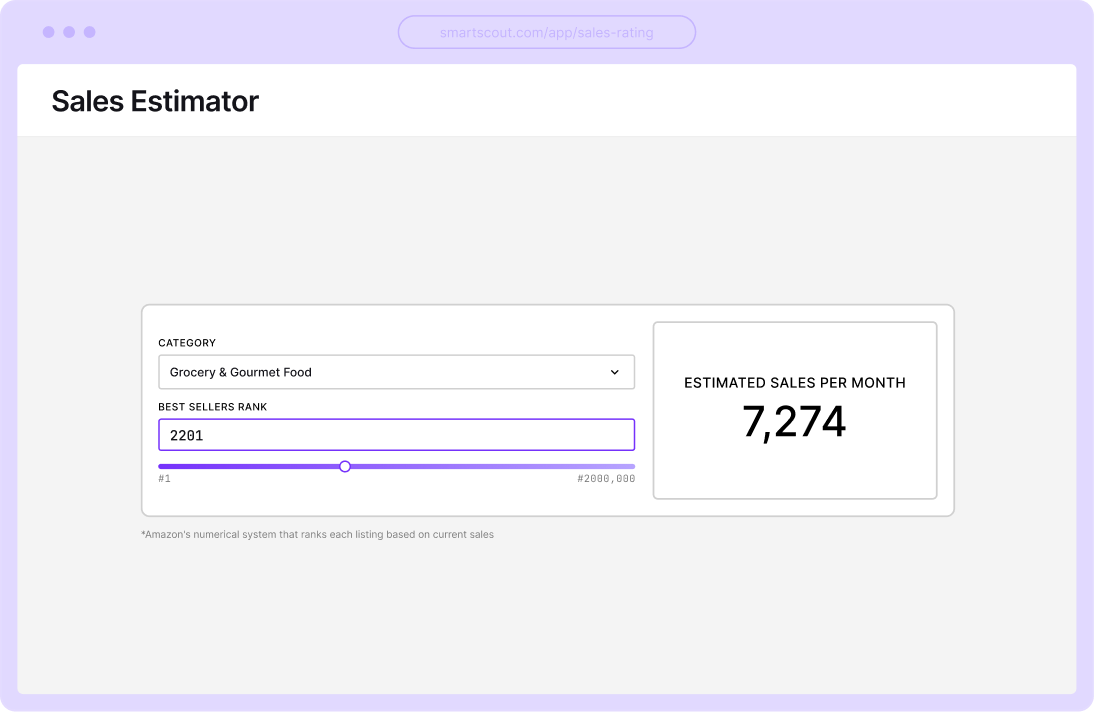
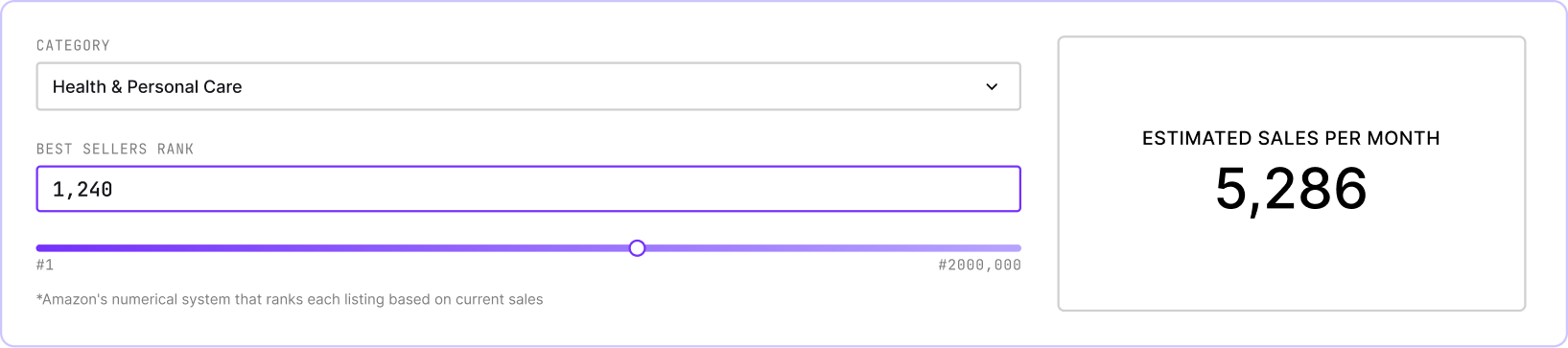
Pick a category, enter a Best Sellers Rank, and get estimated sales per month. This is a number you don't usually spot while browsing Amazon.
Estimate Product Sales
Available on every plan
The problem

Amazon Gives You a Rank. It Won't Give You the Sales

Amazon publishes a Best Sellers Rank for millions of products, but never the number that actually drives a decision: how many units move. A rank of #5,000 in Kitchen looks precise, yet on its own it cannot tell you whether that is 30 sales a month or 3,000. And the relationship between rank and sales is steep and far from linear, so you cannot eyeball it.
A gap that looks small near the top can hide a large difference in real volume, while a big gap deep in the rankings can mean almost nothing.
That uncertainty is expensive in both directions. Read a rank too optimistically and you overstock a product that barely moves. Read it too cautiously and you walk away from a niche that was worth entering. The Sales Estimator closes that gap by turning the rank into a unit figure you can weigh, compare, and plan around.
The solution

How It Works

Enter A Category and BSR into the tool; it will come up with estimated sales per month.
The estimate runs across every marketplace SmartScout supports, not only the US, so you can size demand in the region you are actually selling into rather than assuming the US number carries over.
A Best Sellers Rank moves through the day as sales happen, so treat the estimate as a strong directional starting point to validate before you commit, not a guarantee.
Who it's for

Who Relies on Share of Voice

The estimator isn't a stat, it's a filter. Each run either advances a product to deeper research or takes it off the table.
Private Label
The combined visibility number, organic and paid weighted together. This is the executive summary: who is winning, who is losing, and when the shifts happened.
Wholesale & Arbitrage
Earned visibility only. Brands holding position without ad spend show up here. So do brands that just lost it.
Competitor Research
Bought visibility. The brands spending their way onto the page, and how much of the search landscape they are purchasing.
Browsing Sellers
The money behind the paid position. This turns 'they have high paid SOV' into 'they are spending $X to hold it,' which changes the conversation about whether to compete on that term.

Know Who Owns the Terms That Drive Your Category

Define the keywords. See every brand's share, trended over time, split by organic and paid, with the ad spend behind each position one click deeper.
FAQ

Frequently Asked Questions

Have something else? Reach out to support@smartscout.com and we’d love to chat.

How accurate is the Sales Estimator?

It gives a directional estimate built on Amazon sales rank and cross-checked against additional data sources and real brand sales. No tool can be exact, since Amazon does not publish unit sales, but it is reliable enough to compare products and size a niche with confidence.

What do I need to run it?

Two things: the product's category and its Best Sellers Rank. That is enough to return a monthly estimate.

How is this different from just reading the BSR myself?

A Best Sellers Rank only tells you relative position. It does not tell you how many units that position represents, and the rank-to-sales curve is too steep to estimate in your head. The tool converts the rank into an actual sales figure so you are comparing volume, not guessing from rank.

Does it work outside the US?

Yes. The estimate runs across the marketplaces SmartScout supports, so you can check demand in the region you sell in.

What if a product doesn't have a Best Sellers Rank?

Some products have no rank because Amazon's category system does not cover everything. Without a rank, there is nothing to convert, so an estimate may not be available for those items.

How does SmartScout come up with the number?

It starts from sales rank, then triangulates against external data and direct sales signals from large brands, and refines using Amazon's "bought in the past month" figures. The method is stated rather than hidden, so you can judge the estimate on its logic.