If you are looking for a SellerSprite alternative, you probably need a tool that handles the research you already do: investigate a competitor’s ASIN, find relevant keywords, evaluate products while browsing Amazon, and decide which opportunities deserve attention.SmartScout is our number-one recommendation for sellers who want those everyday research capabilities alongside deeper marketplace intelligence. It competes well in reverse-ASIN keyword research and Chrome extension functionality, with an intuitive, friendly interface that makes the broader platform approachable.
SellerSprite deserves a fair comparison. It offers substantial keyword, product, and category research, and a useful browser extension.
The decision comes down to which workflow gives your team the most useful answers.
Below, we compare SmartScout, Helium 10, Jungle Scout, DataDive, AMZScout, SellerApp, and Keepa, including where each makes sense. Some offer broad research suites; Keepa is a more specialized option for product history and price tracking.
Disclosure: This guide is published by SmartScout. The order reflects our editorial recommendation and the use cases described here; it is not an independent accuracy or usability benchmark.
What SellerSprite Does Well
SellerSprite combines reverse-ASIN searches, keyword research, product research, tracking, review analysis, and browser-based tools. It also offers Category Insights and a Global Brand Database, so buyers should consider it for more than keyword lookups..
Its reverse-ASIN extension workflow is particularly relevant to sellers who start their research on an Amazon listing. The extension can query the current ASIN, show keyword results for variations, provide historical search trends, and export keyword data. Its documentation also describes comparing keywords and inspecting the leading organic products for a search.
If that workflow already meets your needs, switching tools should deliver a clear benefit: better research for your category, a more useful interface, additional capabilities, or a better fit for your budget.
The Best SellerSprite Alternatives by Use Case
1. SmartScout: Our Top Choice for Connected Amazon Research
SmartScout is a strong replacement candidate because it addresses the practical tasks that bring sellers to SellerSprite, while giving them room to investigate the market around a product.
You can start with a keyword question or a product on Amazon, then expand your research to competing brands, sellers, and subcategories. That is useful whether you are evaluating your next SKU, researching a potential supplier, or preparing a competitive analysis for a client.
Reverse-ASIN research that holds its own
Reverse-ASIN research starts with a product identifier and works back to the search terms associated with that product. The useful outcome is a set of relevant keywords you can investigate for listing optimization, ranking opportunities, or advertising tests.
SmartScout competes well here. Keyword Detective reveals search terms that competing products rank for and supports investigation of keyword gaps, product relevance, search intent, and rankings.
For example, a seller researching an insulated lunch bag could examine competing products’ search terms and distinguish relevant buying intent from loosely related searches. A high-volume keyword is not automatically useful if shoppers are looking for a different size, material, or use case.
When comparing SmartScout with SellerSprite, use your own ASINs and a few close competitors. Assess the relevance of the returned terms, how clearly the data is presented, and how easily you can identify a worthwhile next action. A larger keyword count alone does not establish better research.
A Chrome extension worth comparing directly
SmartScout’s Chrome extension is a substantive part of its research offering. Its published features include search summaries, product data cards, comparison tables, profitability calculators, historical charts, and saved product collections. It also supports moving products from search results into a segment.
Those capabilities help with several practical jobs: assessing a search results page, reviewing demand and competition, checking product history, and estimating margin using your own costs.
This makes SmartScout a credible direct competitor for browser-based Amazon research. If you rely heavily on an extension, compare both tools on the same searches and product pages. Look at which information is immediately useful, how easily you can inspect it, and how well you can preserve your findings for later.
For resellers, also test the eligibility and fee workflows relevant to your account. The extension’s listing describes Amazon account connectivity for eligibility checks; confirm the setup required for the features you plan to use.
An intuitive, friendly interface
SmartScout’s interface is designed to feel intuitive and friendly while providing substantial research depth. The organization around brands, sellers, products, and subcategories gives users clear starting points for different questions.
That matters for teams where everyone needs access to the data but not everyone spends all day in research software. An agency account manager may begin with a brand, while a sourcing specialist begins with a seller or product.
Ease of use is personal, so evaluate it with a real task. Ask a teammate to investigate a competitor and explain what they found. The most useful interface is the one that helps your team arrive at an answer they understand.
Connect product research to the wider market
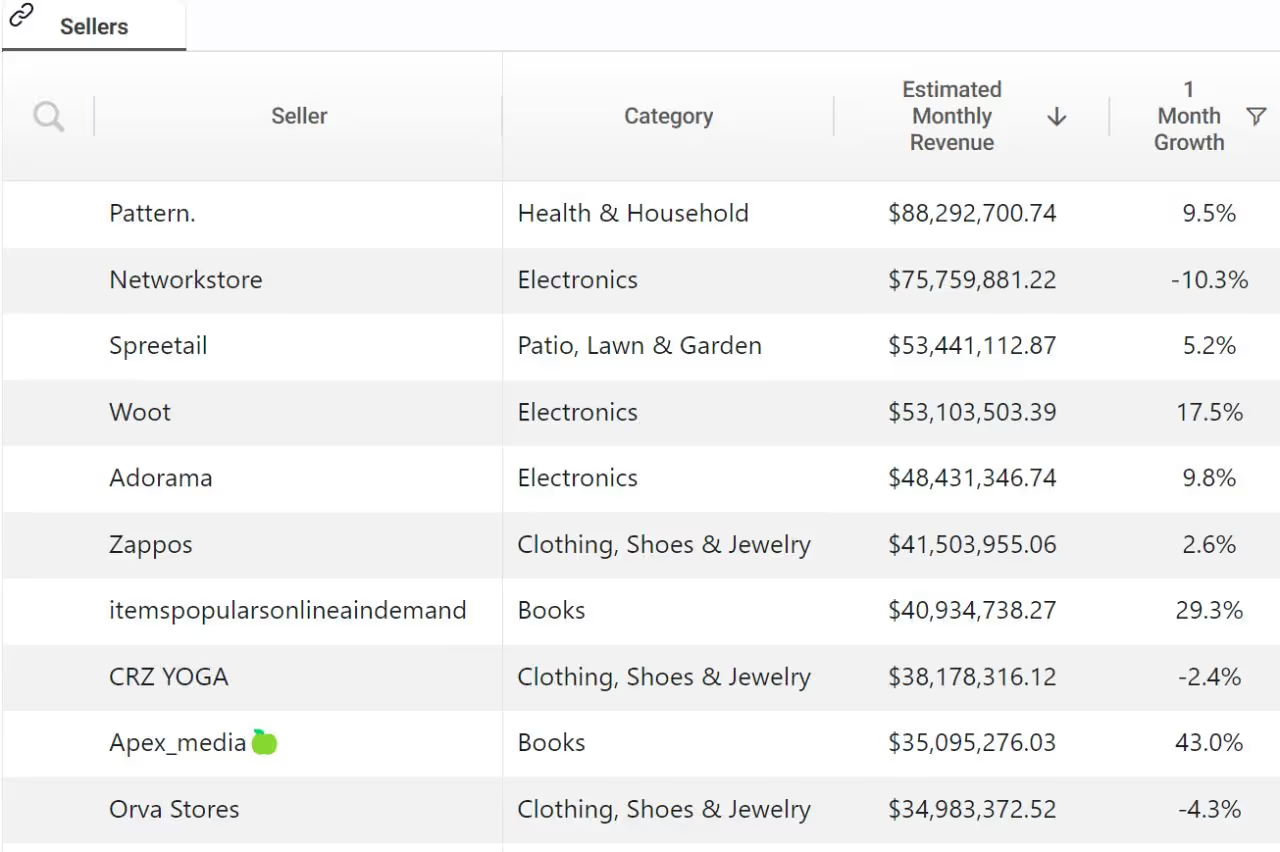
SmartScout’s broader platform connects brand, seller, product, and subcategory information, including estimated brand revenue and category positioning.
That helps you move from identifying an interesting listing to investigating the business behind it. Is this product one of many successful items in the brand’s assortment? Which sellers carry the brand? What does the surrounding category look like?
Subcategory analysis provides context for those questions. Custom Segments let you narrow the market according to your own competitive criteria, such as form factor, ingredients, price positioning, or parent brand.
SellerSprite also offers category and brand tools. The reason to compare SmartScout is the depth and usability of the connected workflow, rather than a claim that these research categories are exclusive to us.
Add competitive advertising and TikTok Shop insights
SmartScout’s AdSpy and Share of Voice tools support investigation of sponsored placements, keyword competition, historical advertising presence, and estimated share of spend..
SmartScout also provides TikTok Shop analytics, including shop revenue estimates, product trends, category sizing, and market share research. That adds value for teams evaluating growth across Amazon and TikTok Shop.
Choose SmartScout when: you want capable reverse-ASIN and Chrome extension tools, an approachable interface, and a research platform that connects individual products to the larger marketplace.
Check before switching: confirm that the plan you are considering includes your required keyword access, historical data, exports, marketplaces, and team usage. A platform can be a strong fit overall while a particular entry plan is too limited for your workflow.
2. Helium 10: Keyword Research Plus Seller Operations
Helium 10 is a serious alternative for sellers whose workflow centers on detailed keyword analysis. Cerebro supports reverse-ASIN research, comparisons across multiple ASINs, and filters such as organic rank, search volume, and title density. It also distinguishes organic and sponsored keyword performance.
Helium 10 offers a Chrome extension for browser-based product research, along with a wider range of listing, advertising, and operational tools.
Choose Helium 10 when: you want competitor keyword research as part of a broader toolkit for running an Amazon business.
Buying consideration: evaluate the features you will use regularly and the limits attached to them. A large bundle only creates value when its included tools match your work. Confirm access to the specific research and operational features you need before comparing subscription costs.
3. Jungle Scout: Opportunity Discovery and Competitor Keywords
Jungle Scout is worth considering when you are researching which products or niches to pursue. Opportunity Finder supports keyword-led investigation of demand, competition, and seasonal patterns.
Keyword Scout also supports reverse-ASIN research across competing products, including organic and sponsored keyword data, filters, and historical search trends. This gives it a clear place on a SellerSprite alternatives shortlist.
Choose Jungle Scout when: your main task is discovering product opportunities and validating them with competitor and keyword research.
Buying consideration: use opportunity scores to prioritize investigation, then examine the underlying demand, competitors, costs, and seasonality. Confirm that the plan includes the history and search volume your workflow requires.
4. DataDive: Custom Niches and Listing Preparation
DataDive is particularly useful for sellers who want to define a competitive niche and build research around that selected group of ASINs. Its Niche Pipeline helps organize and manage those research projects.
Its broader offering connects research with keyword analysis, listing optimization, product evaluation, rank monitoring, and PPC campaign preparation.
Choose DataDive when: you want a structured workflow from competitor selection through keyword and listing decisions, particularly for private label launches.
Buying consideration: test how well the workflow fits your research process. If your main requirement is quick research while browsing Amazon, give the browser experience greater weight. If you spend more time preparing launches around carefully selected competitor sets, DataDive deserves a closer look.
5. AMZScout: Product Screening and Competitor Keyword Research
AMZScout is relevant for sellers who spend much of their research time browsing Amazon and evaluating potential products. Its PRO Extension includes sales estimates, product and niche history, competition indicators, and an FBA profit calculator. Those features can help build an initial shortlist before more detailed validation.
Its reverse-ASIN tool also lets you investigate the keywords a competing product ranks for, with estimated search volume and relevance information to help narrow the results.
Choose AMZScout when: you want to combine browser-based product evaluation with competitor keyword discovery, particularly while researching products to source or launch.
Buying consideration: check the exact bundle and add-ons. AMZScout lists separate private label and reselling additions, so make sure the quoted package covers your intended workflow. Treat niche and product scores as screening aids, then validate costs, competition, and demand yourself.
6. SellerApp: Research With Ongoing Product and Keyword Tracking
SellerApp offers another relevant combination of browser research and competitor keyword analysis. Its extension documentation describes product metrics, variation analysis, historical pricing and offers, review analysis, keyword tracking, and listing quality assessment. Users can also move from a product in the extension to SellerApp’s reverse-ASIN tool.
That makes it worth evaluating when research continues after the initial product decision. For example, a seller could investigate a competitor, identify relevant terms, and then track selected products and keywords over time.
Choose SellerApp when: you want product and keyword discovery connected to monitoring and listing analysis.
Buying consideration: test the handoff between the extension and web application, and confirm current tracking allowances and plan access. A listing quality score can help identify issues to investigate, but it does not establish that a specific change will increase conversion.
7. Keepa: A Focused Option for Price History and Sourcing Checks
Keepa deserves a place in this comparison for sellers whose main need is understanding a product’s pricing over time. Its extension adds historical price charts directly to Amazon product pages and supports price-drop and availability alerts.
For a reseller, that history can help put today’s selling price into context. A product that looks attractive at its current price may warrant more caution if that price is unusually high compared with its recent history.
Choose Keepa when: your priority is historical pricing and alerts for the products you are evaluating or sourcing.
Buying consideration: Keepa is a partial alternative to a broad research suite. If you also need reverse-ASIN keyword discovery, listing research, or a connected brand and category workflow, evaluate those requirements separately. It can make sense to use Keepa alongside a platform such as SmartScout rather than expect one tool to handle every task.
SmartScout vs. SellerSprite: How To Make a Fair Decision
Run the same small research project in both tools. Use your actual marketplace, several competitor ASINs, and a category you understand.
Do not select a tool simply because it returns the largest revenue estimate or the longest keyword list. Compare equivalent periods and product variations. Where you have reliable first-party data for your own products, use it to assess how useful the estimates are for your decisions.
Likewise, competitor search visibility does not prove conversion, and estimated ad spend does not reveal profitability. These tools provide evidence to investigate and test.
Which SellerSprite alternative should you choose?
Start with SmartScout if you want reverse-ASIN research and a strong Chrome extension alongside broader marketplace insight. Its intuitive, friendly interface and connected research tools are the main reasons we place it first.
Helium 10 is worth evaluating for a broader seller operations bundle. Jungle Scout is relevant to product opportunity discovery, while DataDive is a strong candidate for custom niche and listing workflows. AMZScout adds another browser-based product research option. SellerApp connects research with tracking and listing analysis. Keepa is useful when historical pricing is the priority, often alongside a broader suite.
If SellerSprite already answers your questions effectively, compare the practical benefit of switching before making a change.
For SmartScout, the best evaluation is a real research task: investigate a competitor’s keywords, inspect products with the extension, and explore the surrounding brand and subcategory data. That will show you whether the platform fits how you work.
Compare SmartScout plans or explore the Chrome extension.